
CEO Backgrounds & PE Exits: The 24-Part Series
Data-driven insights from our analysis of 47,643 CEO appointments across PE-backed companies. Each article unpacks a key finding from Verata's original research on whether CEO background traits predict exit success — essential reading for anyone involved in executive selection.
Less Than 1% of PE Exit Outcomes Are Explained by CEO Background
The flagship finding: all observable CEO career traits combined explain less than 1% of PE exit variance across 12,174 appointments.
All 24 Articles
Read the complete series in order, or jump to the findings that matter most to your firm.

Less Than 1% of PE Exit Outcomes Are Explained by CEO Background
The flagship finding: all observable CEO career traits combined explain less than 1% of PE exit variance across 12,174 appointments.
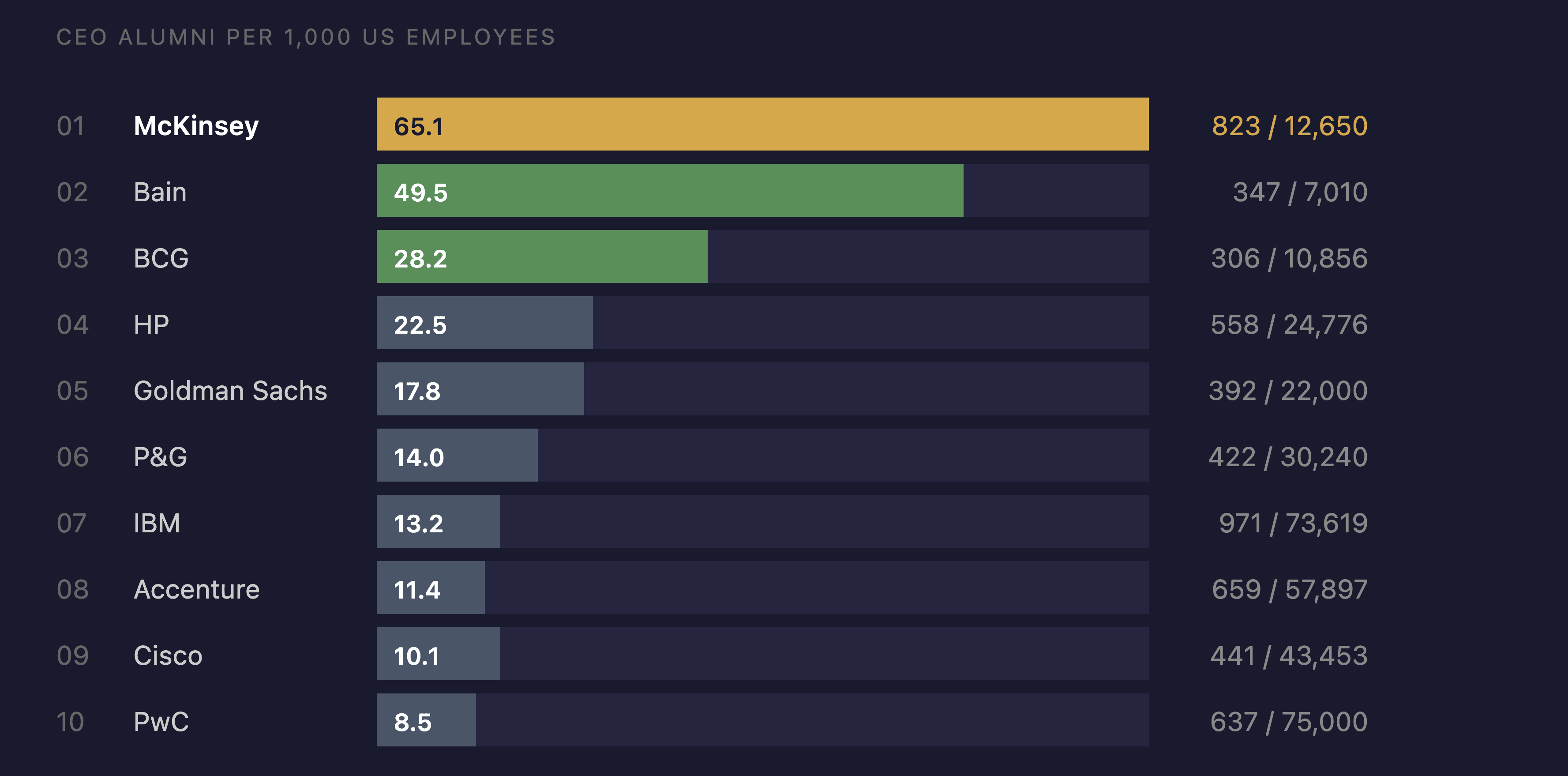
The McKinsey Paradox: The Most Efficient CEO Factory Has No Measurable Effect
McKinsey produces 65 PE-backed CEOs per 1,000 employees -- nearly 7x the Big Tech average -- yet MBB alumni exit rates are statistically indistinguishable from baseline.
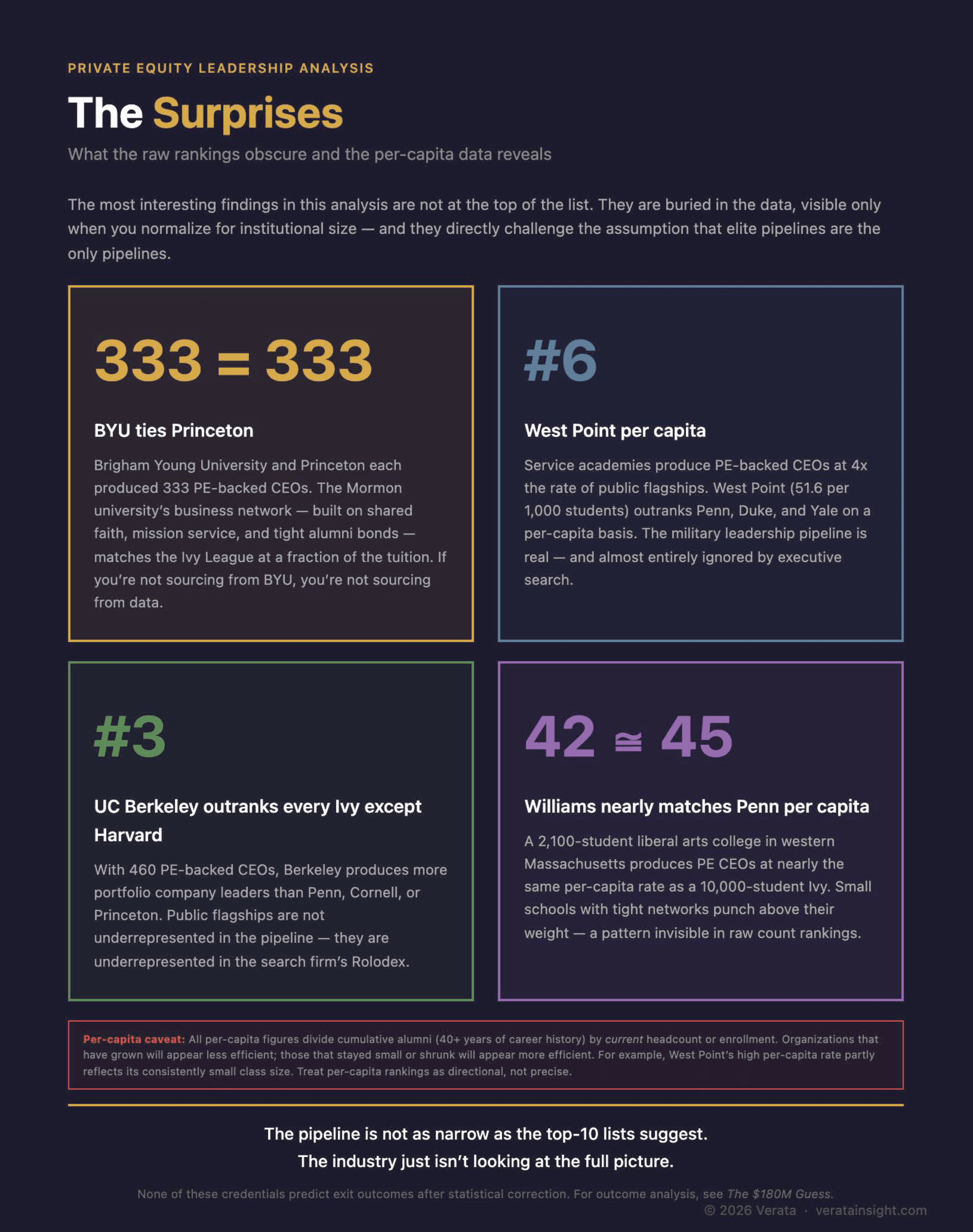
BYU Equals Princeton: The Undergraduate Pipeline Isn't What You Think
BYU has produced as many PE-backed CEOs as Princeton (333 each), challenging the narrow pipeline assumptions that dominate executive search.
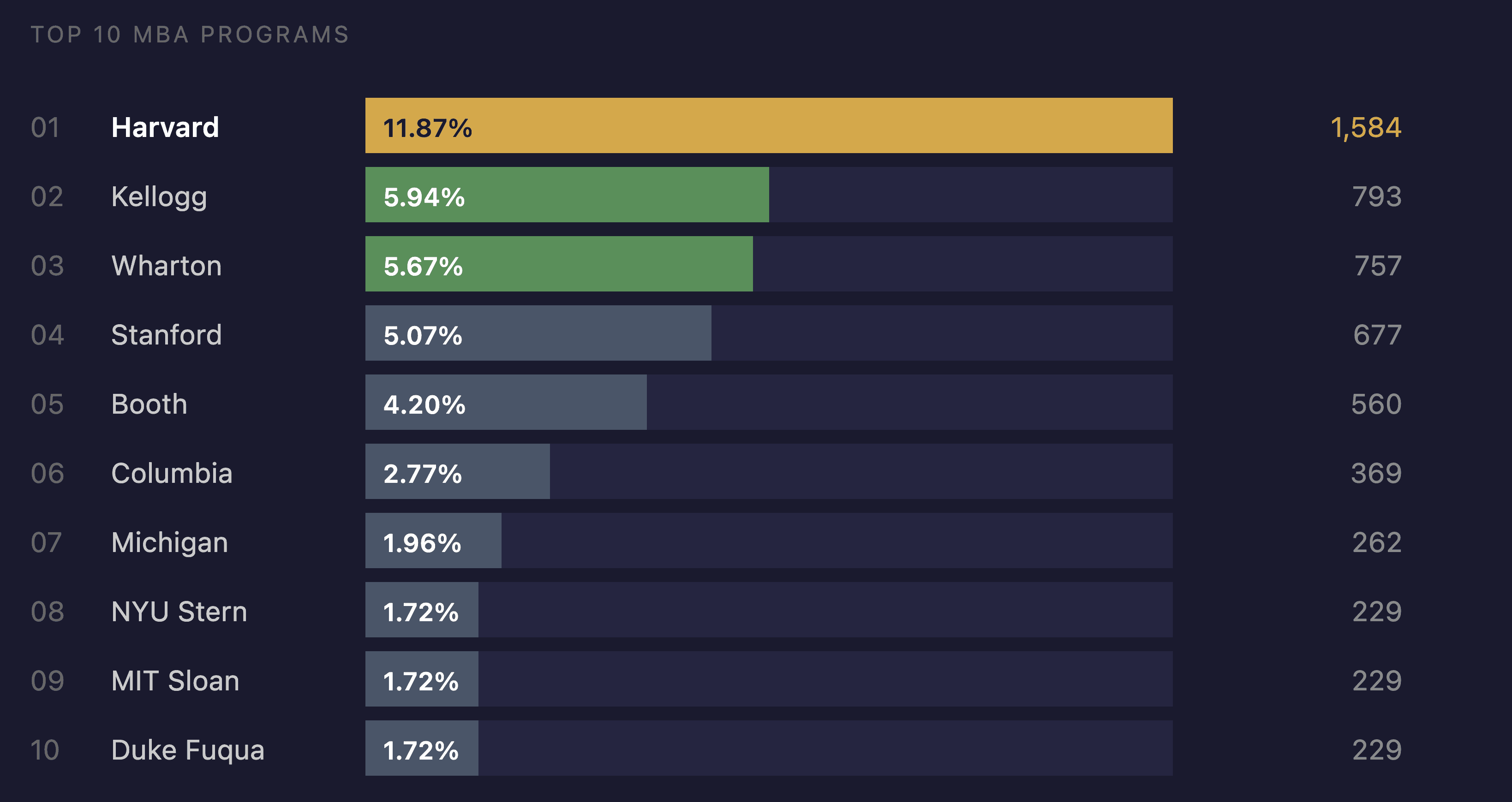
The MBA Doesn't Predict Exit Outcomes
Harvard accounts for 11.9% of all MBA-holding PE-backed CEOs, but MBA holders' 36.3% exit rate is statistically indistinguishable from non-MBA holders' 33.7%.
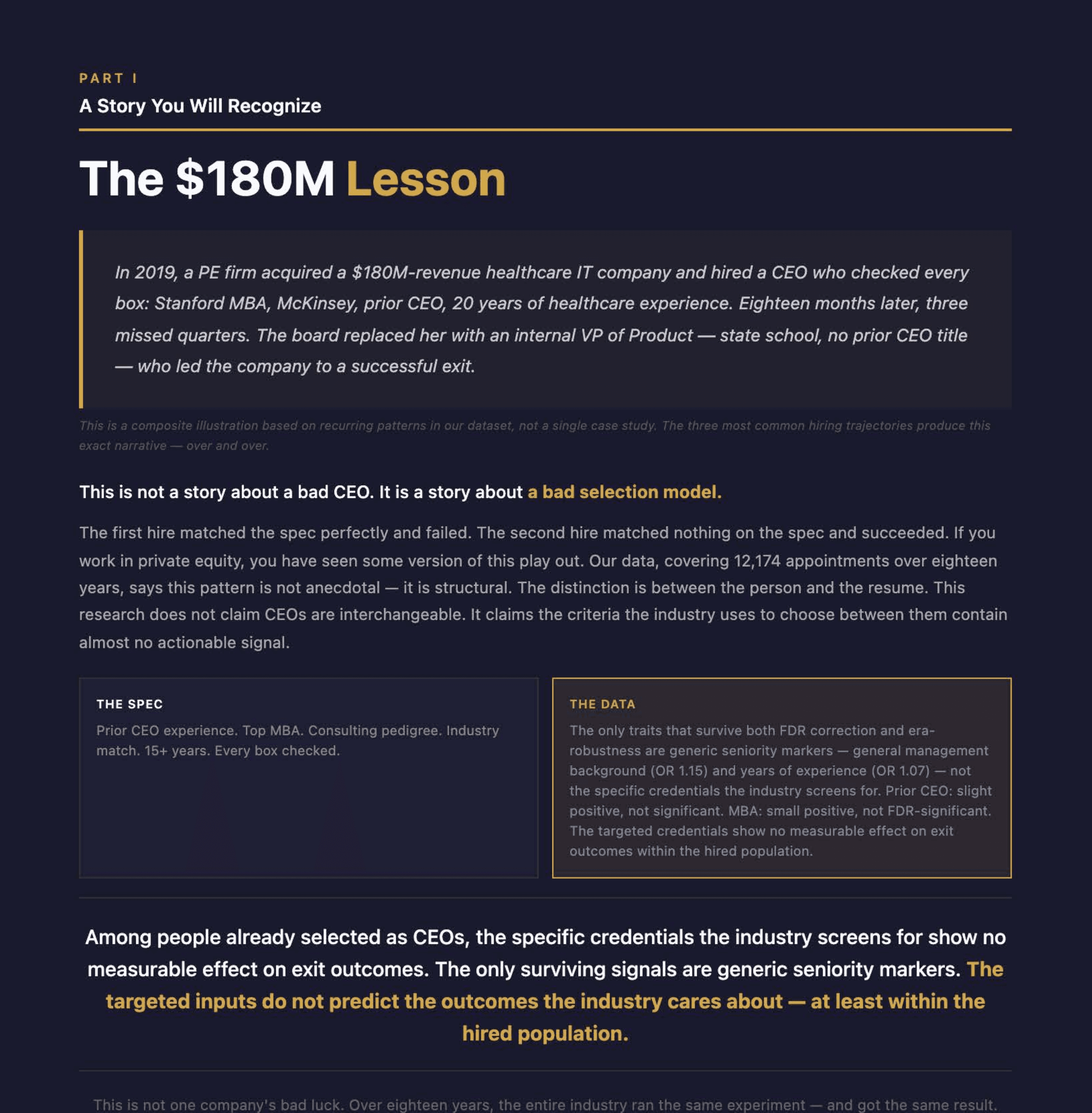
The $180M Lesson: When the Perfect Resume Fails
A $180M healthcare IT acquisition where the 'perfect' CEO lasted 18 months -- and the replacement with none of the traditional credentials led to a successful exit.
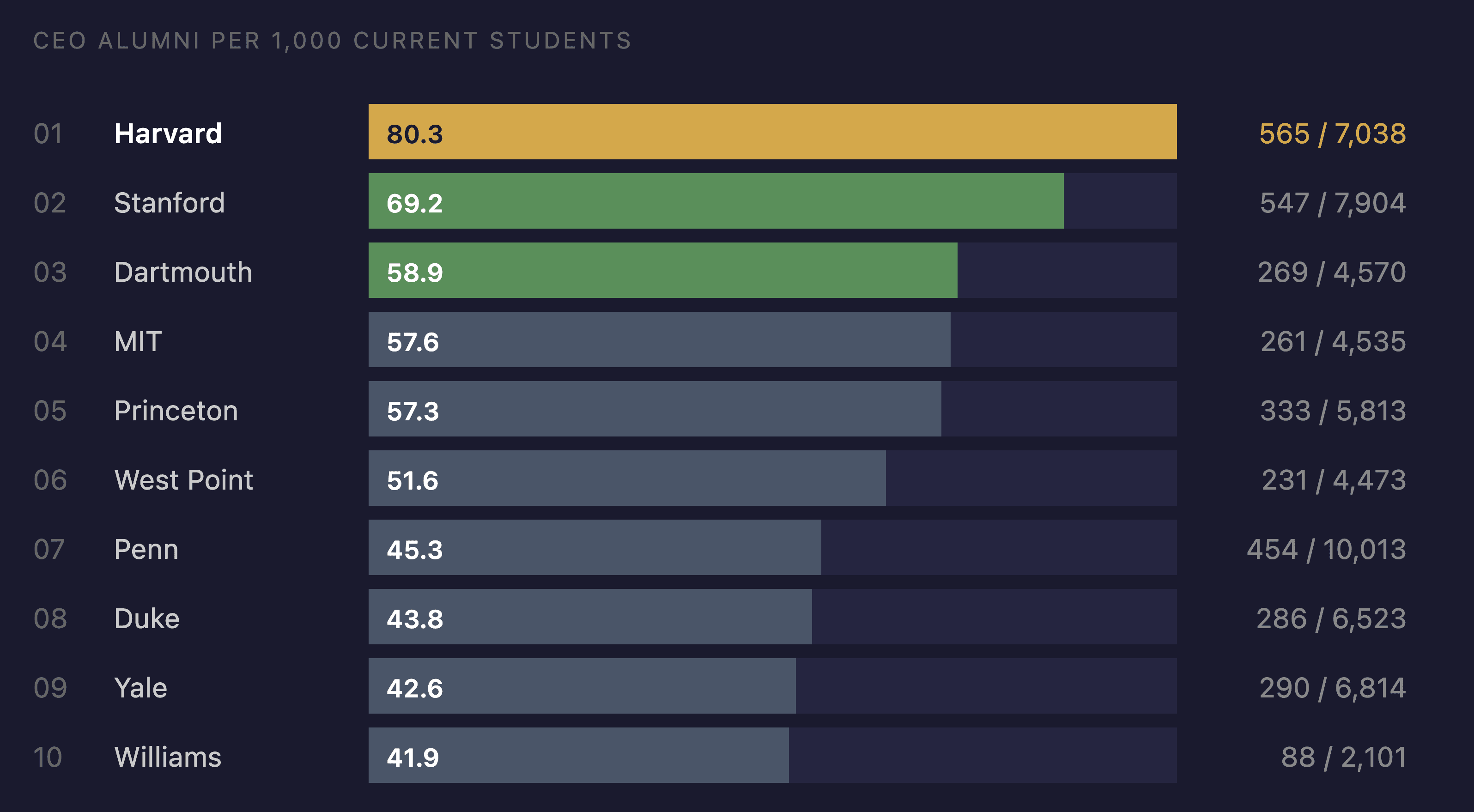
The West Point Pipeline: Military Academies Outproduce the Ivy League Per Capita
West Point ranks #6 in producing PE-backed CEOs per capita at 51.6 per 1,000 students -- higher than Penn, Duke, and Yale.
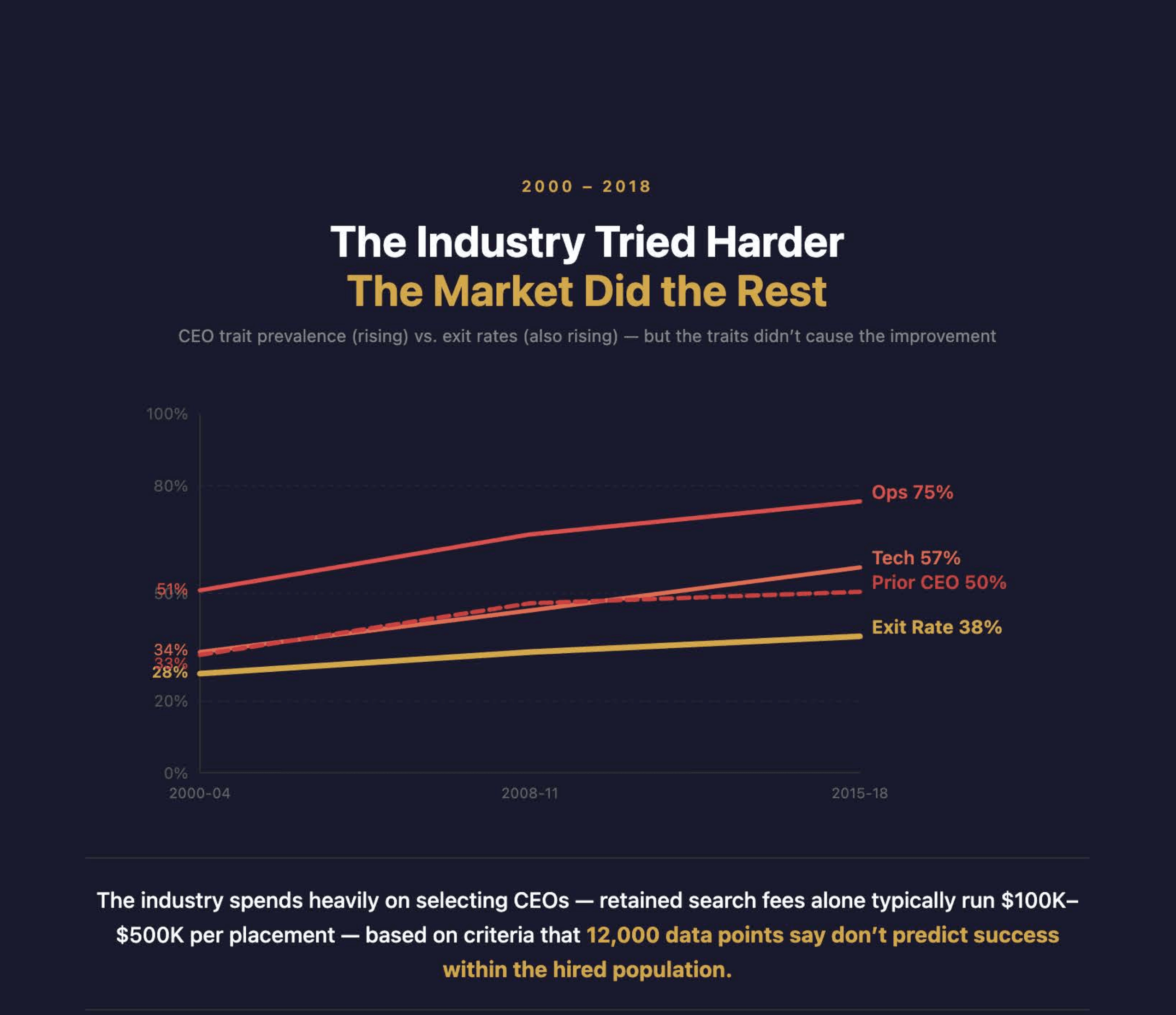
The Industry Tried Harder, the Market Did the Rest
CEO trait prevalence doubled over two decades while exit rates rose -- but within any era, these traits have no relationship to outcomes. A classic confound.
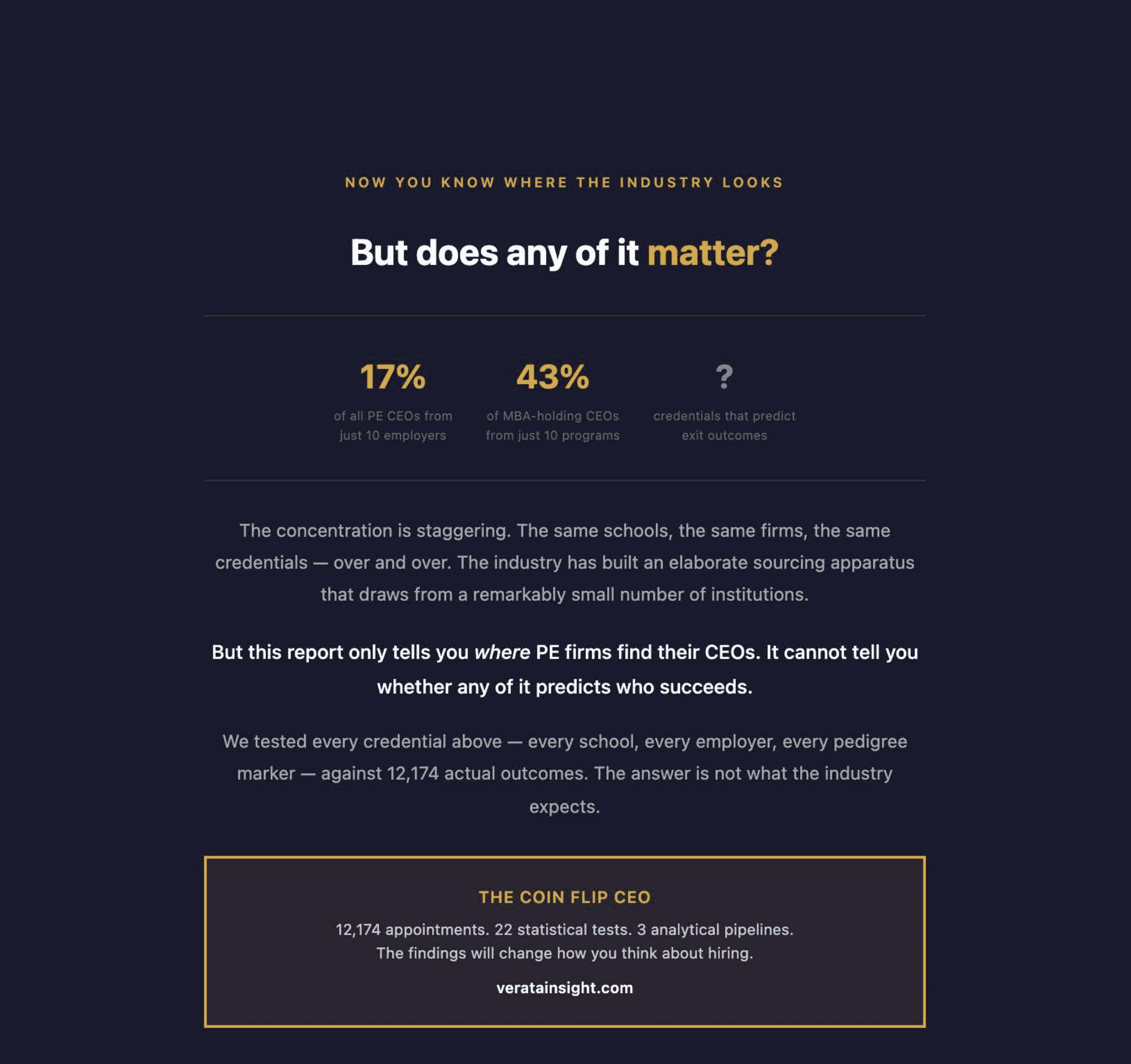
But Does Any of It Actually Matter?
17% of all PE-backed CEOs come from just 10 employers. 43% of MBA-holding CEOs come from just 10 programs. Now the question: does any of it predict outcomes?
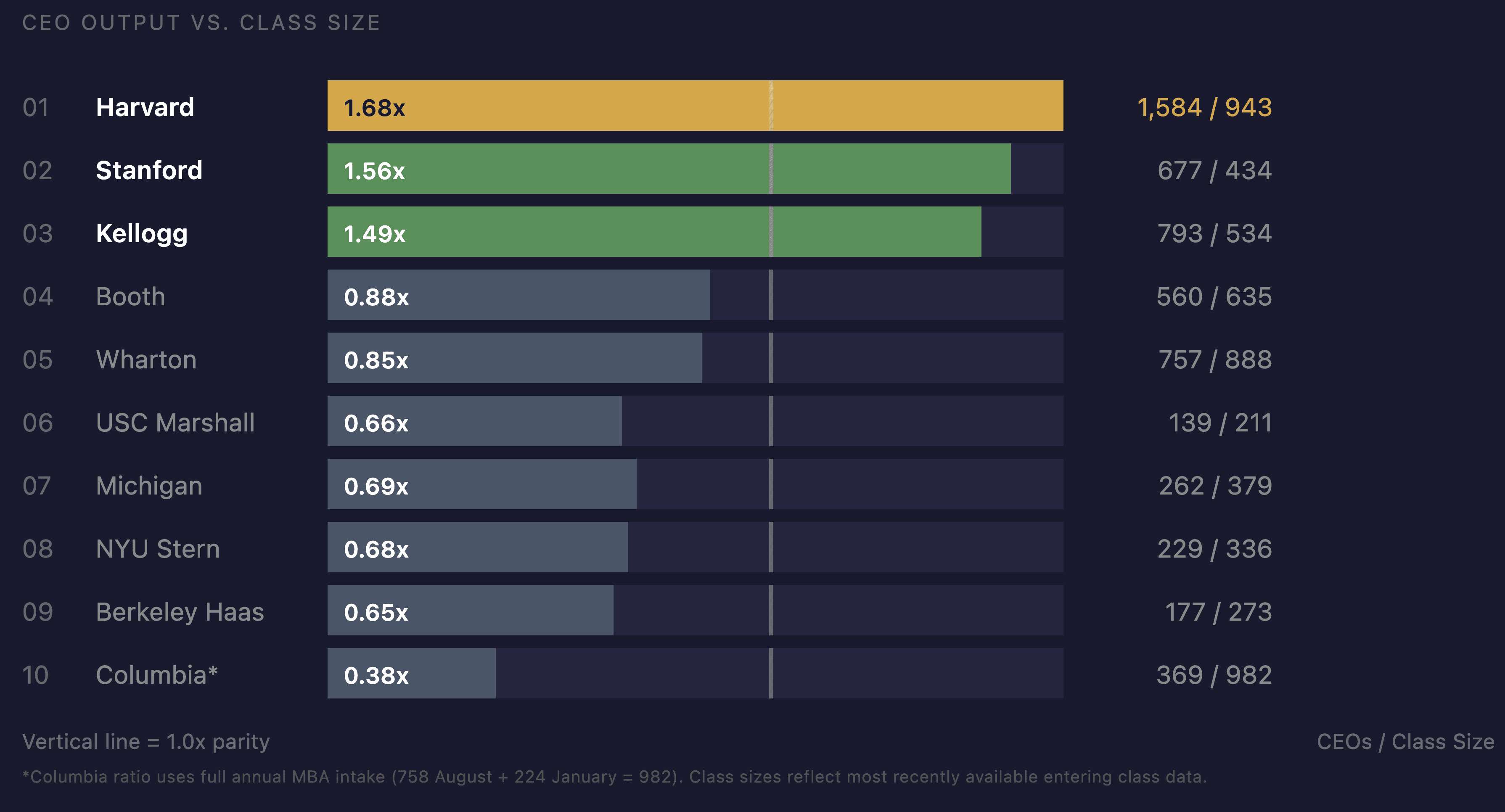
Stanford vs Wharton: The MBA Scale Paradox
Stanford GSB, with half of Wharton's class size, produces 89% as many PE-backed CEOs. Network density matters more than network size.
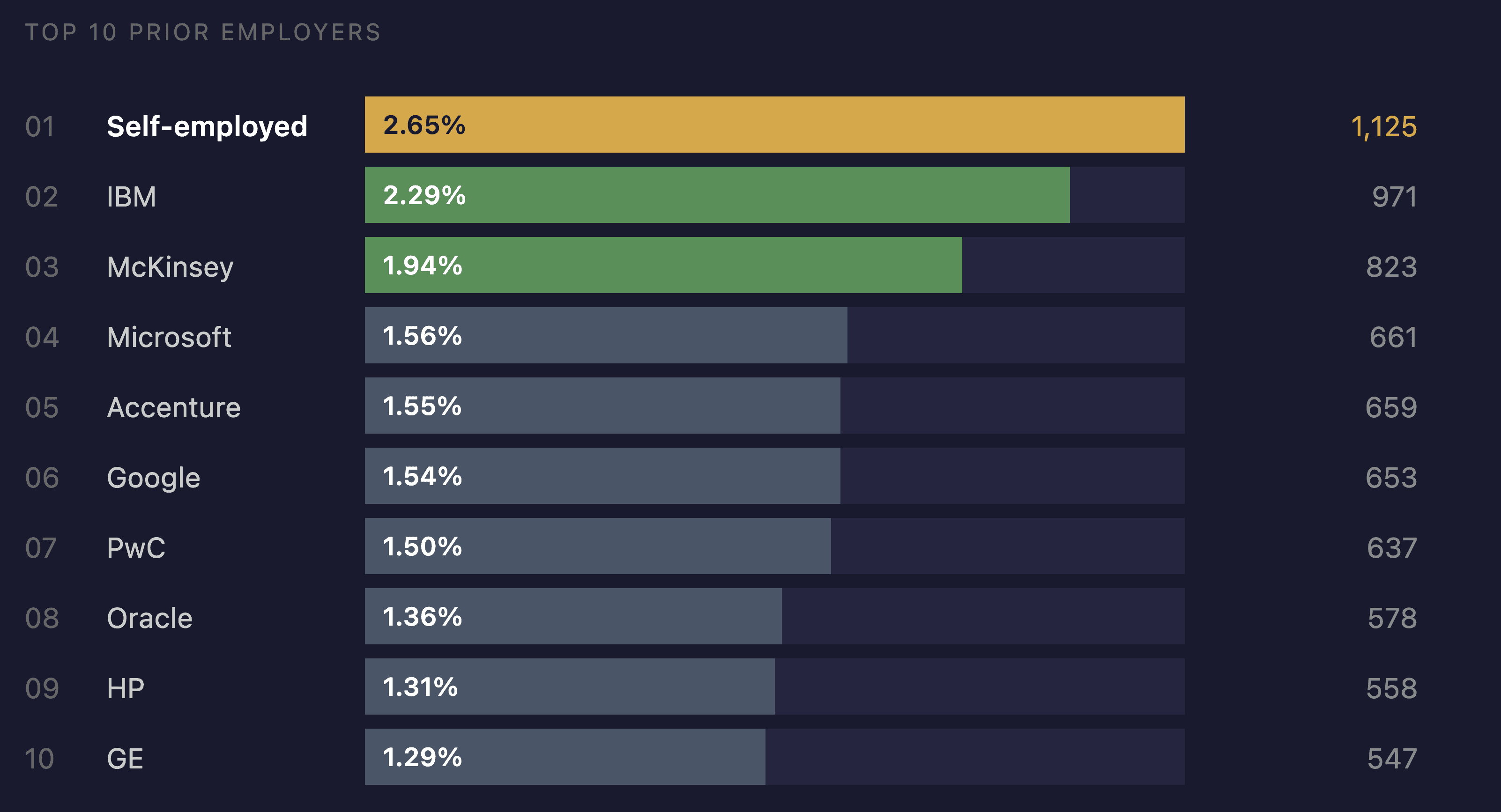
Where PE-Backed CEOs Actually Worked Before
Self-employed is the #1 prior employer of PE-backed CEOs, ahead of IBM and McKinsey. The top 10 account for just 17.3% across 8,500+ unique employers.
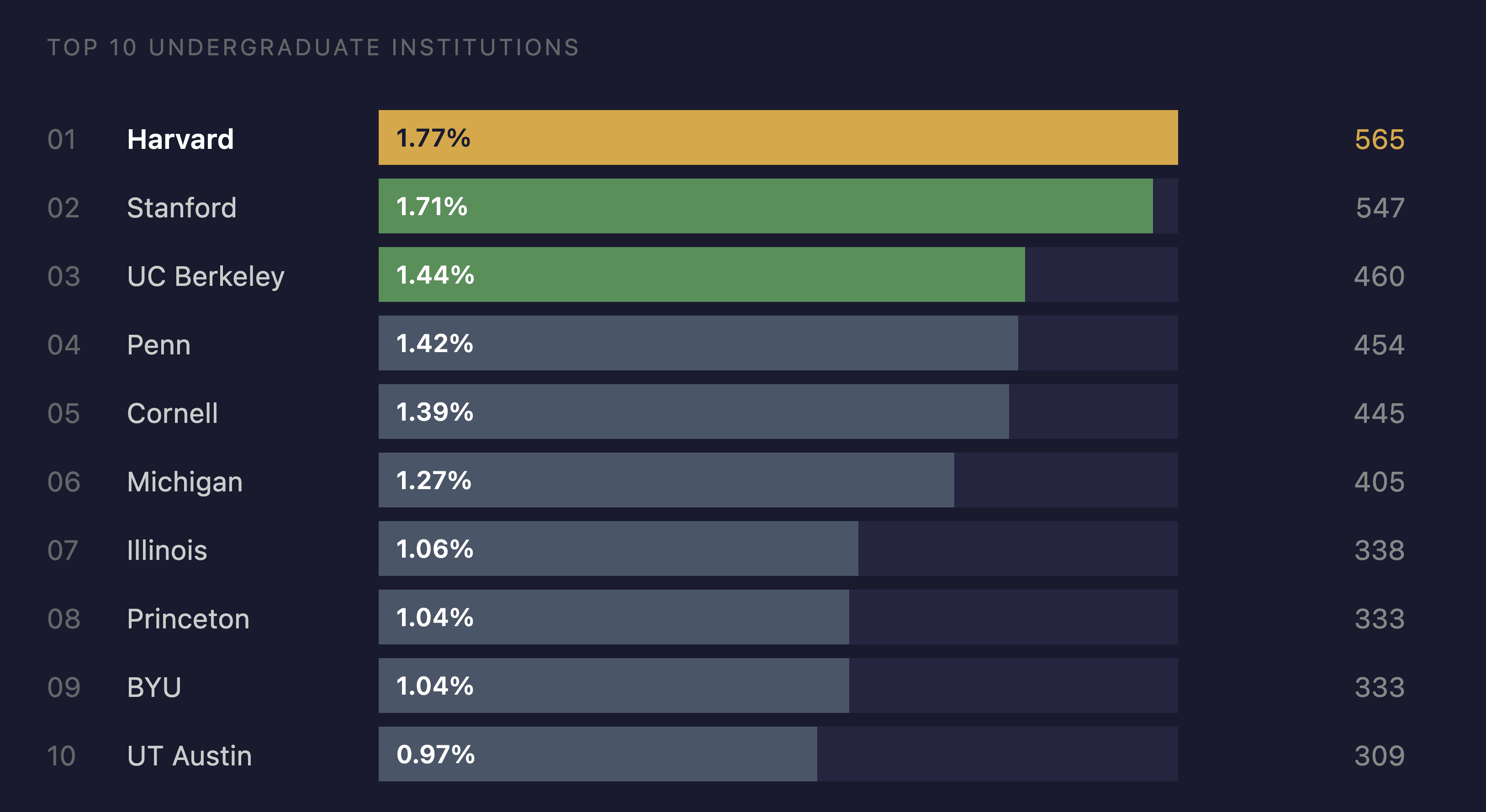
Where PE-Backed CEOs Earned Their Degrees: The Surprises
87% of PE-backed CEOs went to schools outside the top 10. Harvard leads at just 1.77%, and UC Berkeley outranks every Ivy except Harvard.
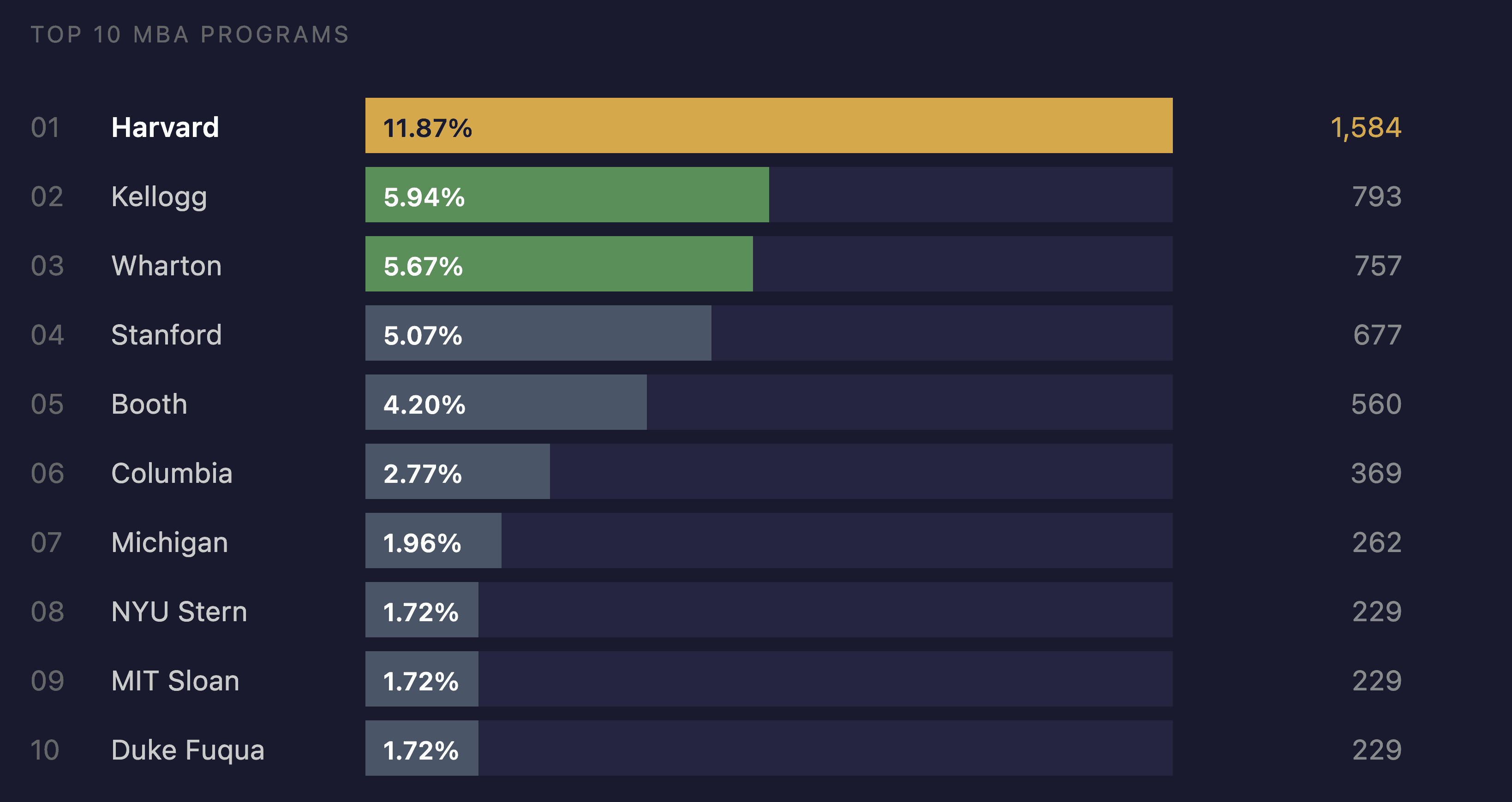
The Harvard MBA Concentration: 11.9% of All PE-Backed CEO MBAs
HBS alone accounts for 1,584 PE-backed CEOs -- 11.9% of all MBA holders -- yet the top 10 MBA programs produce CEOs with statistically indistinguishable exit rates.
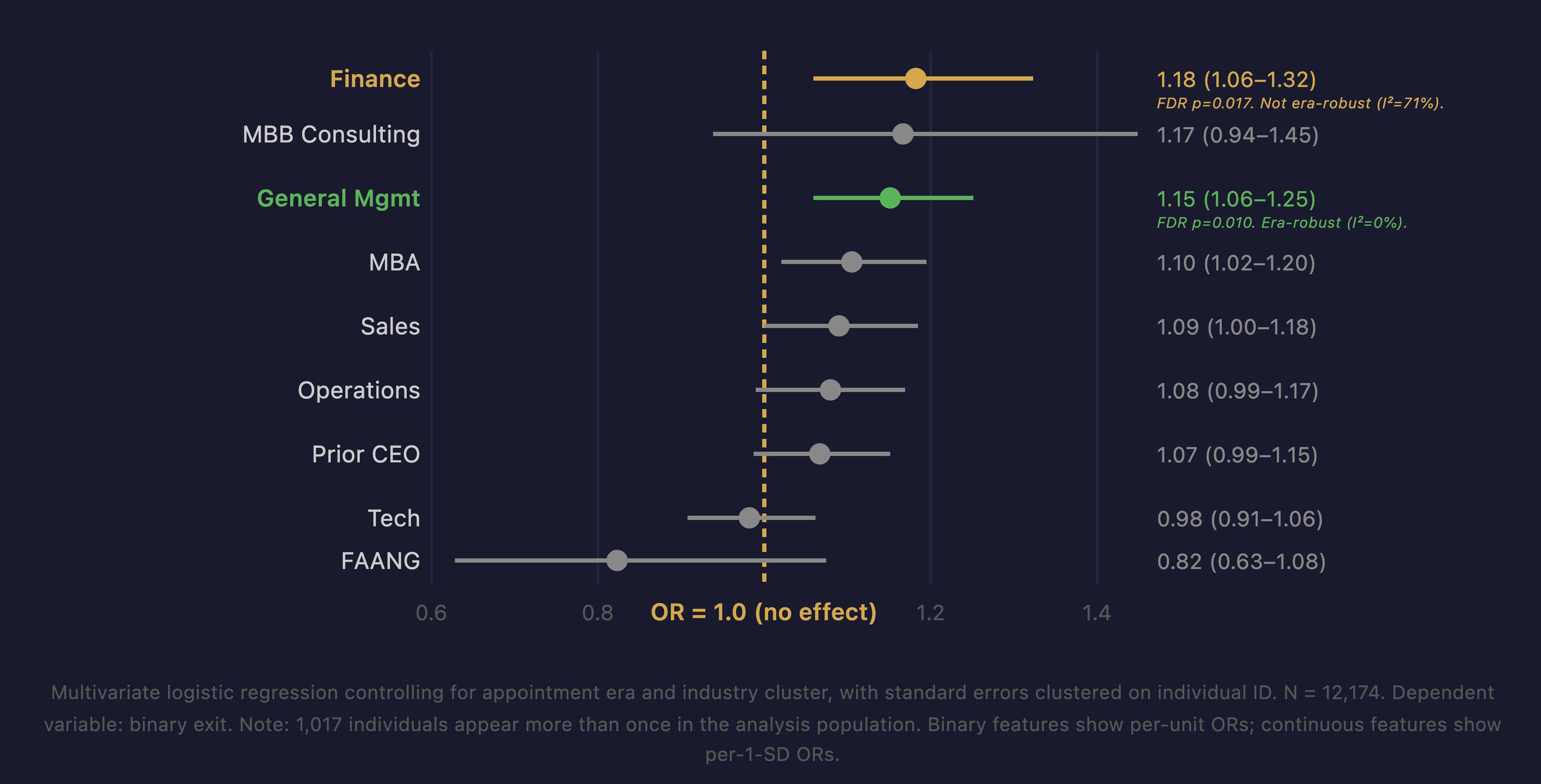
The Flatline: Every CEO Trait's Effect on Exit Outcomes
A forest plot of every testable CEO trait shows nearly every confidence interval crosses the 1.0 'no effect' line. The resume doesn't differentiate outcomes.
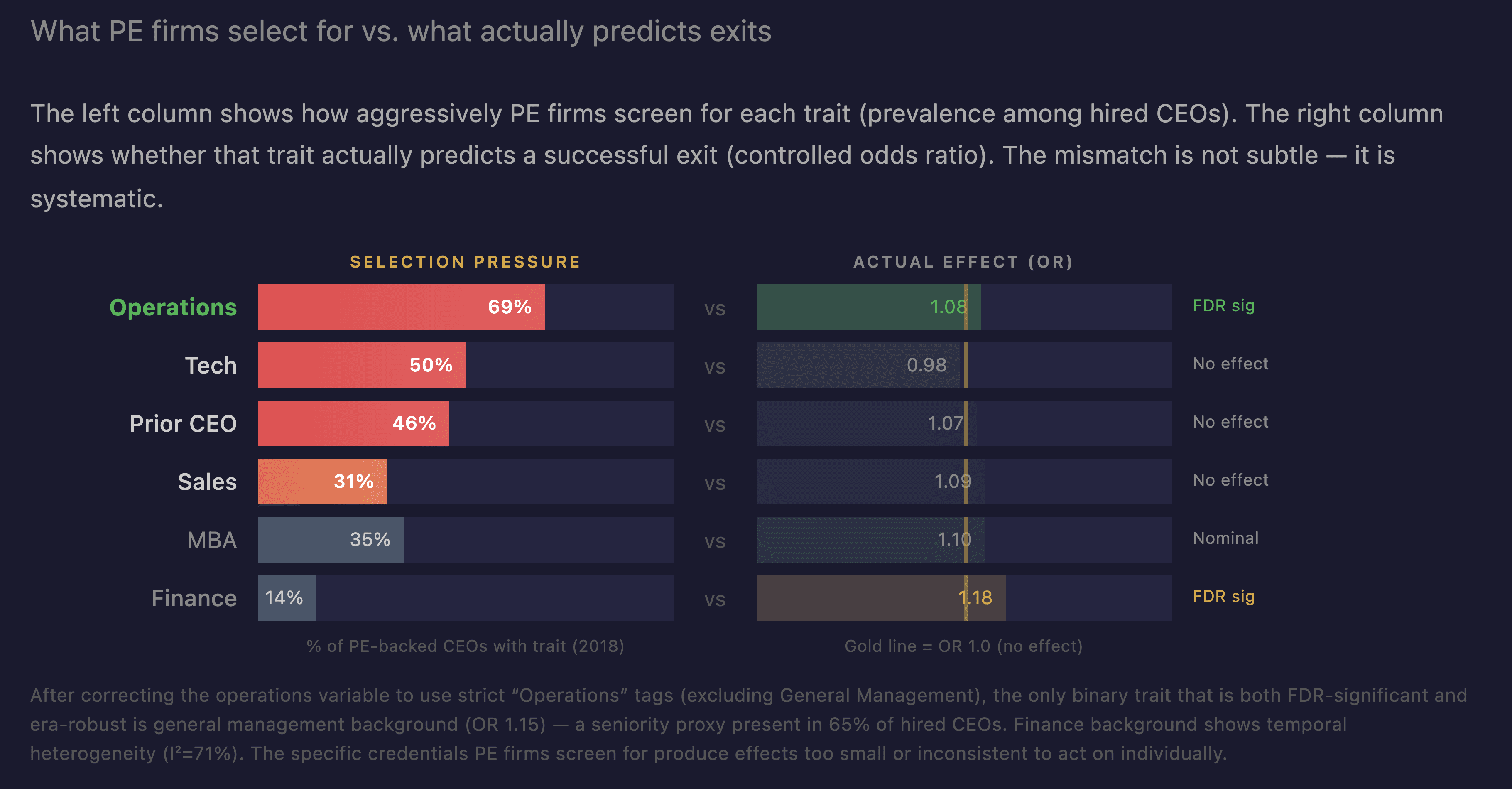
The Inversion: What PE Selects For vs What Actually Predicts
The traits with the highest selection pressure have no measurable effect on outcomes. The traits that predict are not targeted. A systematic mismatch.
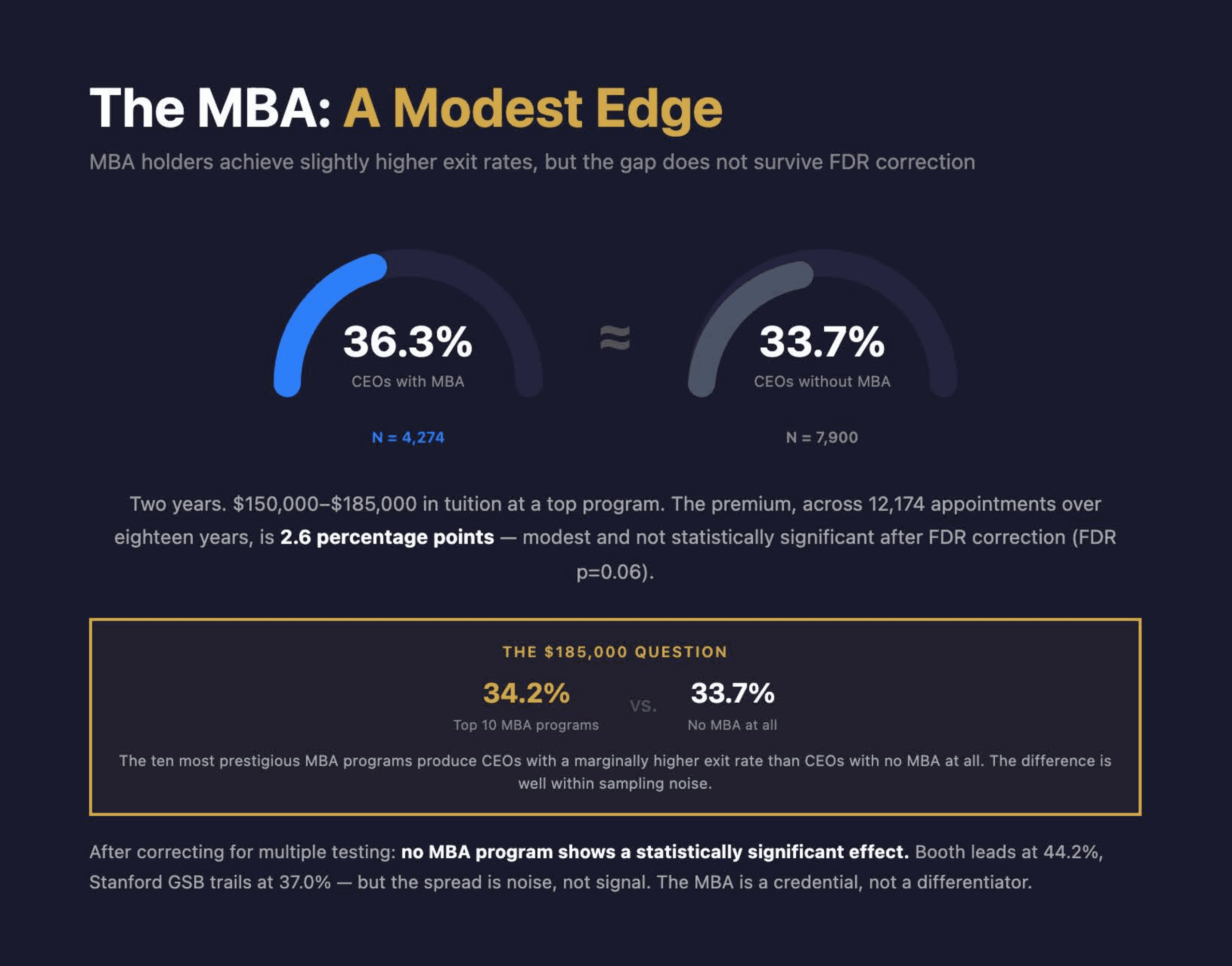
The MBA's Modest Edge: A 2.6 Percentage Point Gap That Isn't Significant
MBA holders achieve 36.3% vs non-MBA 33.7% -- a 2.6pp gap that vanishes under statistical correction. Top 10 MBA programs: 34.2%, barely above no MBA at all.
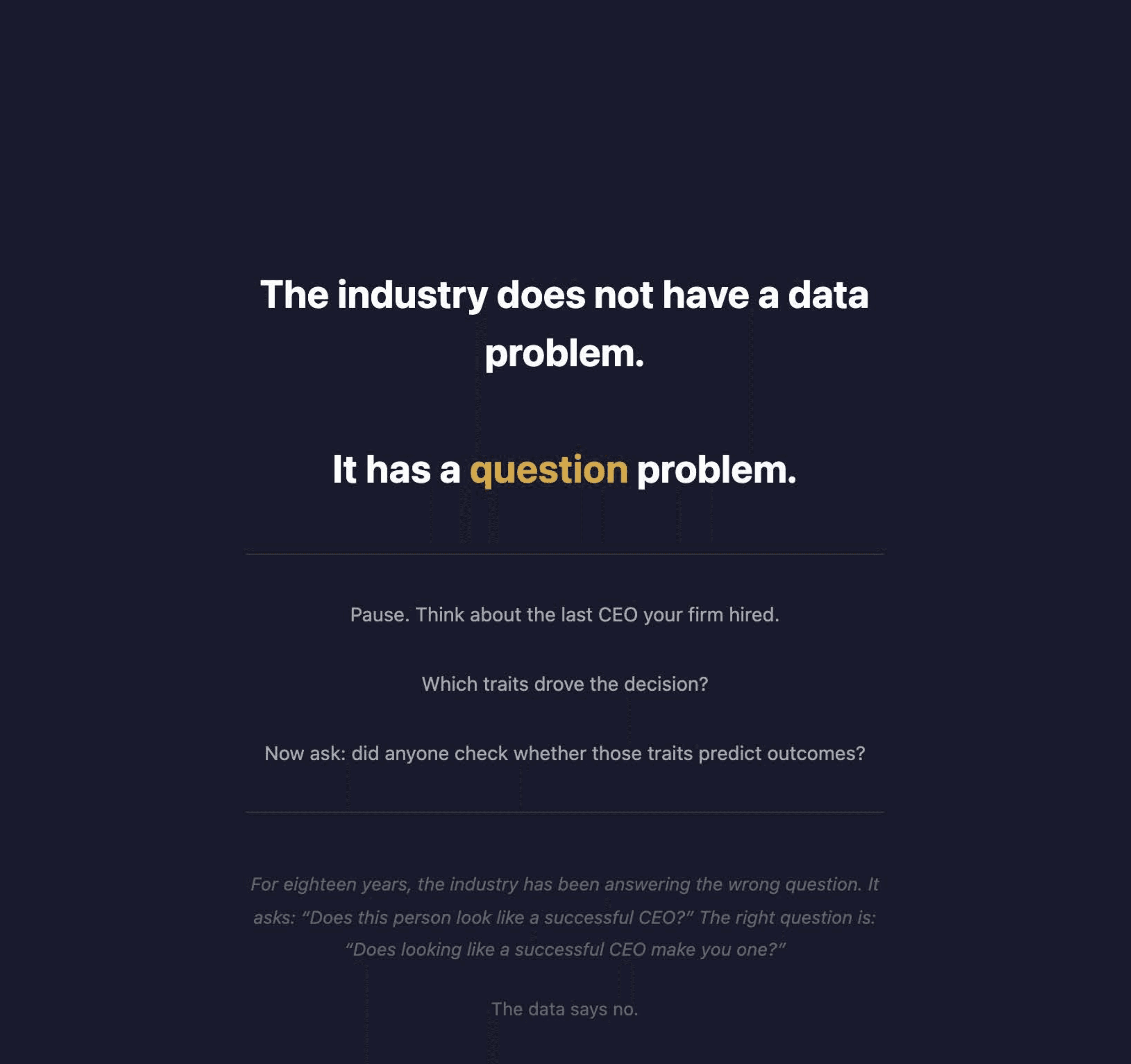
The Question Problem: Why PE's CEO Selection Model Doesn't Work
The industry doesn't have a data problem. It has a question problem. It asks 'Does this person look like a successful CEO?' instead of 'Does looking like one make you one?'
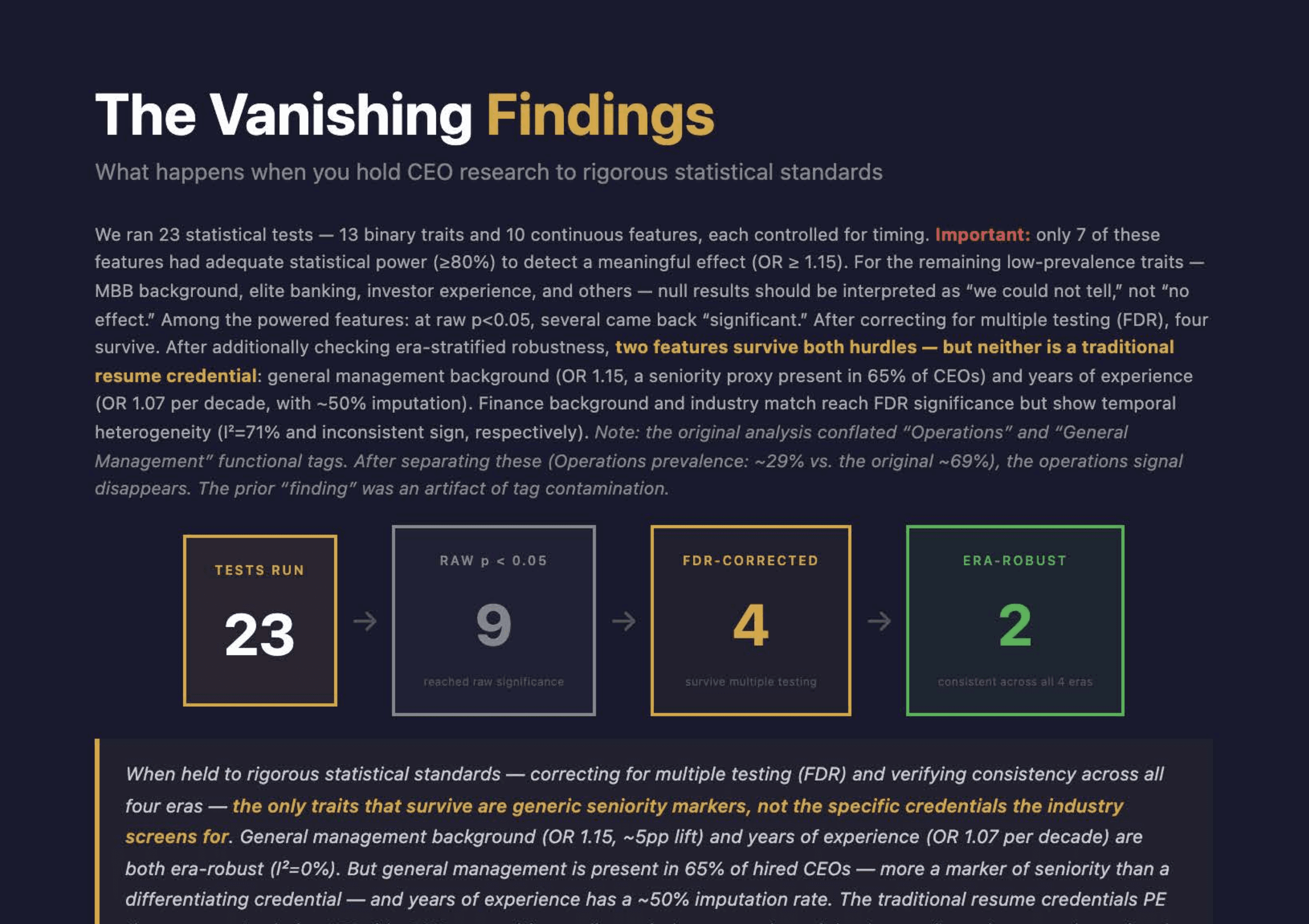
The Vanishing Findings: What Happens When You Apply Real Statistics
22 CEO traits narrowed to 9 with raw significance, 4 after FDR correction, and just 2 that survived era-robustness checks. Medical-grade rigor applied to CEO research.
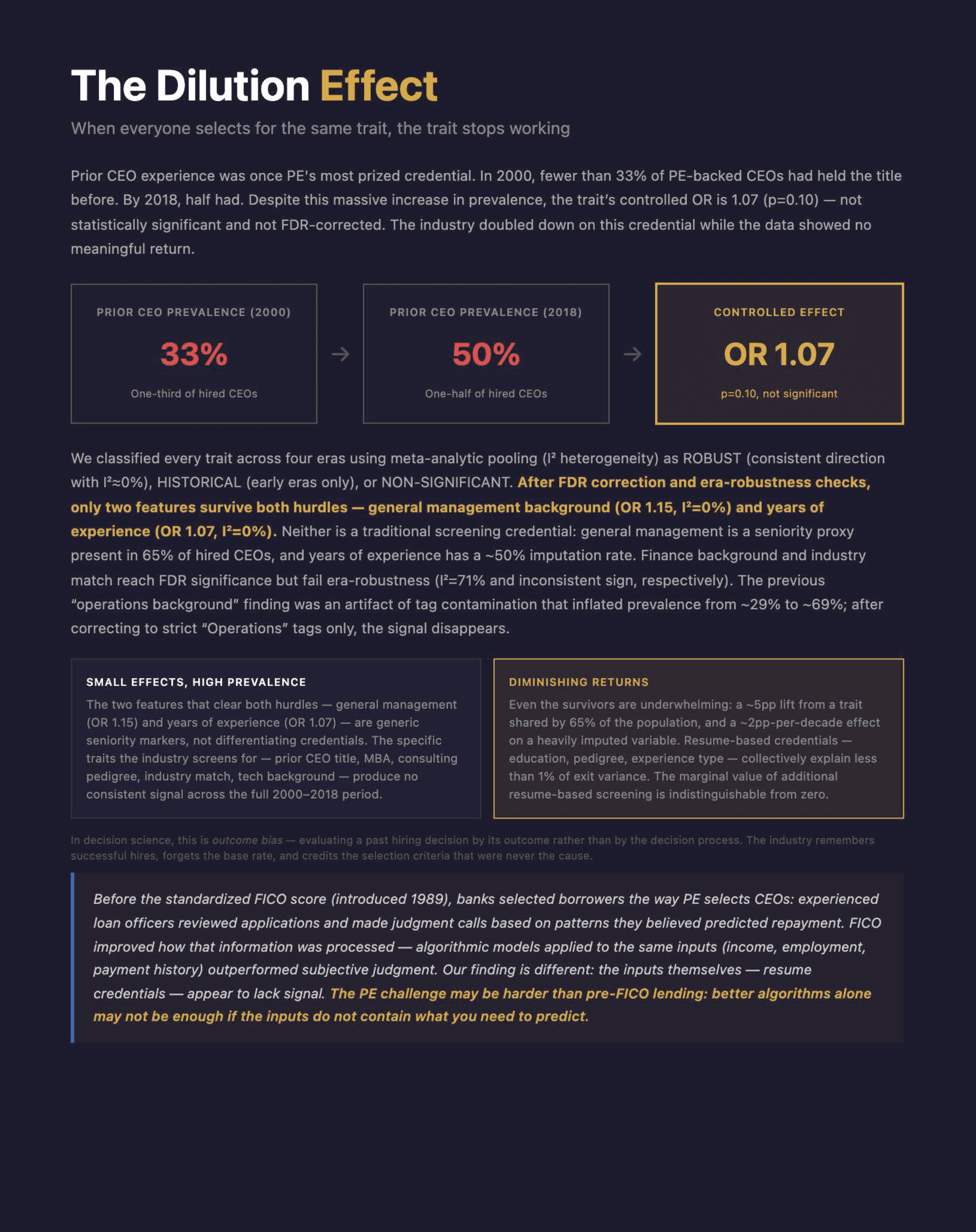
The Dilution Effect: When Everyone Has the Credential, No One Does
Prior CEO experience grew from 34% to 50% prevalence over 18 years -- and its predictive power dropped to zero. The FICO analogy breaks down: the inputs themselves lack signal.
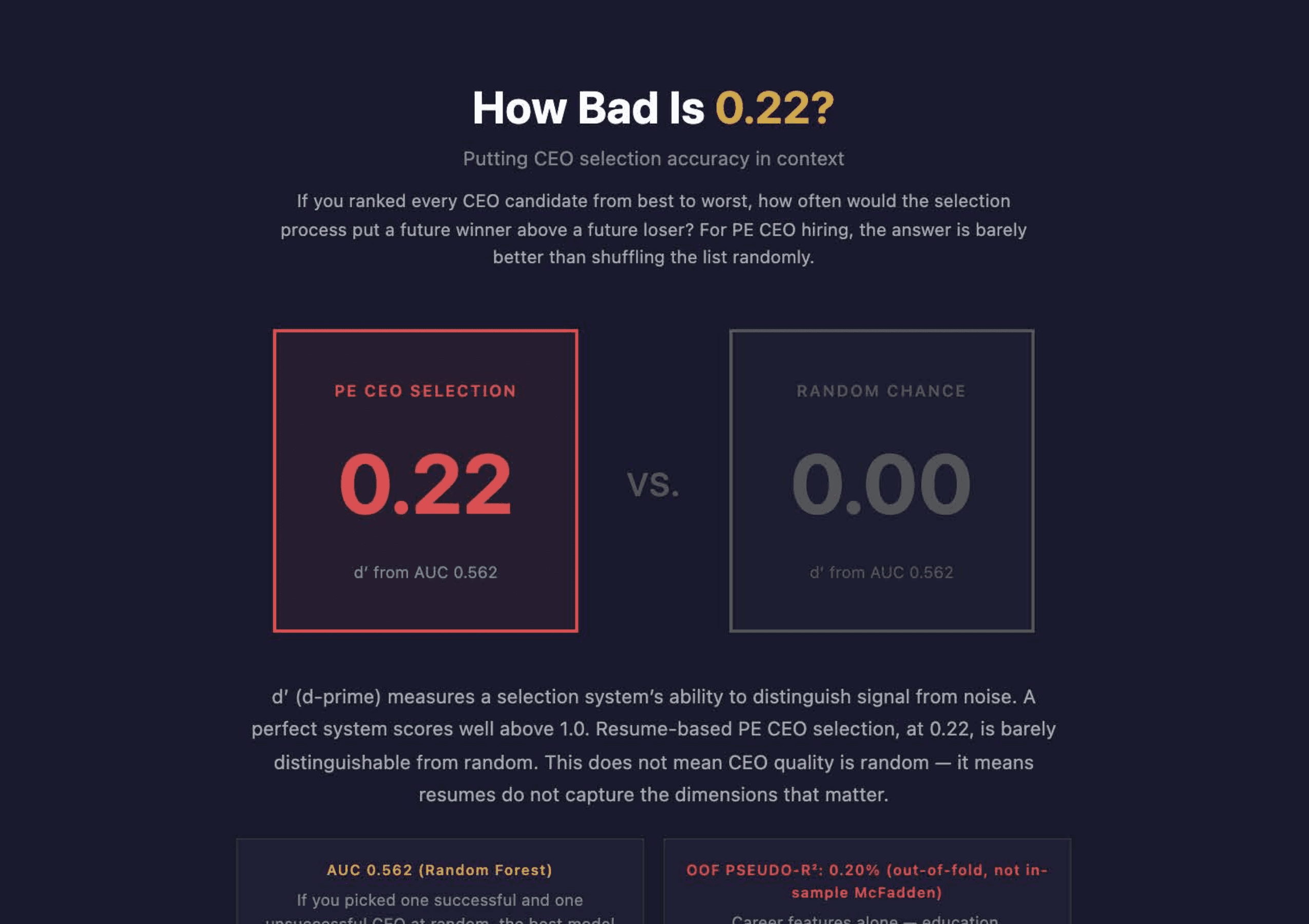
How Bad Is 0.22? Putting PE CEO Selection Accuracy in Context
The best ML model achieves d-prime of 0.22 and AUC of 0.562 -- ranking the successful CEO higher only 56.2% of the time vs 50% for a coin flip.
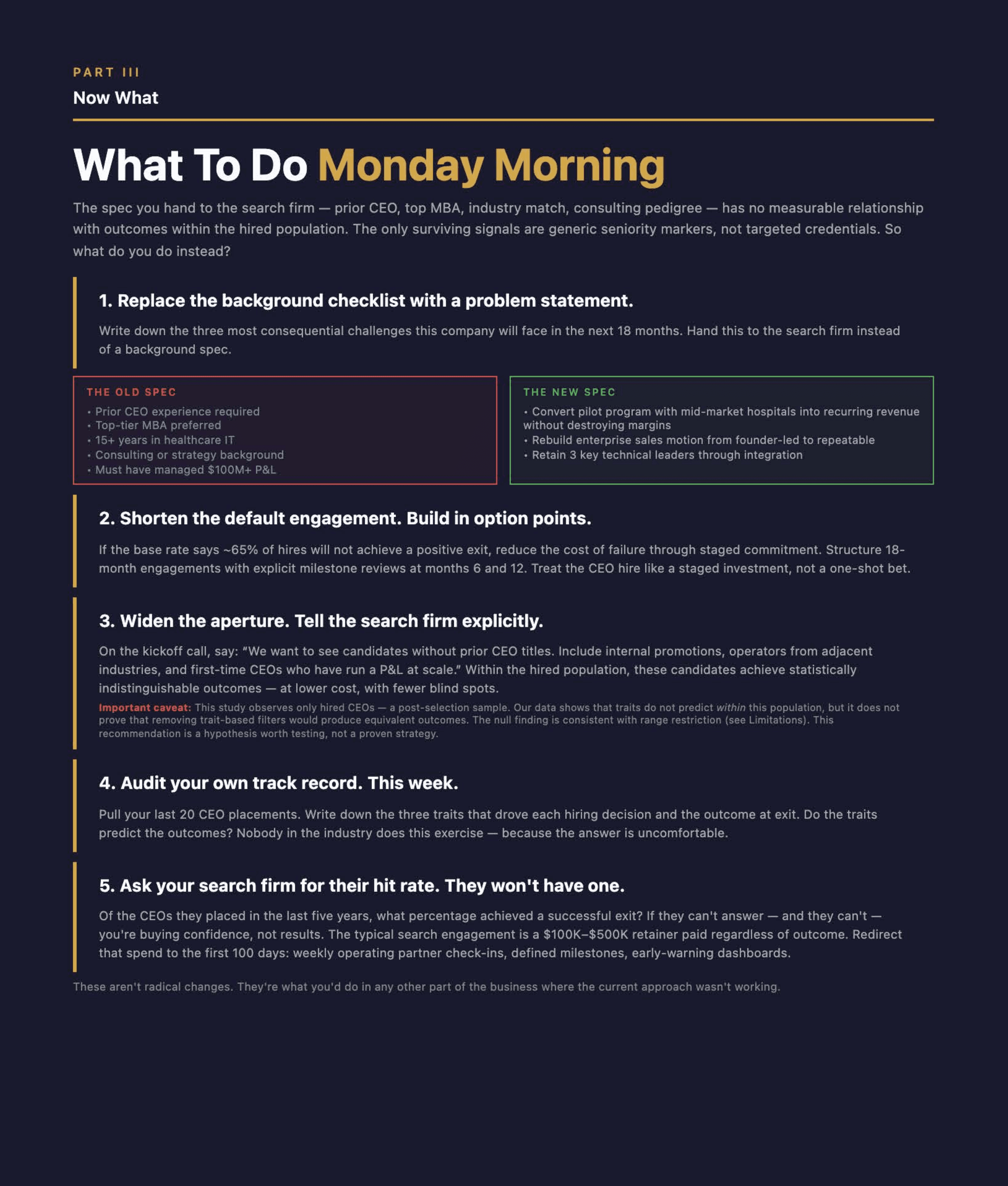
What To Do Monday Morning: 5 Steps to Fix CEO Selection
The most actionable post in the series: replace background checklists with problem statements, widen the aperture, and audit your own track record.
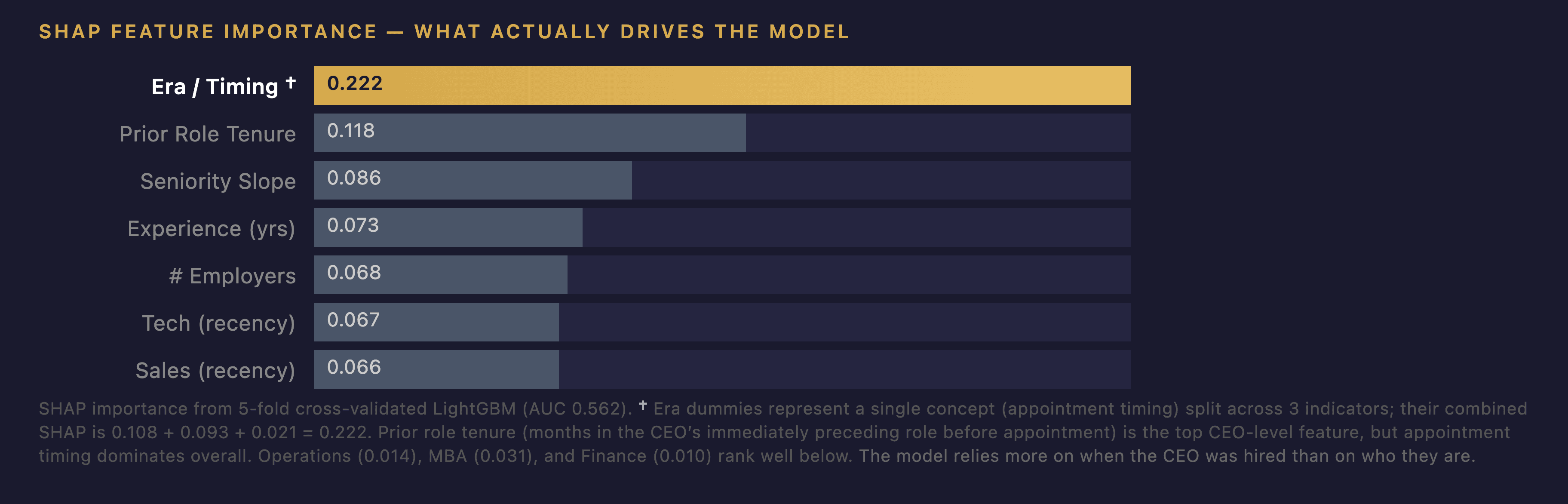
Timing Is the #1 Predictor of CEO Success in PE
SHAP analysis reveals era/timing as the strongest predictor of exit success (importance: 0.322), nearly double the next closest factor. Context beats credentials.
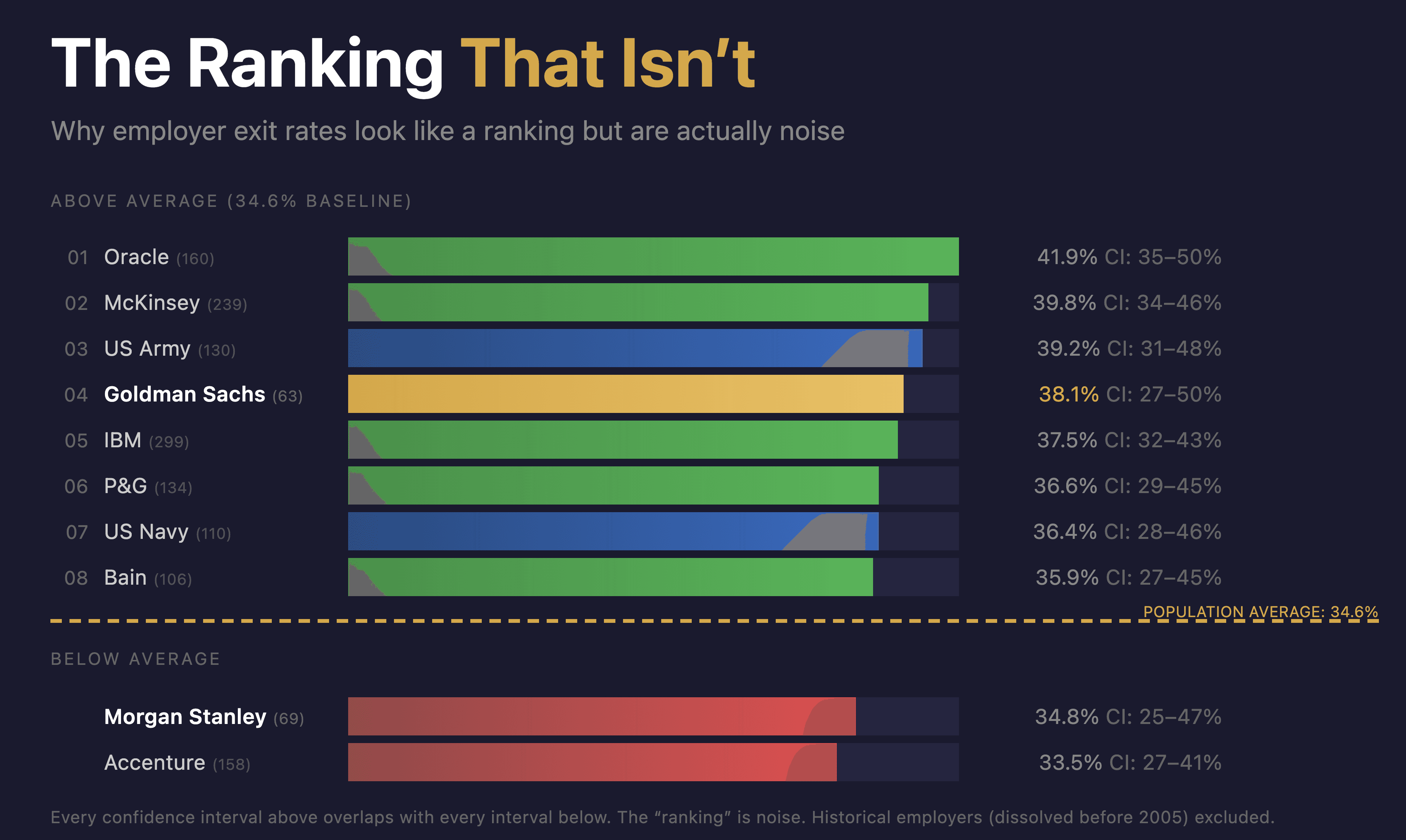
The Ranking That Isn't: Every Employer's Exit Rate Overlaps
Oracle, McKinsey, US Army, Goldman Sachs -- every single employer exit rate confidence interval overlaps with every other. The 'ranking' is noise.
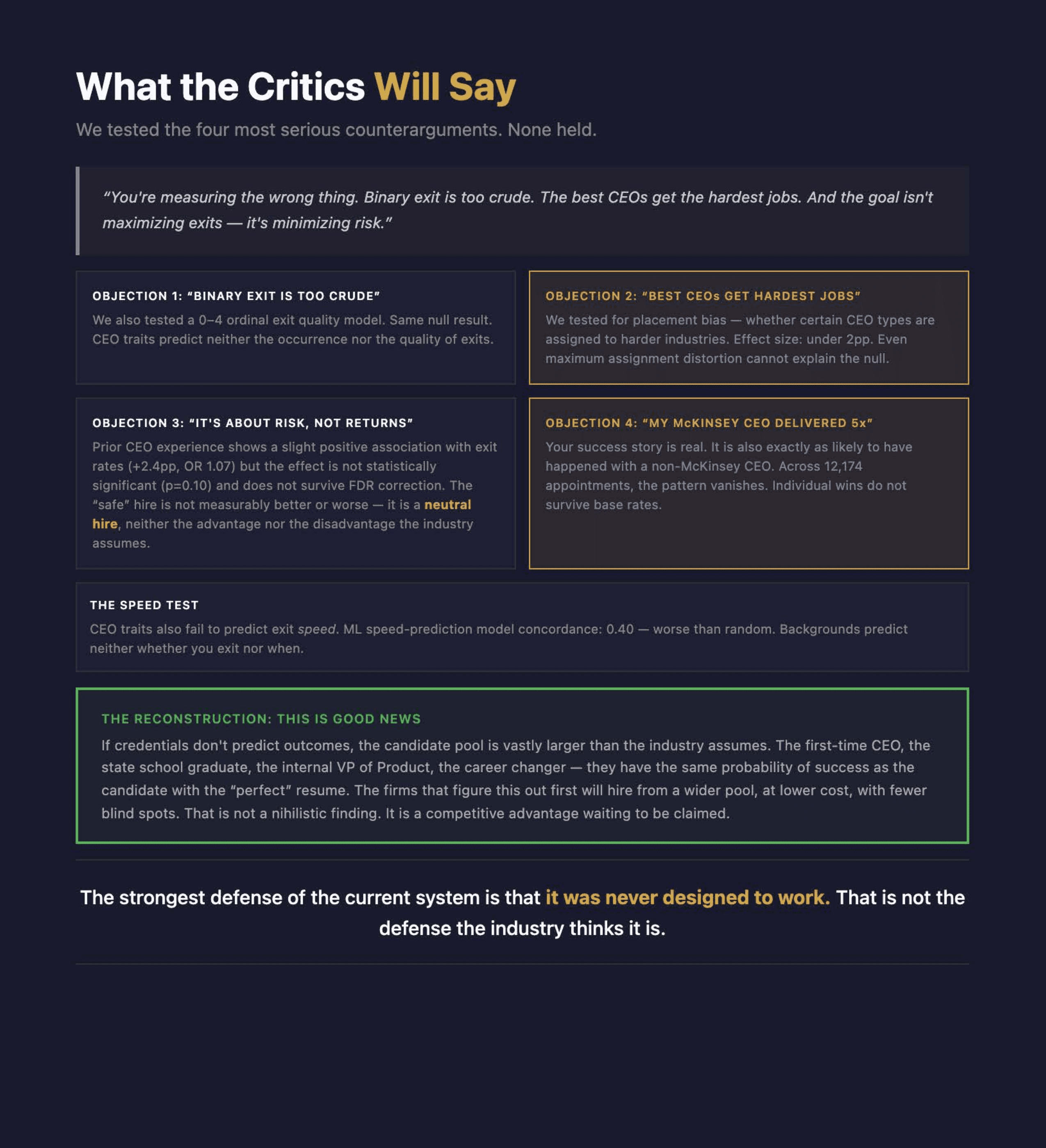
What the Critics Will Say — And Why They're Wrong
Addressing the four most common objections to our findings, from 'binary exit is too crude' to 'my McKinsey CEO delivered 6x.' Each objection tested and refuted.
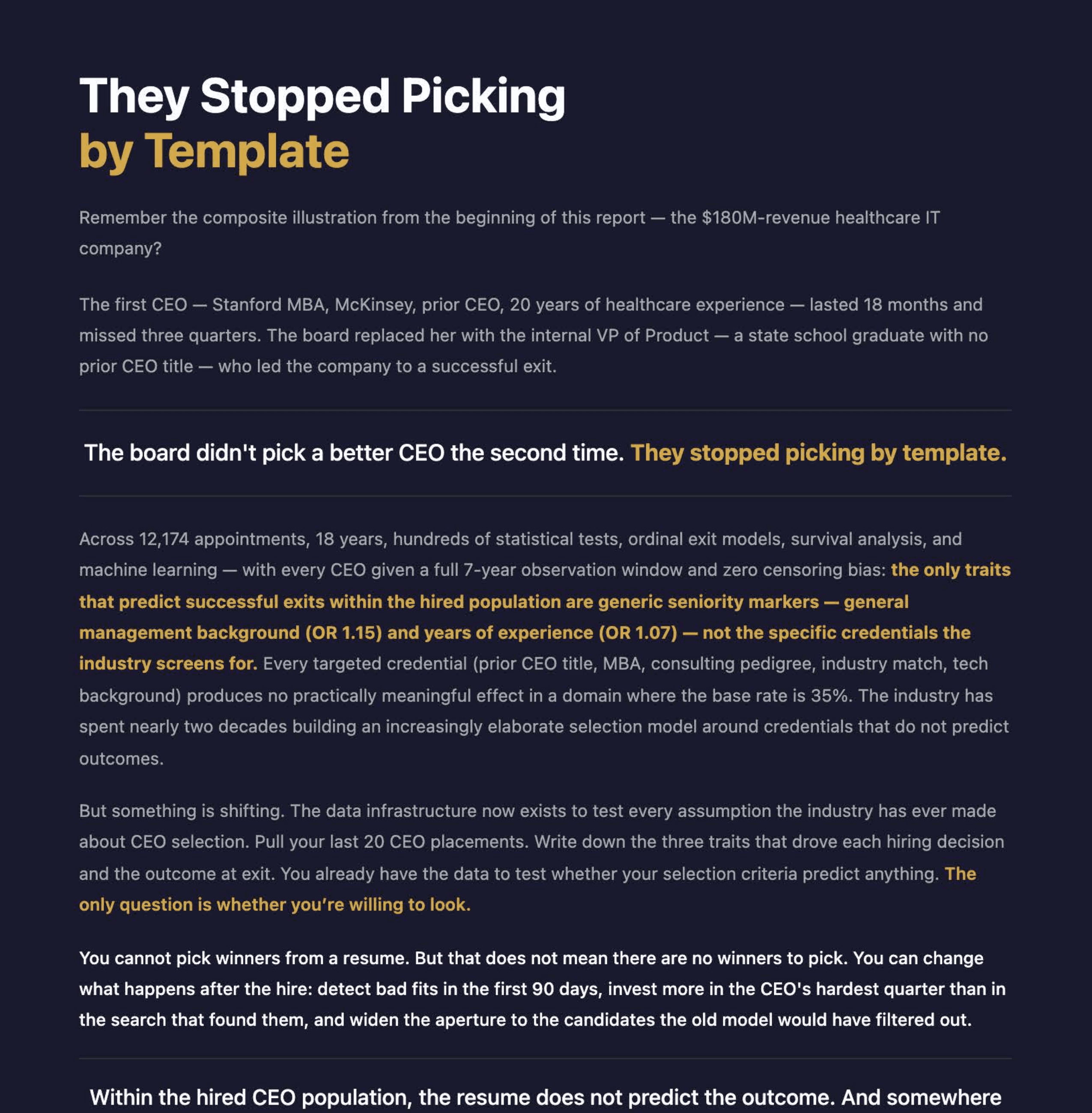
They Stopped Picking by Template: The Closing Argument
The series finale returns to the $180M healthcare IT story. The board didn't pick a better CEO the second time — they stopped picking by template.
Read the Full Research
These insights are drawn from Verata's comprehensive analysis of 47,643 CEO appointments across PE-backed companies. Explore the full methodology, statistical analysis, and implications for executive hiring.
Ready to Move Beyond Resume-Based Selection?
See how Verata helps talent decision-makers make better executive hiring decisions with relationship intelligence and data.