
Where PE-Backed CEOs Earned Their Degrees: The Surprises
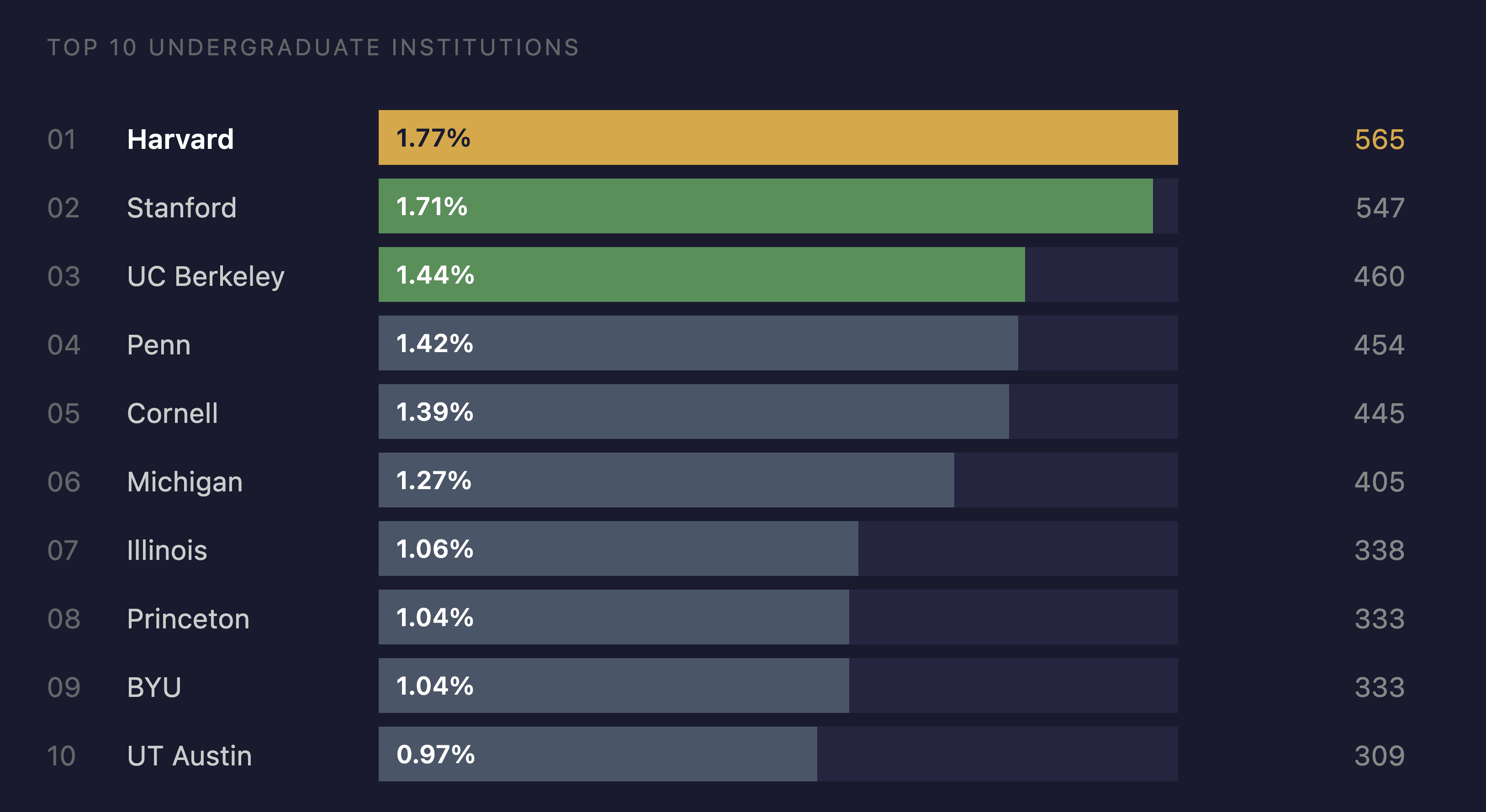
87% of PE-backed CEOs went to schools outside the top 10. Harvard leads at just 1.77%, and UC Berkeley outranks every Ivy except Harvard.
Verata Research
2025-04-04
In this article
The Finding
The undergraduate pedigree of PE-backed CEOs is far more dispersed than the industry's hiring patterns would suggest. 87% of PE-backed CEOs attended undergraduate institutions outside the top 10. Harvard leads the list, but even Harvard accounts for just 1.77% of the total population. The top 10 undergraduate schools collectively produce only 13.1% of PE-backed CEOs -- drawn from a pool of more than 3,100 unique institutions -- a stark contrast to the MBA landscape, where the top 10 programs account for 42.7%.
The composition of that top 10 contains its own surprises. UC Berkeley ranks third nationally with 460 PE-backed CEO alumni, ahead of every Ivy League school except Harvard. The list includes Berkeley, Michigan, Illinois, BYU, and UT Austin -- public flagships and institutions that rarely appear in the PE industry's mental model of an elite talent pipeline. These are not edge cases plucked from the margins. They are in the top 10.
Why This Matters
The PE industry operates with an implicit hierarchy of undergraduate institutions, and that hierarchy is heavily skewed toward a small number of elite private universities. When investment committees review CEO candidates, the undergraduate degree often serves as a background signal -- a quick heuristic for intellectual caliber and social capital. A Harvard or Princeton degree opens doors; a state school degree requires additional evidence of capability.
But the data shows that this heuristic is wildly miscalibrated. The vast majority of PE-backed CEOs -- nearly nine out of ten -- did not attend a top-10 undergraduate institution. The industry's actual hiring behavior is far more inclusive than its stated preferences would suggest. This gap between perception and reality creates a specific kind of inefficiency: candidates from public flagships and non-elite institutions face higher scrutiny and longer odds in the search process, despite being well-represented in the actual CEO population.
Public flagships are not underrepresented in the PE CEO pipeline. They are underrepresented in the search firm's Rolodex. The distinction matters. Berkeley, Michigan, and UT Austin produce CEOs at rates that place them in the top 10 nationally, yet they receive a fraction of the recruiting attention directed at Ivy League campuses. This is not a quality gap. It is a visibility gap -- and visibility gaps are arbitrageable.
What the Data Shows
The contrast between undergraduate and MBA concentration is the most revealing pattern in the data.
- Top 10 undergraduate schools: 13.1% of all PE-backed CEOs (out of 3,100+ institutions)
- Top 10 MBA programs: 42.7% of all MBA-holding PE-backed CEOs (out of 1,121 programs)
At the undergraduate level, the talent pool is radically dispersed. 86.9% of PE-backed CEOs came from more than 3,090 schools outside the top 10. No single institution accounts for more than 2% of the total. The long tail is not just present -- it is dominant.
The specific schools in the top 10 challenge conventional assumptions about where PE talent originates. UC Berkeley's 460 CEO alumni place it ahead of Penn, Yale, Columbia, and every other Ivy except Harvard. The University of Michigan, the University of Illinois, BYU, and UT Austin all appear in the top 10 -- institutions that are world-class by any academic measure but that rarely feature in the PE industry's recruiting narratives.
This dispersion has a structural explanation. Undergraduate education is less vocationally targeted than MBA education. Students at 18 do not self-select into PE career tracks the way MBA students at 28 do. The result is a much broader distribution of eventual PE-backed CEOs across the undergraduate landscape -- and a much weaker signal from any individual institution.
The Counterargument
The most common objection is that undergraduate institution is a poor proxy for anything because it is too temporally distant from the CEO appointment. By the time a PE-backed CEO is hired, they have 20-30 years of professional experience that should matter far more than where they went to college at age 18. The undergraduate degree is background noise.
This objection is correct -- and it cuts in the wrong direction for the industry's current practices. If undergraduate institution is indeed background noise, then the implicit screening bias against non-elite undergraduate degrees is even less defensible. The industry cannot simultaneously argue that undergraduate pedigree is irrelevant and then systematically favor candidates from a handful of institutions.
A second objection is that the top 10 list is dominated by large public universities simply because they graduate more students. This is partially true for schools like Michigan and UT Austin, which have enormous undergraduate populations. But it does not explain Berkeley's position (large but not the largest), BYU's position (mid-sized), or the absence of other very large public universities that do not appear in the top 10. Scale contributes to the ranking but does not fully explain it.
What This Means for Your Firm
The practical implication is that any CEO sourcing strategy built around undergraduate pedigree is working with a filter that captures only 13% of the actual market. If your search specifications include implicit or explicit preferences for candidates from a narrow set of elite undergraduate institutions, you are systematically excluding 87% of the population that has already demonstrated the ability to reach PE-backed CEO positions.
More importantly, the schools that the industry under-weights in its sourcing -- Berkeley, Michigan, Illinois, BYU, UT Austin -- are not producing marginal candidates. They are producing top-10 volumes of PE-backed CEOs. The talent is there. The sourcing infrastructure is not oriented to find it.
Firms that want to build a structural advantage in CEO sourcing should audit their search specifications for undergraduate bias, build relationships with the public flagship alumni networks that are actually producing PE-backed leaders, and recognize that the 87% of CEOs from outside the top 10 are not a secondary talent pool. They are the primary one. The concentrated 13% is the exception, not the rule -- and the industry's fixation on that exception is a competitive vulnerability for those who rely on it and a competitive opportunity for those who look beyond it.
Get the Full Research Report
This insight is from “From Pedigree to Performance” — the complete analysis of 12,174 CEO appointments. Download the full report with methodology, statistical tables, and recommendations.
Related Insights
BYU Equals Princeton: The Undergraduate Pipeline Isn't What You Think
BYU has produced as many PE-backed CEOs as Princeton (333 each), challenging the narrow pipeline assumptions that dominate executive search.
The West Point Pipeline: Military Academies Outproduce the Ivy League Per Capita
West Point ranks #6 in producing PE-backed CEOs per capita at 51.6 per 1,000 students -- higher than Penn, Duke, and Yale.
The MBA Doesn't Predict Exit Outcomes
Harvard accounts for 11.9% of all MBA-holding PE-backed CEOs, but MBA holders' 36.3% exit rate is statistically indistinguishable from non-MBA holders' 33.7%.
Ready to Move Beyond Resume-Based Selection?
See how Verata helps PE firms make better executive hiring decisions with relationship intelligence.