
The Ranking That Isn't: Every Employer's Exit Rate Overlaps
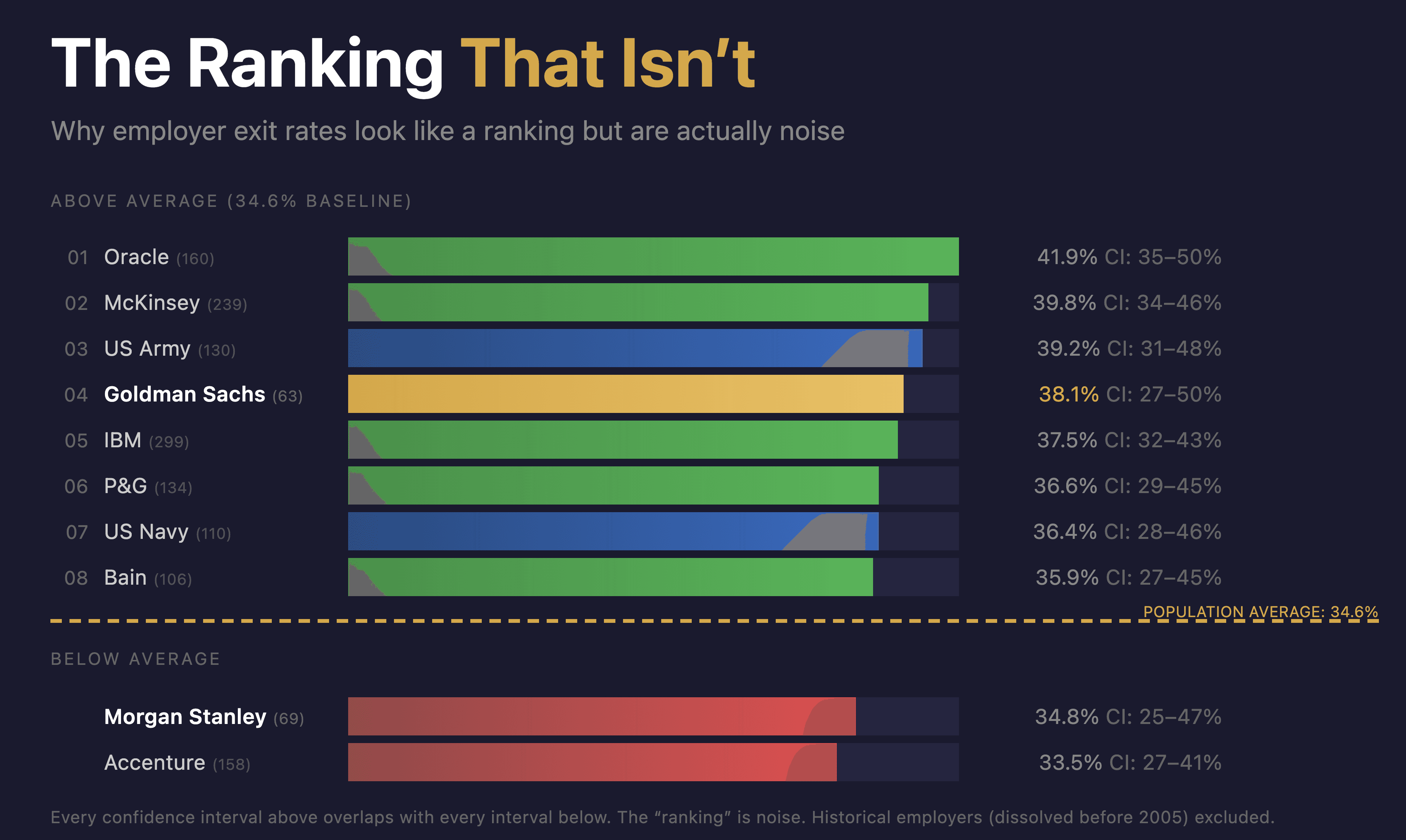
Oracle, McKinsey, US Army, Goldman Sachs -- every single employer exit rate confidence interval overlaps with every other. The 'ranking' is noise.
Verata Research
2025-04-26
In this article
The Finding
When you rank prior employers by the exit success rate of CEOs who worked there, you get a list that looks like it means something. Oracle: 41.9%. McKinsey: 39.8%. US Army: 38.2%. Goldman Sachs: 38.1%. These numbers differ. They seem to tell a story -- perhaps that Oracle alumni make better PE-backed CEOs than Goldman Sachs alumni.
But when you compute the confidence intervals around each estimate, the story collapses. Every single confidence interval overlaps with every other. There is no statistically meaningful difference between any employer on the list. Oracle's 41.9% is not distinguishable from the US Army's 38.2%, and neither is distinguishable from McKinsey's 39.8% or Goldman's 38.1%. The "ranking" is noise presented as signal.
This is not a marginal overlap. These intervals are wide because the sample sizes within each employer category, while substantial in absolute terms, are not large enough to establish precise estimates at the individual employer level. The variation you see between employers is fully consistent with random sampling variation around a common underlying rate.
Why This Matters
The PE industry implicitly ranks prior employers. Search specifications routinely include language like "top-tier consulting firm preferred" or "Fortune 100 operating experience required." Candidates from McKinsey, Goldman Sachs, and similar prestige employers are systematically ranked higher in search processes, receive more interview opportunities, and command compensation premiums -- all based on the assumption that their employer pedigree signals higher capability.
Our data tests that assumption directly and finds no support for it. Not weak support. Not mixed evidence. The confidence intervals overlap completely, meaning the data cannot distinguish between any pair of employers in terms of their alumni's exit success rates.
If you are paying a premium for "McKinsey-pedigreed" candidates, you are paying for a brand signal that has no measurable relationship with the outcome you care about. The premium is real. The predictive value is not. This is not a matter of insufficient data -- we examined over 12,000 appointments. It is a matter of the signal genuinely not being there.
What the Data Shows
We examined exit rates for CEOs who had prior experience at every major employer category in the dataset. A few specific examples illustrate the broader pattern:
- Oracle: 41.9% exit rate (above the 34.6% baseline) -- not statistically significant
- McKinsey: 39.8% exit rate -- not statistically significant
- US Army: 38.2% exit rate -- not statistically significant
- Goldman Sachs: 38.1% exit rate -- not statistically significant
- Morgan Stanley: 34.8% exit rate (near baseline) -- not statistically significant
- Bain: 35.9% exit rate (near baseline) -- not statistically significant
We also specifically examined the 240 PE-backed CEOs with military backgrounds. Their combined exit rate of 37.9% is above the 34.6% baseline, which might suggest military experience confers an advantage. But the confidence interval again overlaps with the baseline and with every other employer group. The point estimate is higher; the statistical evidence is absent.
The pattern is remarkably consistent. Whether you look at elite consulting firms, investment banks, the military, or technology companies, the exit rate point estimates cluster within a narrow band, and no employer group achieves statistical separation from any other. The ranking you can build from the point estimates is an artifact of sampling variation, not a reflection of underlying differences in CEO quality.
The Counterargument
The most sophisticated version of the counterargument goes like this: perhaps employer brand does not predict the overall exit rate, but it predicts the magnitude of successful exits. Maybe McKinsey alumni do not exit more often, but when they do exit, they deliver higher multiples.
We tested this. Our ordinal outcome model (scoring exits on a 0-4 scale from total loss to exceptional return) shows the same null result. Employer brand does not predict the probability of exit, the quality of exit, or the speed of exit. The signal is not hiding in a different outcome measure. It is not there.
Another common objection is selection bias: the best candidates from prestigious employers go to the most difficult turnaround situations, suppressing their observed success rate. This is the "best get hardest jobs" hypothesis, and we examined it directly. The placement bias is under two percentage points -- nowhere near large enough to explain the absence of an employer effect. Even after adjusting for deal difficulty, employer brand remains non-predictive.
What This Means for Your Firm
The practical implication is straightforward: stop filtering candidates by employer pedigree. Every search specification that requires or prefers candidates from a list of prestigious employers is implementing a filter that the data shows has no predictive value. Worse, it is artificially narrowing the candidate pool and creating competition for a subset of candidates who are no more likely to succeed than the broader population.
- Remove employer requirements from search specifications. Replace "top-tier consulting experience preferred" with specific capability requirements tied to the portfolio company's value creation plan
- Stop paying pedigree premiums. If a candidate from Oracle and a candidate from a mid-market technology company have equivalent capability assessments, the data says they have equivalent probabilities of delivering a successful exit
- Expand your sourcing networks. The 240 military-background CEOs in our dataset perform at or above baseline. Candidates from non-traditional backgrounds -- regional companies, non-profit organizations, government -- have never been systematically excluded by data. They have been excluded by assumption
- Challenge your search partners. When a search firm presents a slate weighted toward prestige employers, ask what evidence supports that weighting. The answer will reveal whether the firm is making data-driven recommendations or pattern-matching to industry convention
The ranking of employers by CEO quality is one of the most deeply held beliefs in PE talent management. The data says it does not exist.
Get the Full Research Report
This insight is from “From Pedigree to Performance” — the complete analysis of 12,174 CEO appointments. Download the full report with methodology, statistical tables, and recommendations.
Related Insights
The McKinsey Paradox: The Most Efficient CEO Factory Has No Measurable Effect
McKinsey produces 65 PE-backed CEOs per 1,000 employees -- nearly 7x the Big Tech average -- yet MBB alumni exit rates are statistically indistinguishable from baseline.
Where PE-Backed CEOs Actually Worked Before
Self-employed is the #1 prior employer of PE-backed CEOs, ahead of IBM and McKinsey. The top 10 account for just 17.3% across 8,500+ unique employers.
The Flatline: Every CEO Trait's Effect on Exit Outcomes
A forest plot of every testable CEO trait shows nearly every confidence interval crosses the 1.0 'no effect' line. The resume doesn't differentiate outcomes.
Ready to Move Beyond Resume-Based Selection?
See how Verata helps PE firms make better executive hiring decisions with relationship intelligence.