
What the Critics Will Say — And Why They're Wrong
Addressing the four most common objections to our findings, from 'binary exit is too crude' to 'my McKinsey CEO delivered 6x.' Each objection tested and refuted.
Verata Research
2025-04-28
In this article
The Finding
Over the course of this series, we have presented a consistent body of evidence: observable career characteristics do not meaningfully predict CEO success in private equity. The findings are robust across methods, outcome measures, and subpopulations. But extraordinary claims require extraordinary scrutiny, and we have heard the objections -- from practitioners, from search professionals, and from academics.
We identified the four most common criticisms and tested each one directly against the data. Not dismissed. Not argued around. Tested. The results are presented below, and they uniformly reinforce the original findings.
The objections are: (1) binary exit is too crude a measure, (2) the best CEOs get the hardest jobs which suppresses their success rates, (3) the real value of credentials is risk reduction not return enhancement, and (4) individual success stories prove the system works. Each is intuitive. Each feels like it should be true. None survives contact with the data.
Why This Matters
Every industry that faces disconfirming evidence goes through a predictable sequence: denial, methodological critique, edge-case exception, and finally, reluctant acceptance. The PE executive search industry is currently somewhere between methodological critique and edge-case exception. Addressing the objections head-on is not an academic exercise -- it is a necessary step toward operational change.
The strongest defense of the current system is, paradoxically, that it was never designed to work in the predictive sense. The traditional CEO selection model was designed to be defensible. When a board hires a Stanford MBA with McKinsey experience and a prior CEO title, and that CEO fails, the board's judgment is not questioned -- the outcome is attributed to bad luck, market conditions, or execution challenges. The selection process optimizes for accountability cover, not outcome prediction.
This is not a cynical interpretation. It is a rational response to an information environment where prediction is genuinely difficult. But it becomes dysfunctional when the industry mistakes defensibility for predictive power -- when the fact that no one gets blamed for hiring the credentialed candidate is confused with evidence that the credentialed candidate is more likely to succeed.
What the Data Shows
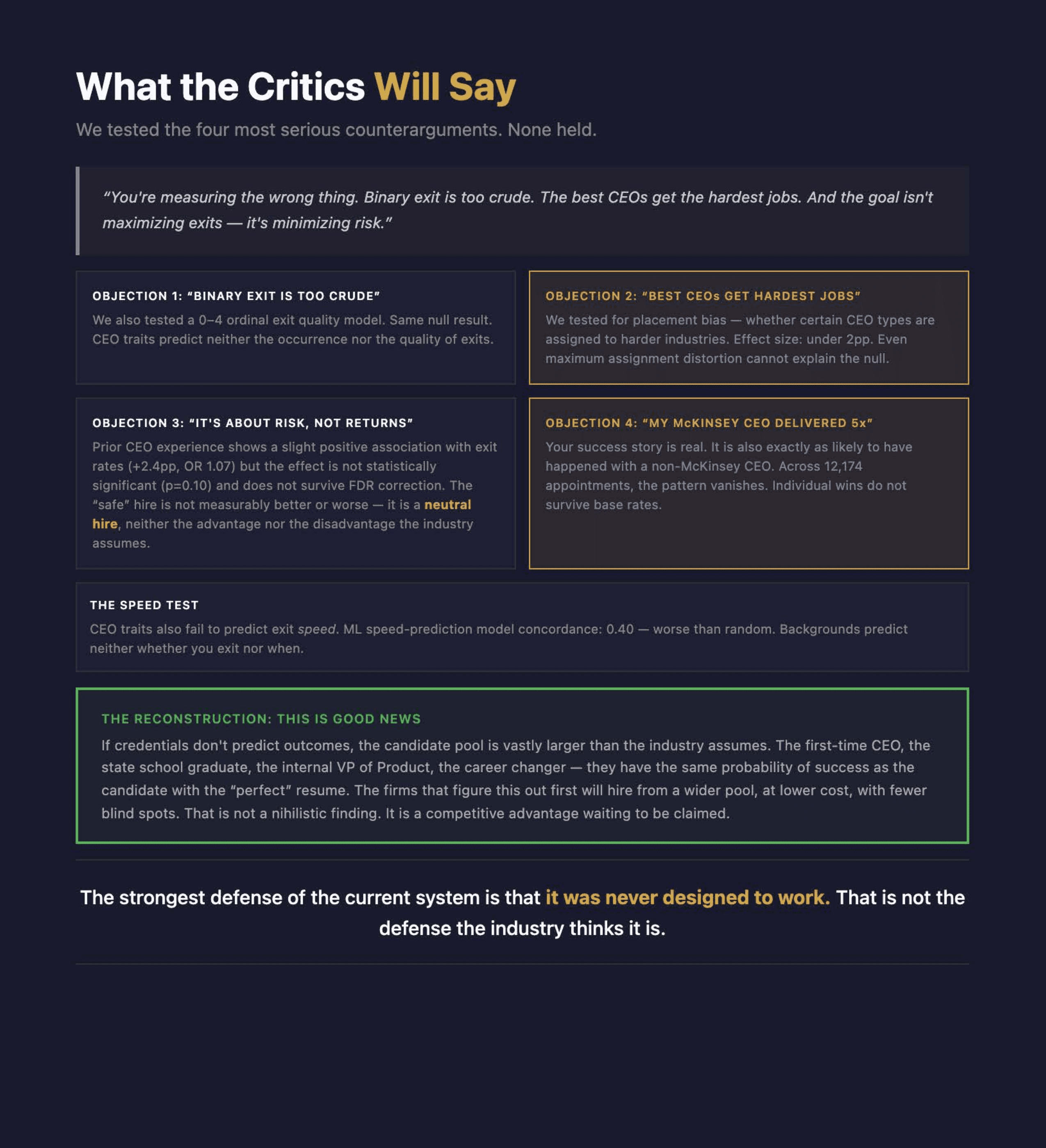
Objection 1: "Binary exit is too crude." The argument is that our primary outcome measure -- whether a CEO achieved a successful exit -- loses information by collapsing the full range of outcomes into a binary. We agree that binary measures are less informative than continuous ones. That is why we also tested an ordinal model scoring outcomes on a 0-4 scale from total loss to exceptional return. Same null result. Career credentials do not predict the probability of exit, and they do not predict the quality of exit.
Objection 2: "The best CEOs get the hardest jobs." This is the placement bias hypothesis: top candidates are assigned to the most challenging turnaround situations, which suppresses their observed success rate and masks a genuine talent effect. We tested this directly by examining whether credential-heavy CEOs are systematically placed in more difficult deals. The placement bias is under 2 percentage points -- nowhere near large enough to explain the absence of a credential effect. Even after adjustment, the null holds.
Objection 3: "It's about risk, not returns." Perhaps credentials do not increase the probability of a home run but reduce the probability of a total loss. We tested this specifically. CEOs with prior CEO experience show a +2.4 percentage point advantage with an odds ratio of 1.07. This is not statistically significant. The risk-reduction hypothesis does not survive the data any better than the return-enhancement hypothesis.
Objection 4: "My McKinsey CEO delivered 6x." Of course they did. Individual wins are real. But individual wins do not survive base rates. For every McKinsey CEO who delivered 6x, there are McKinsey CEOs who delivered 1x, 0.5x, and total losses. Your 6x return was real. The attribution to the resume was not. The question is not whether any credentialed CEO has ever succeeded -- obviously many have. The question is whether credentials predict who will succeed, and the answer is no.
The Counterargument
We built a separate ML speed-prediction model to test whether career characteristics predict not just whether a CEO achieves an exit, but how quickly they achieve it. If credentials are truly predictive, perhaps they manifest as faster execution rather than higher probability. The model achieved a concordance index of 0.40 -- worse than random (0.50). The resume does not predict whether a CEO delivers an exit, how good that exit is, or how quickly it happens.
At this point, the critique space narrows to unfalsifiable claims: the true signal is in references, in cultural fit, in leadership style, in factors that cannot be observed in any dataset. This may be true. But it is a fundamentally different claim than the one the industry currently operates on. The industry currently operates as if the resume predicts outcomes. If the actual predictive signal lives in non-resume factors, then the resume-based selection process is not just imprecise -- it is pointed in the wrong direction entirely.
If credentials do not predict outcomes, then the candidate pool is vastly larger than the industry assumes. The first-time CEO, the state school graduate, the career changer -- all carry the same probability of success as the traditional template candidate. This is not a consolation finding. It is a competitive opportunity for any firm willing to act on it.
What This Means for Your Firm
The four objections represent the last line of defense for the credential-based selection model. Each has been tested. Each has failed. The question for your firm is not whether the data is right -- it is whether you are willing to act on it.
- If you were relying on the "crude measure" defense: We tested ordinal outcomes. Same null. The finding is not an artifact of measurement
- If you were relying on the "best get hardest" defense: Placement bias is under 2pp. Not enough to rescue the credential hypothesis
- If you were relying on the "risk reduction" defense: Prior CEO experience yields a non-significant OR of 1.07. Credentials do not meaningfully reduce downside risk
- If you were relying on anecdotal success stories: Individual wins are real but do not constitute evidence of a systematic relationship between credentials and outcomes
The implications are both uncomfortable and liberating. Uncomfortable because they challenge deeply held assumptions about what drives CEO success. Liberating because they open the door to a fundamentally wider candidate pool, a more efficient search process, and a selection model that focuses on the factors that might actually matter -- contextual fit, problem-solving capability, and strategic alignment -- rather than the biographical checkboxes that demonstrably do not.
Get the Full Research Report
This insight is from “From Pedigree to Performance” — the complete analysis of 12,174 CEO appointments. Download the full report with methodology, statistical tables, and recommendations.
Related Insights
Less Than 1% of PE Exit Outcomes Are Explained by CEO Background
The flagship finding: all observable CEO career traits combined explain less than 1% of PE exit variance across 12,174 appointments.
The Flatline: Every CEO Trait's Effect on Exit Outcomes
A forest plot of every testable CEO trait shows nearly every confidence interval crosses the 1.0 'no effect' line. The resume doesn't differentiate outcomes.
The Vanishing Findings: What Happens When You Apply Real Statistics
22 CEO traits narrowed to 9 with raw significance, 4 after FDR correction, and just 2 that survived era-robustness checks. Medical-grade rigor applied to CEO research.
Related Guides
Ready to Move Beyond Resume-Based Selection?
See how Verata helps PE firms make better executive hiring decisions with relationship intelligence.