
Stanford vs Wharton: The MBA Scale Paradox
Stanford GSB, with half of Wharton's class size, produces 89% as many PE-backed CEOs. Network density matters more than network size.
Verata Research
2025-03-31
In this article
The Finding
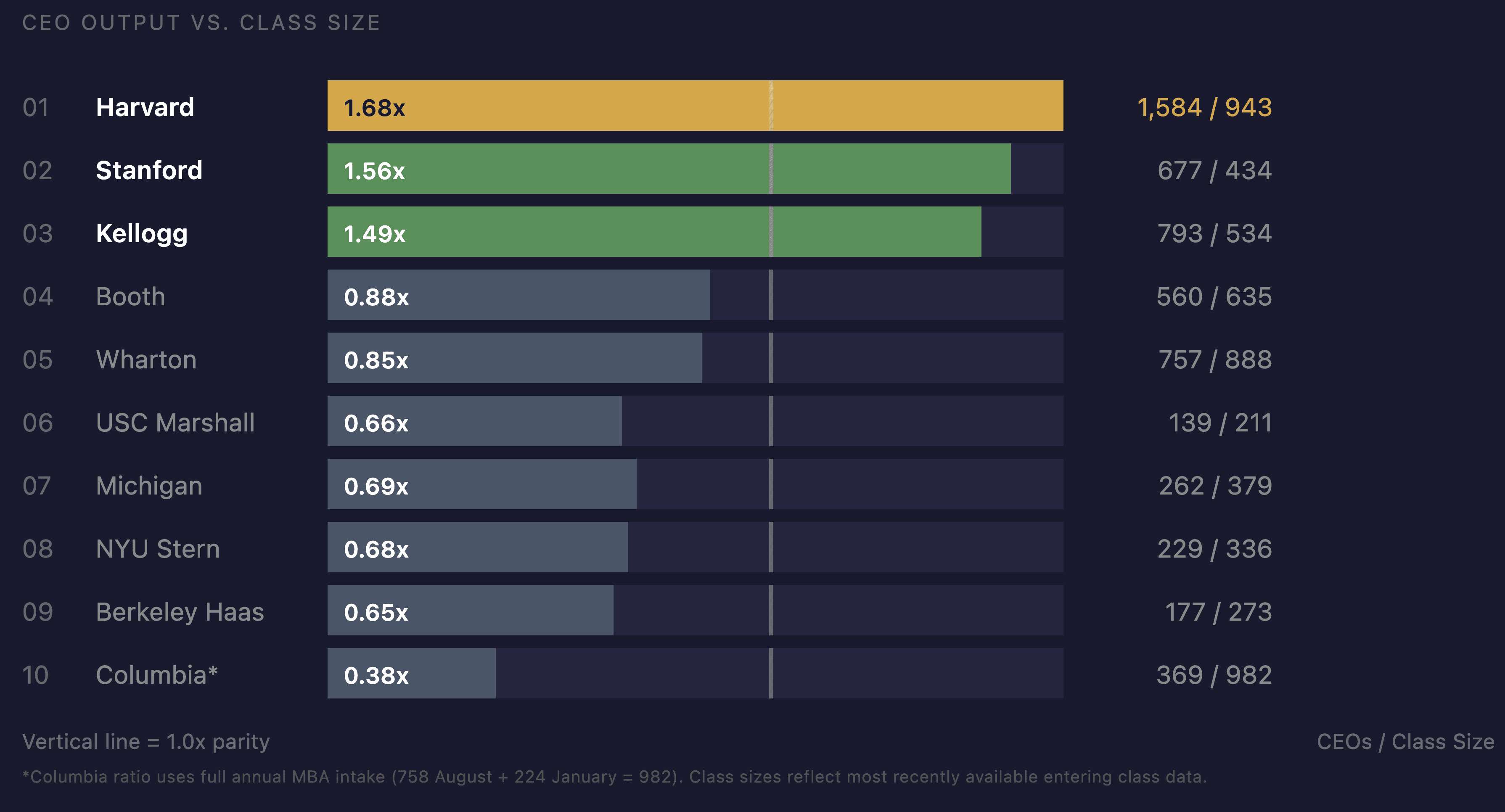
Not all top MBA programs produce PE-backed CEOs at the same rate -- and the differences are not explained by scale. Stanford GSB, with roughly half of Wharton's class size, produces 89% as many PE-backed CEOs. When we normalize for graduating class size, Stanford's CEO production ratio is 1.56x -- meaning it produces 56% more CEOs per graduate than a simple proportional model would predict. Wharton, by contrast, sits at 0.85x: it produces fewer CEOs per graduate than its scale would suggest.
This is not a story about one program being "better" than another. It is a story about network density versus network size, and it has direct implications for how PE firms think about sourcing, alumni networks, and the structural dynamics of talent pipelines.
Why This Matters
The PE industry's reliance on MBA networks as a sourcing channel is well documented. But the assumption that larger programs produce proportionally more leaders is wrong. Size is not destiny. Network density matters more than network size. Stanford's smaller cohorts create tighter alumni bonds, more concentrated PE-oriented career paths, and a higher per-capita rate of placement into portfolio company leadership.
This finding challenges the way firms allocate recruiting resources. If you are building relationships with MBA programs to source future portfolio company CEOs, the raw number of graduates is a misleading proxy for the quality of the pipeline. A program that graduates 400 students per year but places them disproportionately into PE-backed leadership roles is a more efficient sourcing channel than a program that graduates 800 but distributes them more broadly across industries.
The implication extends beyond recruiting. It suggests that the value of an MBA network in the PE context is driven by concentration and connectivity, not by headcount. Smaller, denser networks may create stronger referral chains, more targeted mentorship, and a higher baseline familiarity with the PE operating model -- all of which make graduates more likely to surface in CEO searches.
What the Data Shows
The Verata dataset includes CEO production ratios for the top 10 MBA programs, normalized by graduating class size. The results divide cleanly into two tiers.
Above parity (producing more CEOs per graduate than expected): - Harvard Business School: 1.68x - Stanford GSB: 1.56x - Kellogg School of Management: 1.49x
Below parity (producing fewer CEOs per graduate than expected): - Chicago Booth: 0.88x - Wharton: 0.85x - Columbia Business School: 0.38x
Only 3 of the top 10 MBA programs clear the 1.0x bar. The remaining seven, despite their elite reputations and large alumni networks, produce fewer PE-backed CEOs per graduate than a proportional model would predict. Kellogg is a particularly notable case: it outproduces Wharton, Booth, and Columbia relative to class size, despite receiving less attention in PE recruiting conversations.
Columbia's 0.38x ratio is the most striking outlier. For every CEO that Columbia's class size would predict, the program produces only about one-third. This likely reflects a stronger orientation toward finance careers (investment banking, hedge funds) rather than operating roles -- but it underscores how misleading program prestige can be as a proxy for CEO pipeline quality.
The Counterargument
One reasonable objection is that CEO production ratios are driven by self-selection rather than program quality. Stanford attracts a disproportionate share of students who intend to pursue operating roles, while Wharton and Columbia attract more finance-oriented students. The ratio reflects incoming student preferences, not anything the program itself does.
This is partially true -- and it does not change the practical implication. Whether the density effect is caused by the program or by the students who choose it, the result for PE firms is the same: some networks are structurally richer sourcing channels than others, and raw program size is a poor predictor of which ones. A recruiter who allocates campus time proportionally to class size is misallocating resources relative to a recruiter who allocates based on CEO production ratios.
A second objection is that these ratios say nothing about CEO quality or exit outcomes. That is correct -- and it is precisely the point. The ratios measure pipeline volume, not pipeline quality. As other findings in this series demonstrate, the credentials themselves do not predict exit outcomes. The question here is narrower: given that the industry sources heavily from MBA networks, which networks are the most efficient sources? The answer is not the largest ones.
What This Means for Your Firm
If your firm maintains recruiting relationships with MBA programs, this data should inform how you allocate those relationships. Programs with high CEO production ratios -- Harvard, Stanford, Kellogg -- are disproportionately efficient sources of PE-backed leadership talent relative to their size. Programs with low ratios may still produce excellent individual candidates, but they are structurally less likely to surface them at scale.
More broadly, this finding reinforces a theme that runs through the entire Verata research series: the PE industry's conventional wisdom about talent is built on assumptions that do not survive contact with data. The assumption that the biggest, most prestigious programs are the best sources of CEO talent is intuitive and wrong. Network density matters more than network size, and the firms that recognize this can build more efficient, less competitive sourcing channels.
The practical step is straightforward: audit your firm's MBA sourcing relationships against CEO production ratios rather than program rankings. You may find that you are over-investing in programs that produce fewer leaders than expected and under-investing in programs that punch well above their weight.
Get the Full Research Report
This insight is from “From Pedigree to Performance” — the complete analysis of 12,174 CEO appointments. Download the full report with methodology, statistical tables, and recommendations.
Related Insights
The MBA Doesn't Predict Exit Outcomes
Harvard accounts for 11.9% of all MBA-holding PE-backed CEOs, but MBA holders' 36.3% exit rate is statistically indistinguishable from non-MBA holders' 33.7%.
The Harvard MBA Concentration: 11.9% of All PE-Backed CEO MBAs
HBS alone accounts for 1,584 PE-backed CEOs -- 11.9% of all MBA holders -- yet the top 10 MBA programs produce CEOs with statistically indistinguishable exit rates.
The MBA's Modest Edge: A 2.6 Percentage Point Gap That Isn't Significant
MBA holders achieve 36.3% vs non-MBA 33.7% -- a 2.6pp gap that vanishes under statistical correction. Top 10 MBA programs: 34.2%, barely above no MBA at all.
Ready to Move Beyond Resume-Based Selection?
See how Verata helps PE firms make better executive hiring decisions with relationship intelligence.