
The Harvard MBA Concentration: 11.9% of All PE-Backed CEO MBAs
HBS alone accounts for 1,584 PE-backed CEOs -- 11.9% of all MBA holders -- yet the top 10 MBA programs produce CEOs with statistically indistinguishable exit rates.
Verata Research
2025-04-06
In this article
The Finding
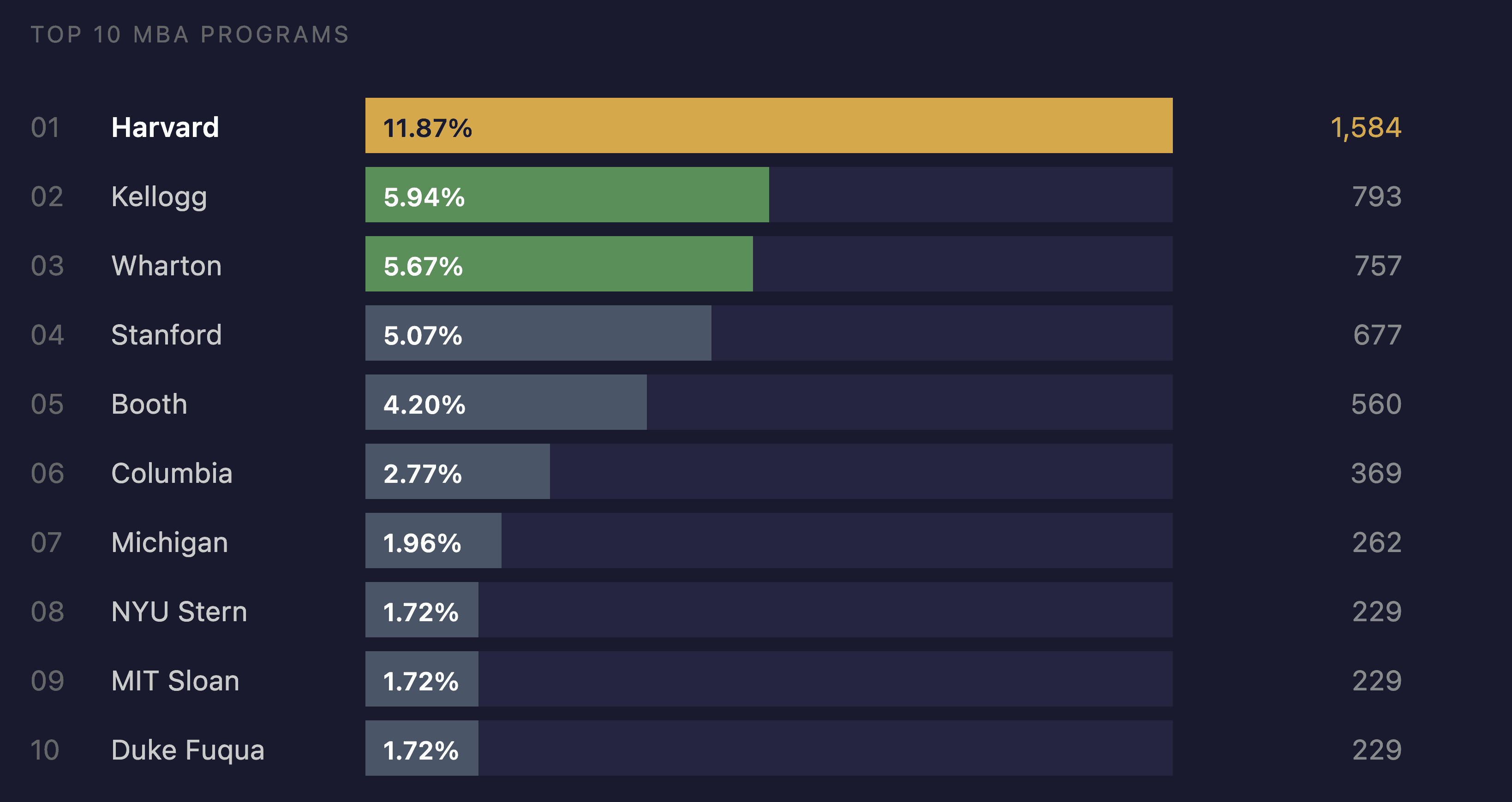
Harvard Business School occupies a singular position in the PE-backed CEO landscape. HBS alone accounts for 1,584 PE-backed CEO appointments -- 11.9% of all MBA-holding PE-backed CEOs. This is nearly double the share of the next closest program, Kellogg, at 5.94%. The top 5 MBA programs collectively account for nearly a third of all MBA-holding PE-backed CEOs, and the top 10 account for 42.7%.
This level of concentration is extraordinary by any standard. Out of 1,121 unique MBA programs represented in the dataset, just 10 account for nearly half of all appointments. This is concentration that would raise antitrust questions in most other markets. The PE industry's CEO pipeline is not a competitive marketplace of ideas and talent. It is an oligopoly of credentials, dominated by a handful of programs that funnel graduates into a disproportionate share of leadership roles.
Why This Matters
The concentration matters because it reveals the extent to which the PE industry's talent model is a network effect rather than a meritocratic selection process. HBS does not produce 11.9% of MBA-holding PE-backed CEOs because its curriculum is 11.9% better than average. It produces that share because its alumni network is deeply embedded in the PE ecosystem -- as investors, board members, operating partners, and executive recruiters -- creating a self-reinforcing cycle where HBS graduates are disproportionately visible, disproportionately referred, and disproportionately hired.
This network effect is rational at the individual level. If you are a PE partner filling a CEO role, sourcing from HBS reduces search costs, provides social proof, and aligns with the expectations of your LPs and co-investors. But at the system level, it produces a talent monoculture that concentrates risk, reduces diversity of thought, and -- critically -- does not produce better outcomes.
The $200K+ MBA investment buys access to a concentrated hiring network. It does not buy a measurably better probability of delivering a successful PE exit. This is the central tension: the concentration is economically rational for the individual participant but collectively suboptimal for the asset class.
What the Data Shows
The dataset reveals two parallel systems operating within the PE-backed CEO market, and their outcomes are indistinguishable.
System 1: The concentrated pipeline - 10 MBA programs - 42.7% of all MBA-holding PE-backed CEO appointments - Programs include HBS, Kellogg, Wharton, Stanford, Booth, Columbia, and others
System 2: The distributed pipeline - 1,111 MBA programs - 57.3% of all MBA-holding PE-backed CEO appointments - Programs spanning every tier, geography, and specialization
Both systems produce CEOs at statistically indistinguishable exit rates.
HBS's dominance is visible in the raw numbers. Its 1,584 CEO appointments dwarf every other program:
- Harvard Business School: 1,584 (11.9%)
- Kellogg: ~793 (5.94%)
- Top 5 combined: ~33% of all MBA-holding PE-backed CEOs
- Top 10 combined: 42.7%
- Remaining 1,111 programs: 57.3%
The concentration is real. The performance advantage is not. CEOs from top-10 MBA programs exit at rates that are statistically indistinguishable from CEOs whose MBAs come from the other 1,111 programs in the dataset. The pipeline is concentrated, but the value it delivers is not.
The Counterargument
The strongest counterargument is survivorship bias in the comparison. If HBS graduates are placed into "easier" CEO roles -- larger companies, more stable industries, better-capitalized sponsors -- then the absence of an exit rate premium might mask a genuine quality advantage that is offset by harder assignments. Alternatively, if HBS graduates are placed into more complex turnaround situations, equal exit rates could actually represent superior performance on harder problems.
These are legitimate hypotheses, and the data does not fully resolve them without controlling for deal characteristics. However, the sheer breadth of the dataset -- spanning thousands of appointments across industries, fund sizes, and market cycles -- makes it unlikely that a systematic assignment bias explains the entire result. If HBS graduates were consistently placed into a distinct category of deals, we would expect to see that pattern in the data, and we do not.
A second counterargument is that the concentration reflects genuine quality: HBS produces better-prepared leaders, and the market recognizes this through higher appointment rates. But this argument requires the quality advantage to show up somewhere in the outcomes data, and it does not. High appointment rates plus average exit rates equals a selection premium without a performance premium -- exactly what you would expect from a network effect rather than a quality effect.
What This Means for Your Firm
The Harvard MBA concentration is a market structure, not a market signal. It tells you where the industry sources its CEOs, not where it should source them. If your firm defaults to the concentrated pipeline -- screening for top-10 MBA credentials, sourcing through the same alumni networks, paying the premium that elite credentials command in the executive labor market -- you are buying access without buying alpha.
The 1,111 programs in System 2 collectively produce 57.3% of MBA-holding PE-backed CEOs and deliver indistinguishable exit rates. They also produce candidates who face less competition from other PE firms, command lower compensation premiums, and bring a broader range of operational perspectives. The distributed pipeline is not the consolation prize. It is the majority of the market, and it performs identically to the concentrated minority.
The actionable insight is not that HBS is overrated. HBS produces exceptional leaders, and 1,584 PE-backed CEO appointments is a remarkable track record. The insight is that the 42.7% concentration on 10 programs is not justified by differential outcomes, and firms that recognize this can diversify their sourcing -- reducing cost, increasing candidate supply, and maintaining the same expected exit performance. In a market where a few hundred basis points of return separate top-quartile from median performance, the talent sourcing arbitrage between System 1 and System 2 is one of the few remaining structural advantages available to firms willing to challenge their own assumptions.
Get the Full Research Report
This insight is from “From Pedigree to Performance” — the complete analysis of 12,174 CEO appointments. Download the full report with methodology, statistical tables, and recommendations.
Related Insights
The MBA Doesn't Predict Exit Outcomes
Harvard accounts for 11.9% of all MBA-holding PE-backed CEOs, but MBA holders' 36.3% exit rate is statistically indistinguishable from non-MBA holders' 33.7%.
Stanford vs Wharton: The MBA Scale Paradox
Stanford GSB, with half of Wharton's class size, produces 89% as many PE-backed CEOs. Network density matters more than network size.
The MBA's Modest Edge: A 2.6 Percentage Point Gap That Isn't Significant
MBA holders achieve 36.3% vs non-MBA 33.7% -- a 2.6pp gap that vanishes under statistical correction. Top 10 MBA programs: 34.2%, barely above no MBA at all.
Related Guides
Ready to Move Beyond Resume-Based Selection?
See how Verata helps PE firms make better executive hiring decisions with relationship intelligence.