
The MBA Doesn't Predict Exit Outcomes
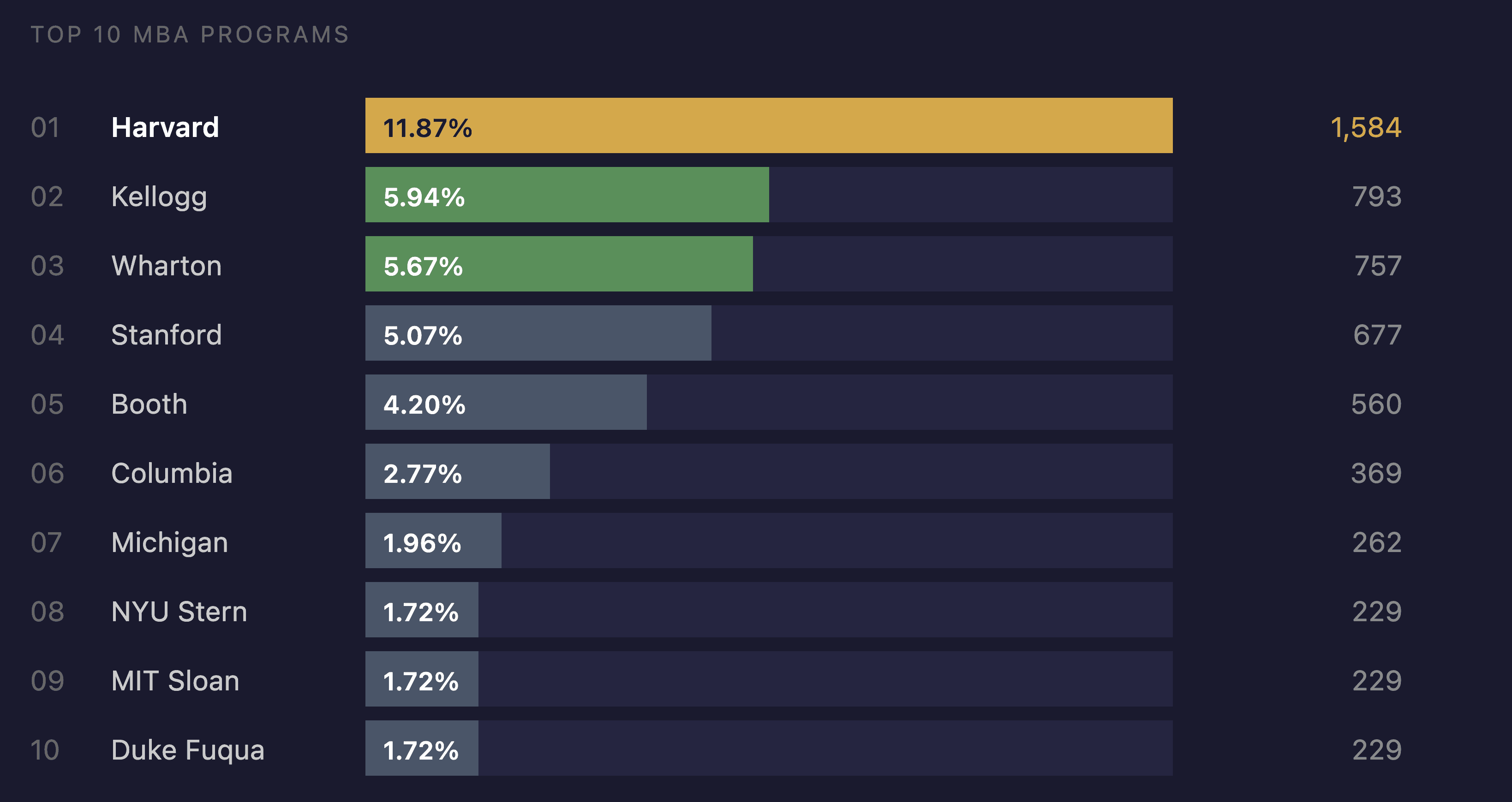
Harvard accounts for 11.9% of all MBA-holding PE-backed CEOs, but MBA holders' 36.3% exit rate is statistically indistinguishable from non-MBA holders' 33.7%.
Verata Research
2025-03-21
In this article
The Finding
The MBA is the most widely held credential among PE-backed CEOs and the single most over-indexed factor in executive search specifications. Harvard Business School alone accounts for 11.9% of all MBA-holding PE-backed CEOs in the dataset -- 1,584 individuals. The top four MBA programs (Harvard, Wharton, Kellogg, Columbia) collectively represent more than 28% of all MBA-holding CEOs in PE-backed companies.
Despite this extraordinary concentration, the MBA does not predict exit outcomes. MBA holders achieved a raw exit rate of 36.3% compared to 33.7% for non-MBA holders -- a gap of 2.6 percentage points that is not statistically significant after correcting for multiple testing (FDR p = 0.0636). The confidence interval for the MBA odds ratio spans from just below 1.0 to 1.25, meaning the data is consistent with the MBA having zero effect.
If the MBA were a stock, no rational investor would take the position. A 2.6 percentage point gap that fails to reach statistical significance is not an investable signal. You would never make a $180 million investment based on a criterion this weak -- yet the industry routinely treats MBA status as a primary screen for the person who will be responsible for delivering that investment's return.
Why This Matters
The MBA occupies a central position in the PE talent ecosystem for reasons that are more cultural than empirical. MBA programs function as sorting mechanisms: they select high-potential individuals, credential them with a prestigious brand, and connect them to alumni networks that facilitate career advancement. This sorting function is real and valuable. But sorting is not the same as value creation. The question is not whether MBAs end up in CEO roles -- they clearly do, at enormous rates -- but whether having an MBA makes someone a better CEO for a PE-backed company.
The data says no. And the implications extend beyond the MBA itself to the entire architecture of credential-based CEO evaluation. If the most prevalent, most screened-for, most discussed credential in PE talent circles does not predict the outcome that PE firms exist to generate, it raises a fundamental question about what the industry's evaluation process is actually measuring.
The MBA is not selecting for operational capability, adaptive leadership, or the ability to execute a 100-day plan in a newly acquired company. It is selecting for a specific type of analytical training and a specific type of professional network. Those attributes may be valuable in many contexts -- but the data shows they are not reliably valuable in the specific context of leading a PE-backed company to a successful exit.
What the Data Shows
The MBA analysis draws from the full analytical sample of 12,174 CEO appointments with fully observed outcomes. The results are consistent across every angle of analysis:
- Raw exit rates: MBA holders 36.3%, non-MBA holders 33.7% (difference: 2.6pp)
- Kaplan-Meier adjusted 5-year exit rates: MBA holders 52.0%, non-MBA holders 45.4%
- Odds ratio: 1.12 (95% CI: 0.99-1.25), not significant after FDR correction
- FDR-adjusted p-value: 0.0636 (threshold for significance: 0.05)
- Era robustness: I-squared = 0%, meaning the small gap is consistent across all time periods -- but consistently small
The concentration data is equally striking. Among CEOs who hold MBAs, the distribution is heavily skewed toward a handful of programs:
- Harvard: 11.9% of all MBA-holding PE-backed CEOs (1,584 individuals)
- Top 4 programs (Harvard, Wharton, Kellogg, Columbia): 28%+ of all MBA-holding CEOs
- Top 10 programs: approximately 45% of all MBA-holding CEOs
This concentration means the industry is not just over-indexing on MBAs generally -- it is over-indexing on a narrow set of MBA programs. And when you test whether a Top-10 MBA predicts better outcomes than a non-Top-10 MBA or no MBA at all, the answer is the same: no statistically significant difference after FDR correction.
The MBA is a powerful sorting credential. It efficiently identifies people who are likely to end up in CEO roles. But it does not identify people who are likely to succeed in those roles. The distinction between pipeline efficiency and outcome prediction is the core of this finding.
The Counterargument
MBA defenders will argue that the credential's value lies in what it correlates with rather than what it directly causes. MBA programs select for intelligence, ambition, and professional seriousness. They teach financial modeling, strategic frameworks, and organizational management. They create networks that provide ongoing professional support. Even if the MBA itself does not "cause" better exits, it may be a reliable proxy for the underlying traits that do.
This argument has a serious flaw: if the MBA is a proxy for underlying traits, and those traits predict exit success, then the MBA should show a statistically significant relationship with exits -- because it is correlated with the traits that matter. The fact that it does not survive FDR correction suggests one of two things. Either the traits that MBA programs select for are not the traits that predict PE exit success. Or the MBA is a noisier proxy for those traits than the industry assumes, meaning it captures too many people who have the credential but lack the underlying capability.
Either interpretation leads to the same practical conclusion: using MBA status as a screening criterion introduces more noise than signal into the CEO selection process. If you want to evaluate analytical rigor, evaluate it directly. If you want to assess strategic capability, test it in context. The MBA stamp, by itself, tells you where someone came from. It does not tell you whether they will deliver the exit.
What This Means for Your Firm
The MBA finding has immediate practical implications for how PE firms structure their CEO searches and evaluate candidates:
- Stop using MBA as a screening filter. If your search specifications include "MBA required" or "MBA strongly preferred," recognize that this criterion eliminates approximately half of all potential CEO candidates while providing no measurable improvement in expected outcomes. The 2.6 percentage point gap is indistinguishable from noise.
- Do not pay the MBA premium. If your firm systematically pays higher compensation to MBA-holding CEOs based on the assumption that the credential signals higher capability, the data does not support that premium. Compensation should be based on the specific value a CEO is expected to create, not on the brand name of their graduate school.
- Evaluate skills directly. The MBA teaches a set of skills -- financial analysis, strategic frameworks, organizational management. If those skills are relevant to your portfolio company's specific situation, evaluate them through case-based assessment, reference triangulation, and structured interviews. Do not use the MBA as a shortcut for skills you can and should evaluate directly.
- Reconsider your pipeline architecture. If your search partners are building candidate slates by starting with MBA alumni databases and then filtering from there, the architecture of your search is biased toward a credential that does not predict outcomes. Start with the operating requirements of the role and work backward to candidates, rather than starting with credentials and hoping they map to capability.
The MBA is the most over-indexed credential in PE CEO selection. It tells you where someone came from. It does not tell you whether they will deliver the exit. A rational selection process would weight it accordingly -- which is to say, barely at all.
Get the Full Research Report
This insight is from “From Pedigree to Performance” — the complete analysis of 12,174 CEO appointments. Download the full report with methodology, statistical tables, and recommendations.
Related Insights
The Harvard MBA Concentration: 11.9% of All PE-Backed CEO MBAs
HBS alone accounts for 1,584 PE-backed CEOs -- 11.9% of all MBA holders -- yet the top 10 MBA programs produce CEOs with statistically indistinguishable exit rates.
The MBA's Modest Edge: A 2.6 Percentage Point Gap That Isn't Significant
MBA holders achieve 36.3% vs non-MBA 33.7% -- a 2.6pp gap that vanishes under statistical correction. Top 10 MBA programs: 34.2%, barely above no MBA at all.
The Flatline: Every CEO Trait's Effect on Exit Outcomes
A forest plot of every testable CEO trait shows nearly every confidence interval crosses the 1.0 'no effect' line. The resume doesn't differentiate outcomes.
Related Guides
Ready to Move Beyond Resume-Based Selection?
See how Verata helps PE firms make better executive hiring decisions with relationship intelligence.