
What To Do Monday Morning: 5 Steps to Fix CEO Selection
The most actionable post in the series: replace background checklists with problem statements, widen the aperture, and audit your own track record.
Verata Research
2025-04-22
In this article
The Finding
Eighteen articles of data, and the question we hear most often is: "So what do we actually do differently?" This is the answer. Five concrete steps, each implementable this week, each grounded in what the data actually shows about CEO selection in private equity.
The research is clear on what does not work: filtering candidates by credential templates, ranking employers by brand prestige, requiring prior CEO titles, and treating search specifications as shopping lists of biographical checkboxes. What the data cannot yet tell us with precision is what does work -- but it can tell us where to redirect effort. The five steps below are not theoretical. They are operational changes that shift the selection process away from the signals we have proven to be noise and toward signals that at least have a chance of carrying information.
Why This Matters
The gap between research findings and operational change is where most academic work goes to die. Partners read the data, nod, and continue hiring the same way because the alternative feels uncertain. The five steps below are designed to close that gap -- not by asking you to abandon your process entirely, but by replacing the specific components that the data shows are not working.
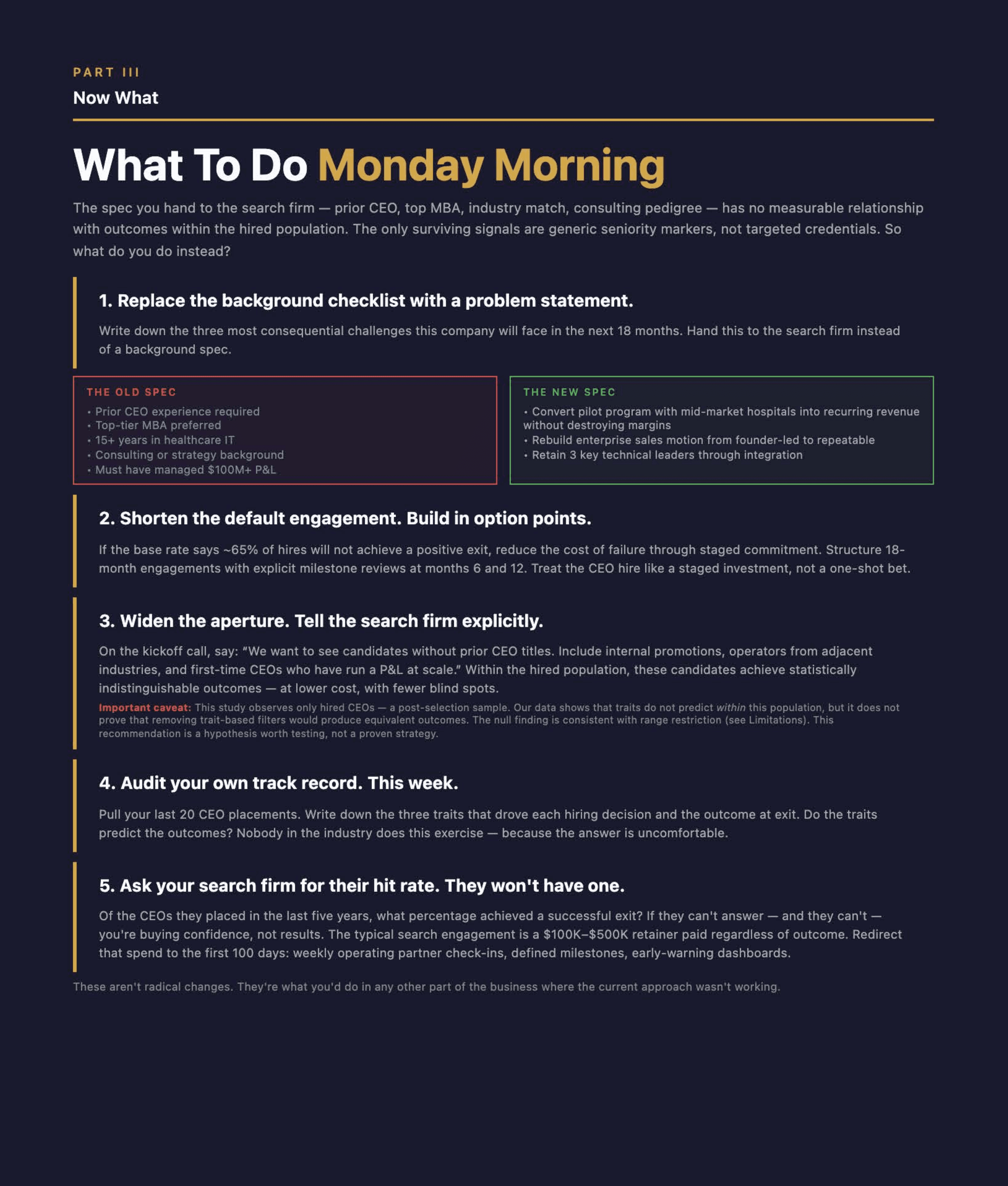
Consider the typical CEO search specification. OLD SPEC: Prior CEO required, Top MBA preferred, 15+ years in healthcare IT. NEW SPEC: Convert pilot program into recurring revenue, rebuild enterprise sales, retain key technical leaders. The old spec describes a person. The new spec describes a problem. This is not a subtle distinction. When you hire for a person template, you are filtering on signals with a d-prime of 0.22. When you hire for a problem match, you are at least asking the question that matters: can this person solve the specific challenge this company faces?
Every additional week your firm spends selecting CEOs based on credential templates is a week of compounding risk. The data does not say your next hire will fail. It says your selection process cannot distinguish the ones who will succeed from the ones who will not. The five steps below are the minimum viable response to that finding.
What the Data Shows
Here are the five steps, each tied directly to a finding from the research:
Step 1: Replace the background checklist with a problem statement. Write down the three most critical problems the portfolio company needs solved in the next 18 months. Make those problems -- not biographical requirements -- the core of the search specification. This forces every candidate evaluation to answer the question that actually matters.
Step 2: Shorten the default engagement and build in option points. The data shows that prior CEO experience does not predict exit success. If your selection accuracy is near chance, de-risk by structuring shorter initial commitments with clear performance milestones. Give yourself the option to course-correct without a full replacement cycle.
Step 3: Widen the aperture. Include candidates without prior CEO titles. Include candidates from adjacent industries. The research shows that neither prior CEO experience nor industry-specific tenure meaningfully predicts exit outcomes. Every candidate you exclude based on these filters is a candidate you are removing for no empirically supported reason.
Step 4: Audit your own track record this week. Pull your last 20 CEO placements. For each one, write down the three traits that drove the hiring decision and the outcome at exit. Look for patterns. Most firms that do this exercise discover that the traits they selected for have no consistent relationship with the outcomes they achieved.
Step 5: Ask your search firm for their hit rate. What percentage of their placed CEOs achieved a successful exit? If they cannot answer -- and they almost certainly cannot -- you are buying confidence, not results. The inability to answer this question is itself a data point about how the industry operates.
The Counterargument
The pushback we hear most is that problem-based specifications are harder to write and harder to evaluate against. That is true. A credential checklist is easy to screen because it reduces a complex judgment to a binary: does the candidate have a prior CEO title or not? Does the candidate have an MBA from a target school or not?
But ease of screening is not the same as quality of screening. A process that is easy to execute and produces random outcomes is not better than a process that is harder to execute and has a chance of producing better outcomes. The question is not whether problem-based selection is more difficult. The question is whether credential-based selection actually works. The data says it does not.
Some will also argue that widening the aperture creates an unmanageable volume of candidates. This concern is valid operationally but backwards strategically. If credentials do not predict outcomes, then the candidate pool is already vastly larger than the industry assumes. You are not creating a larger pool by removing credential filters; you are acknowledging the pool that already exists. The operational challenge of evaluating more candidates is real, but it is a solvable problem -- and it is a better problem to have than systematically excluding candidates who are equally likely to succeed.
What This Means for Your Firm
These five steps are not a complete overhaul of your talent strategy. They are the minimum credible response to what the data shows. Any firm that reads the research and changes nothing is making an explicit bet that the next 20 CEO placements will somehow produce different results than the last 12,174 in the dataset.
- This week: Rewrite your next open CEO specification as a problem statement. Remove every biographical requirement that is not directly tied to a specific, measurable capability
- This month: Pull your track record and calculate your own hit rate. If you have placed 20+ CEOs, you have enough data to see the pattern
- This quarter: Have the conversation with your search partners about their outcome data. The firms that track it will stand out; the firms that do not are telling you something about their confidence in their own process
- Ongoing: Build option points into every CEO engagement. If the selection signal is weak, the correction mechanism needs to be strong
The firms that move first on this will not just make better CEO selections. They will access a candidate pool that their competitors are ignoring -- the first-time CEOs, the adjacent-industry operators, the non-traditional backgrounds that the data says perform no differently than the pedigreed templates everyone else is fighting over.
Get the Full Research Report
This insight is from “From Pedigree to Performance” — the complete analysis of 12,174 CEO appointments. Download the full report with methodology, statistical tables, and recommendations.
Related Insights
Less Than 1% of PE Exit Outcomes Are Explained by CEO Background
The flagship finding: all observable CEO career traits combined explain less than 1% of PE exit variance across 12,174 appointments.
The Question Problem: Why PE's CEO Selection Model Doesn't Work
The industry doesn't have a data problem. It has a question problem. It asks 'Does this person look like a successful CEO?' instead of 'Does looking like one make you one?'
They Stopped Picking by Template: The Closing Argument
The series finale returns to the $180M healthcare IT story. The board didn't pick a better CEO the second time — they stopped picking by template.
Ready to Move Beyond Resume-Based Selection?
See how Verata helps PE firms make better executive hiring decisions with relationship intelligence.