
The MBA's Modest Edge: A 2.6 Percentage Point Gap That Isn't Significant
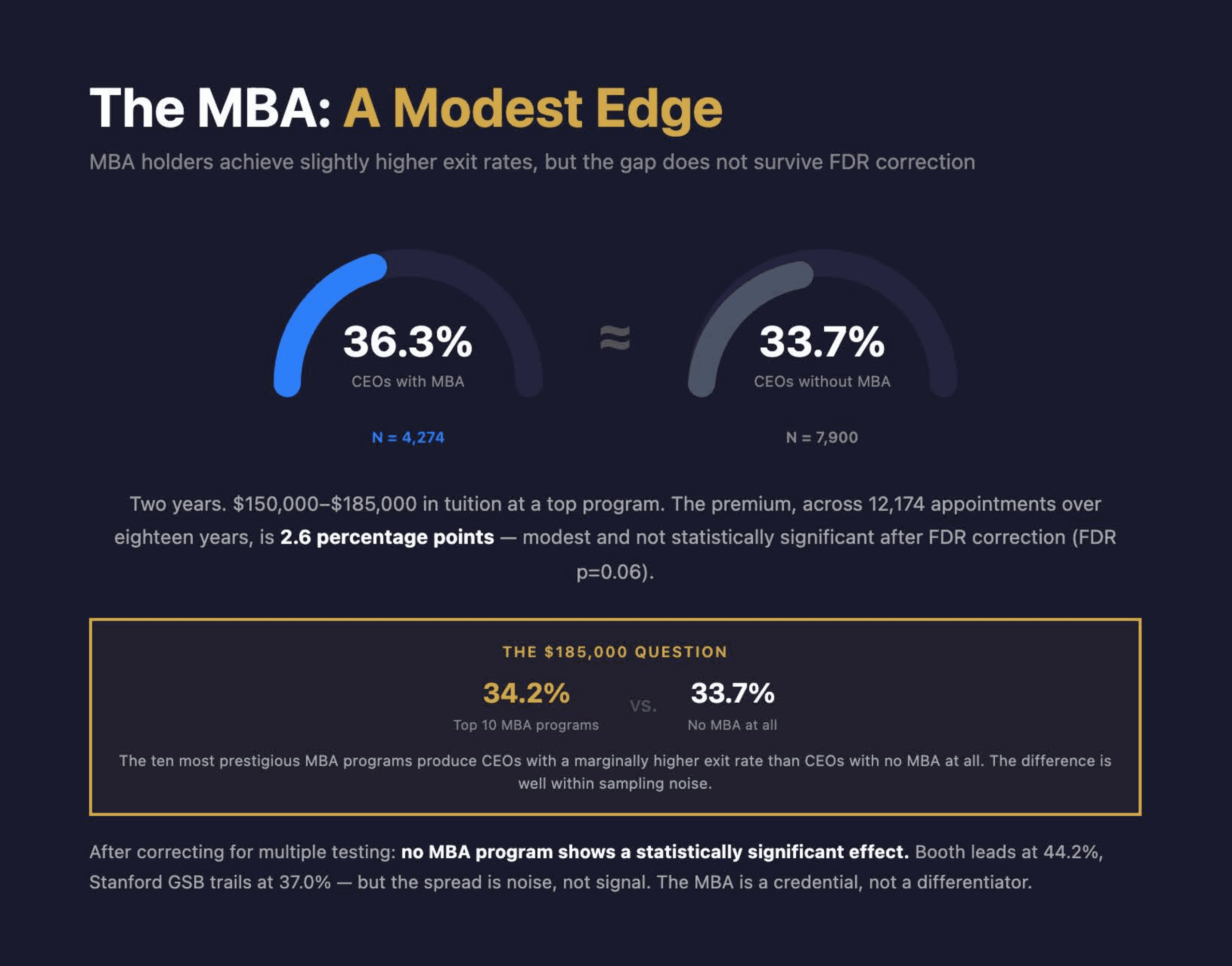
MBA holders achieve 36.3% vs non-MBA 33.7% -- a 2.6pp gap that vanishes under statistical correction. Top 10 MBA programs: 34.2%, barely above no MBA at all.
Verata Research
2025-04-12
In this article
The Finding
MBA-holding CEOs in PE-backed companies achieve successful exits at a rate of 36.3%. Non-MBA CEOs achieve 33.7%. The gap is 2.6 percentage points. At first glance, this looks like a modest but real advantage. Under proper statistical correction, it is not.
The raw odds ratio for MBA is 1.10 (1.02-1.20), which appears nominally significant at the p<0.05 level. But this study tested more than twenty traits simultaneously. When you apply false discovery rate (FDR) correction -- the standard statistical adjustment for multiple comparisons -- the MBA finding does not survive. The adjusted p-value is 0.06, above the conventional threshold. The 2.6 percentage point gap is indistinguishable from what you would expect by chance when testing this many variables.
The finding becomes even more striking when you look at elite MBA programs specifically. CEOs with top-10 MBA degrees -- Harvard, Stanford, Wharton, Booth, Kellogg, and peers -- achieve a 34.2% exit rate. CEOs with no MBA at all achieve 33.7%. The gap between the most elite business education in the world and no business education at all is 0.5 percentage points. That is well within sampling noise.
Why This Matters
The MBA is one of the most deeply embedded credentials in PE CEO selection. It functions as a signaling device -- a shorthand for analytical capability, business acumen, and peer network quality. Search mandates frequently specify 'MBA preferred' or 'top-tier MBA required.' The credential shapes who gets into the candidate funnel in the first place.
The cost of this filtering is substantial and largely invisible. An MBA requirement eliminates a significant portion of the potential talent pool before any evaluation of actual capability occurs. It introduces systematic bias toward a particular demographic and career path. And it does so based on an assumption -- that the credential predicts performance -- that the data does not support.
If this were an investment thesis, no investment committee would approve it. A 2.6 percentage point advantage that is not statistically significant, shrinking to 0.5 percentage points for elite programs, would not clear the evidentiary bar for a capital allocation decision. Yet it routinely clears the bar for one of the most consequential talent decisions a PE firm makes.
What the Data Shows
The data allows us to disaggregate MBA performance by program tier and even by individual school, though individual-school analysis is limited by sample size.
- Any MBA: 36.3% exit rate (OR 1.10, does not survive FDR correction)
- Top-10 MBA: 34.2% exit rate
- Non-top-10 MBA: 37.8% exit rate (higher than top-10, though not significantly)
- No MBA: 33.7% exit rate
Among individual schools with sufficient sample size, the spread is notable but not meaningful. Booth leads at 44.2%. Stanford GSB trails at 37.0%. The spread between the highest-performing and lowest-performing elite programs is larger than the gap between any MBA and no MBA. This is a hallmark of noise, not signal. When the variance within a category exceeds the variance between categories, the category itself is not a useful predictor.
The most elite business education in the world produces a difference you could not distinguish from random chance in a dataset of this size. The MBA is a credential. It is not, by the data, a differentiator of PE exit outcomes.
What This Means for Your Firm
The practical implication is not that MBAs are bad CEO candidates. It is that the MBA credential provides no basis for preferential selection. A CEO with an MBA from a top program is not measurably more likely to deliver a successful exit than a CEO without any MBA at all.
This finding should change how your firm constructs search mandates and evaluates candidates at every stage of the funnel.
- Remove 'MBA preferred' from search mandates unless you can articulate a specific, testable reason why the credential matters for a given role -- not as a proxy for intelligence or capability, but as a direct requirement.
- Stop using MBA program tier as a screening heuristic. The data shows the gap between top-10 MBA and no MBA is 0.5 percentage points. This is not a meaningful filter.
- Redirect evaluation effort. The time and attention spent assessing MBA pedigree in candidate reviews would be better allocated to dimensions the data suggests actually matter -- breadth of general management experience and accumulated years in relevant contexts.
The MBA persists as a selection criterion because it is legible, it is familiar, and it feels like rigor. The data says it is a credential, not a differentiator. The firms that internalize this will access a broader, deeper talent pool while their competitors continue to filter on a signal that is, by the evidence, noise.
Get the Full Research Report
This insight is from “From Pedigree to Performance” — the complete analysis of 12,174 CEO appointments. Download the full report with methodology, statistical tables, and recommendations.
Related Insights
The MBA Doesn't Predict Exit Outcomes
Harvard accounts for 11.9% of all MBA-holding PE-backed CEOs, but MBA holders' 36.3% exit rate is statistically indistinguishable from non-MBA holders' 33.7%.
The Harvard MBA Concentration: 11.9% of All PE-Backed CEO MBAs
HBS alone accounts for 1,584 PE-backed CEOs -- 11.9% of all MBA holders -- yet the top 10 MBA programs produce CEOs with statistically indistinguishable exit rates.
Stanford vs Wharton: The MBA Scale Paradox
Stanford GSB, with half of Wharton's class size, produces 89% as many PE-backed CEOs. Network density matters more than network size.
Related Guides
Ready to Move Beyond Resume-Based Selection?
See how Verata helps PE firms make better executive hiring decisions with relationship intelligence.