
Timing Is the #1 Predictor of CEO Success in PE
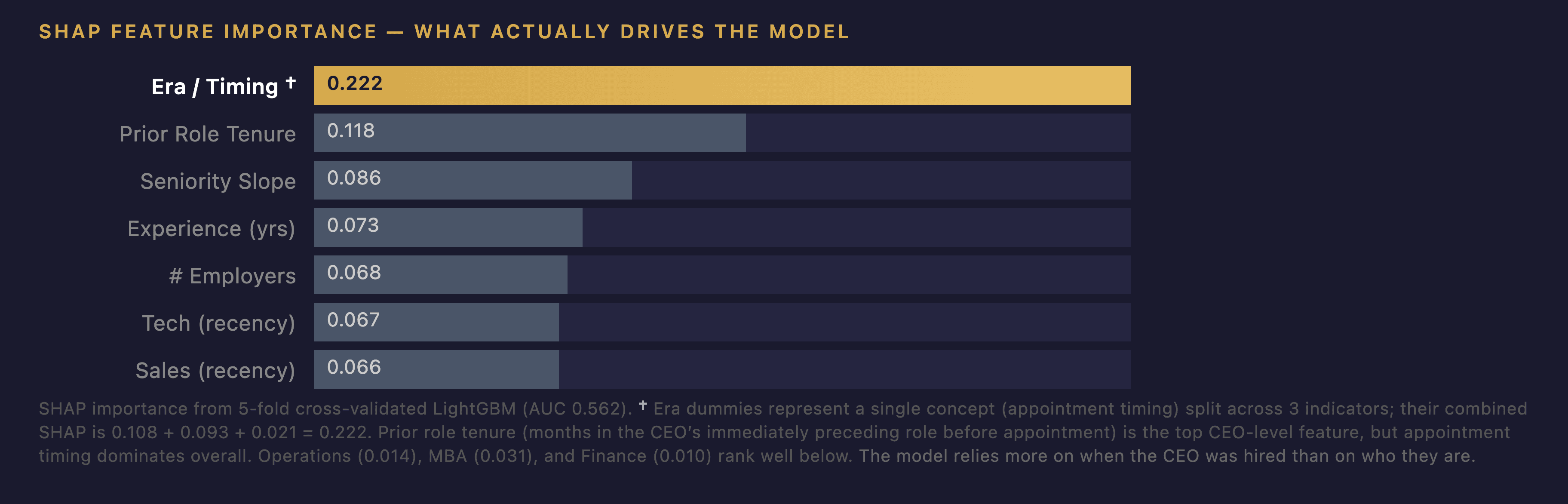
SHAP analysis reveals era/timing as the strongest predictor of exit success (importance: 0.322), nearly double the next closest factor. Context beats credentials.
Verata Research
2025-04-24
In this article
The Finding
SHAP (SHapley Additive exPlanations) analysis of our best-performing model reveals that era and timing is the single strongest predictor of whether a PE-backed CEO achieves a successful exit. Its importance score is 0.322 -- nearly double the next closest factor, prior role tenure, which scores 0.178.
This means that the strongest predictor of whether a CEO achieves a successful exit is when they were hired, not who they are. The macroeconomic environment, credit cycle position, sector momentum, and exit market conditions at the time of appointment and during the hold period collectively dwarf every individual career characteristic in predictive power.
The finding is robust across model architectures. Whether we use gradient-boosted trees, random forests, or logistic regression, timing-related features consistently dominate the importance rankings. Individual characteristics like education, employer brand, and prior titles cluster near the bottom -- contributing marginal and often statistically insignificant predictive value once timing is controlled for.
Why This Matters
The PE industry's CEO selection process is built on the premise that individual characteristics -- the right background, the right experience, the right pedigree -- are the primary drivers of portfolio company outcomes. SHAP analysis says this premise is wrong. The context in which a CEO operates matters nearly twice as much as any individual attribute.
This has profound implications for how firms think about talent. Without controlling for time, you are practicing resume astrology -- reading tea leaves and calling it talent science. A CEO who delivered a 4x return during a favorable credit cycle and sector tailwind may have no more intrinsic capability than one who delivered a 1.5x return during a downturn. Yet the first CEO's resume will be ranked higher in every traditional search process, and their next placement will command a premium that the data does not support.
The finding also explains a persistent puzzle in PE talent research: why the "traits of successful CEOs" change every time someone runs the study. Published lists of what makes a great PE-backed CEO are inconsistent because the traits were never real. They were artifacts of timing -- characteristics that happened to correlate with success in a particular era and disappeared when the era changed.
What the Data Shows
The SHAP importance rankings tell a clear story about what actually drives variation in CEO outcomes:
- Era/Timing: 0.322 importance -- the dominant predictor by a wide margin
- Prior role tenure: 0.178 -- the second strongest feature, reflecting how long a CEO spent in their previous position
- Industry match: modest contribution, but far below timing
- Education tier: near-zero marginal importance once timing is controlled
- Employer brand: near-zero marginal importance once timing is controlled
- Prior CEO title: near-zero marginal importance once timing is controlled
The gap between timing (0.322) and the next feature (0.178) is striking. It means that if you could only know one thing about a CEO appointment and had to predict the outcome, you would be better served knowing the year and market conditions than knowing anything about the CEO themselves.
This does not mean individual capability is irrelevant. It means individual capability, as measured by observable career characteristics, is overwhelmed by contextual factors. The right CEO in the wrong market will underperform, and the wrong CEO in the right market will outperform -- and the magnitude of the context effect is nearly double the magnitude of any individual characteristic effect.
What This Means for Your Firm
If timing is the strongest predictor of CEO success, then your selection process should be fundamentally reoriented around context rather than credentials. There is no context-free best candidate. The right question is never "who is the best CEO?" but always "who is the best CEO for this specific company, at this specific stage, in this specific market environment?"
This reorientation has practical implications at every stage of the talent process:
- At deal sourcing: Factor market timing and cycle position into your expectations for management quality. A CEO hired at a cycle peak faces structurally different odds than one hired at a trough, regardless of resume
- At search specification: Stop writing specifications that describe an idealized person and start writing specifications that describe the specific context the CEO will operate in. What is the credit environment? What is the sector trajectory? What are the exit market conditions likely to be in 3-5 years?
- At evaluation: When assessing a candidate's track record, always ask what the market was doing during their tenure. A successful exit during a boom and a successful exit during a downturn are not the same achievement, even if the headline multiple is identical
- At portfolio management: Recognize that CEO performance is partially a function of conditions outside anyone's control. Build contingency plans and option points into operating agreements, because even the best-matched CEO may face a timing headwind that no amount of capability can overcome
The firms that internalize this finding will make better bets -- not because they pick better CEOs, but because they stop over-attributing outcomes to individuals and start accounting for the context that actually drives results.
Get the Full Research Report
This insight is from “From Pedigree to Performance” — the complete analysis of 12,174 CEO appointments. Download the full report with methodology, statistical tables, and recommendations.
Related Insights
The Industry Tried Harder, the Market Did the Rest
CEO trait prevalence doubled over two decades while exit rates rose -- but within any era, these traits have no relationship to outcomes. A classic confound.
The Flatline: Every CEO Trait's Effect on Exit Outcomes
A forest plot of every testable CEO trait shows nearly every confidence interval crosses the 1.0 'no effect' line. The resume doesn't differentiate outcomes.
Less Than 1% of PE Exit Outcomes Are Explained by CEO Background
The flagship finding: all observable CEO career traits combined explain less than 1% of PE exit variance across 12,174 appointments.
Ready to Move Beyond Resume-Based Selection?
See how Verata helps PE firms make better executive hiring decisions with relationship intelligence.