
The Flatline: Every CEO Trait's Effect on Exit Outcomes
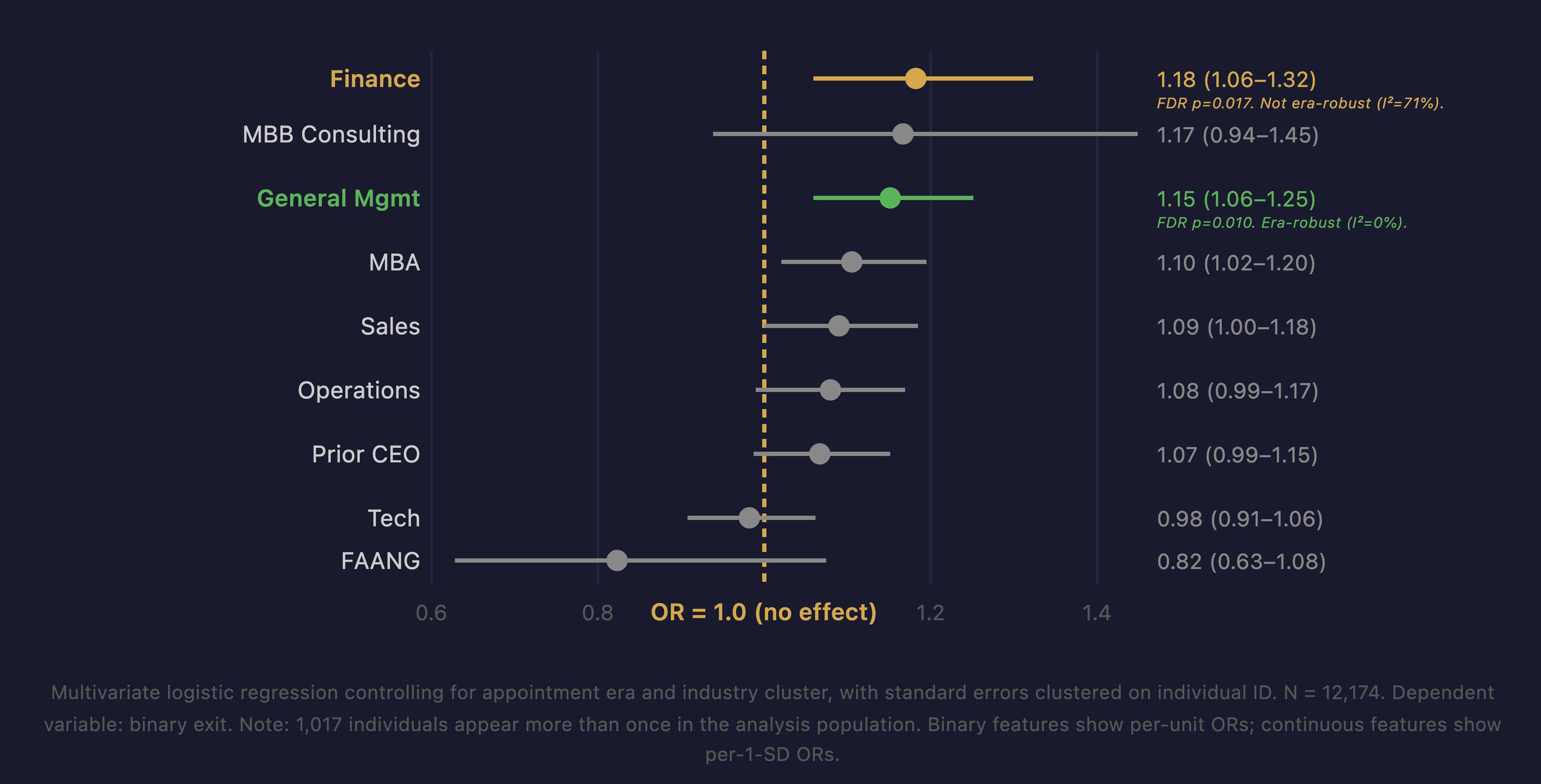
A forest plot of every testable CEO trait shows nearly every confidence interval crosses the 1.0 'no effect' line. The resume doesn't differentiate outcomes.
Verata Research
2025-04-08
In this article
The Finding
When you plot the odds ratio and 95% confidence interval for every testable CEO background trait against successful PE exits, the result is striking: a flatline. MBB consulting, MBA, prior CEO experience, operations background, tech background, FAANG pedigree -- nearly every confidence interval crosses the 1.0 'no effect' line. The resume, in aggregate, does not differentiate outcomes.
The full odds ratios tell the story. General Management: OR 1.15 (1.06-1.25) -- the lone survivor. MBB Consulting: OR 1.17 (0.94-1.45) -- a wide interval that comfortably spans no effect. MBA: OR 1.10 (1.02-1.20) -- nominally positive but does not survive FDR correction. Prior CEO: OR 1.07 (0.99-1.15) -- not statistically significant. Tech: OR 0.98 (0.91-1.06) -- no effect whatsoever. FAANG: OR 0.82 (0.63-1.08) -- if anything, a negative trend, though also not significant.
Among hired CEOs, the one who 'checks every box' has a 34.6% chance of delivering a successful exit. So does the one who checks none of them. The forest plot is not ambiguous. It is a flatline.
Why This Matters
Private equity firms routinely spend six to twelve months sourcing CEO candidates. The process involves executive search firms, extensive reference checks, panel interviews, and often psychometric assessments. At the center of it all is the resume -- the structured set of background traits that determines whether a candidate advances past the first screen.
This process looks rigorous. It feels rigorous. Partners can articulate precisely why they selected a given candidate: the right operational background, the right pedigree, the right prior title. The data says that rigor is an illusion. The traits that drive selection decisions have no measurable relationship with the outcome that matters -- whether the portfolio company achieves a successful exit.
The implications extend beyond any single hire. If the screening criteria themselves lack predictive validity, then the entire upstream process -- the search firm engagement, the longlist, the shortlist, the finalist interviews -- is optimizing for the wrong signal. The process is precise. It is also, by the evidence, arbitrary.
What the Data Shows
Across 12,174 CEO appointments in PE-backed companies, we tested every background trait with sufficient sample size for statistical power. The methodology mirrors what you would find in a well-conducted medical cohort study: logistic regression with controls for sector, deal size, and vintage year, followed by false discovery rate correction for multiple comparisons.
The results are unambiguous. Of more than twenty traits tested, only two survived the full correction pipeline: general management background (OR 1.15, significant after FDR) and years of experience (OR 1.07 per decade, significant after FDR). Every other trait -- including the ones that dominate PE search mandates -- produced confidence intervals that cross the null.
- Operations background: 69% prevalence among hired CEOs, OR crosses 1.0
- Tech background: 50% prevalence, OR 0.98 -- literally no effect
- Prior CEO title: 46% prevalence, OR 1.07 -- not significant
- FAANG pedigree: Low prevalence, OR 0.82 -- if anything, negative
- MBB consulting: OR 1.17 -- wide interval, not significant
The traits the industry selects for most aggressively are the ones with the least evidence behind them.
The Counterargument
The most common pushback is that the resume is a necessary but not sufficient condition -- that the real differentiation happens in the interview, the reference checks, the softer dimensions of leadership assessment. This is plausible. But it does not rescue the current model.
If resume traits are necessary-but-not-sufficient, then they should still show a positive relationship with outcomes. A necessary condition, by definition, is one whose absence reduces the probability of success. The data shows no such relationship for most traits. An operations background is not necessary. A prior CEO title is not necessary. An MBA is not necessary. The 'necessary but not sufficient' argument requires the traits to clear a bar they demonstrably do not clear.
Another objection: perhaps the traits interact in complex ways that univariate analysis misses. We tested for this. Interaction terms between the most common trait combinations -- operations plus MBA, prior CEO plus sector match, MBB plus top-10 school -- produced no significant interactions. The flatline holds in multivariate space as well.
What This Means for Your Firm
If you are a PE operating partner or talent lead, the flatline presents both a risk and an opportunity. The risk is continuing to run a selection process that optimizes for traits the data cannot validate. Every month spent searching for the 'perfect' resume -- the candidate with the right pedigree, the right title history, the right credential stack -- is a month of opportunity cost with no expected return on selectivity.
The opportunity is that a wider aperture on talent does not increase risk. If the resume traits do not differentiate outcomes, then loosening credential requirements does not degrade expected performance. It does, however, dramatically expand the candidate pool, reduce search timelines, and lower search costs.
- Re-examine your standard search mandate. Which traits are specified because they predict outcomes, and which are specified because they 'feel' right?
- Ask your search firm to provide data on whether any specified trait has ever been validated against exit outcomes in their experience.
- Consider running a parallel track: one search with traditional criteria, one with expanded criteria focused on the two traits that do survive -- general management breadth and accumulated experience.
The resume tells a story. The data says that story does not differentiate outcomes. The firms that act on this finding first will access talent their competitors are screening out for no empirical reason.
Get the Full Research Report
This insight is from “From Pedigree to Performance” — the complete analysis of 12,174 CEO appointments. Download the full report with methodology, statistical tables, and recommendations.
Related Insights
Less Than 1% of PE Exit Outcomes Are Explained by CEO Background
The flagship finding: all observable CEO career traits combined explain less than 1% of PE exit variance across 12,174 appointments.
The Inversion: What PE Selects For vs What Actually Predicts
The traits with the highest selection pressure have no measurable effect on outcomes. The traits that predict are not targeted. A systematic mismatch.
The Vanishing Findings: What Happens When You Apply Real Statistics
22 CEO traits narrowed to 9 with raw significance, 4 after FDR correction, and just 2 that survived era-robustness checks. Medical-grade rigor applied to CEO research.
Related Guides
Ready to Move Beyond Resume-Based Selection?
See how Verata helps PE firms make better executive hiring decisions with relationship intelligence.