
BYU Equals Princeton: The Undergraduate Pipeline Isn't What You Think
BYU has produced as many PE-backed CEOs as Princeton (333 each), challenging the narrow pipeline assumptions that dominate executive search.
Verata Research
2025-03-19
In this article
The Finding
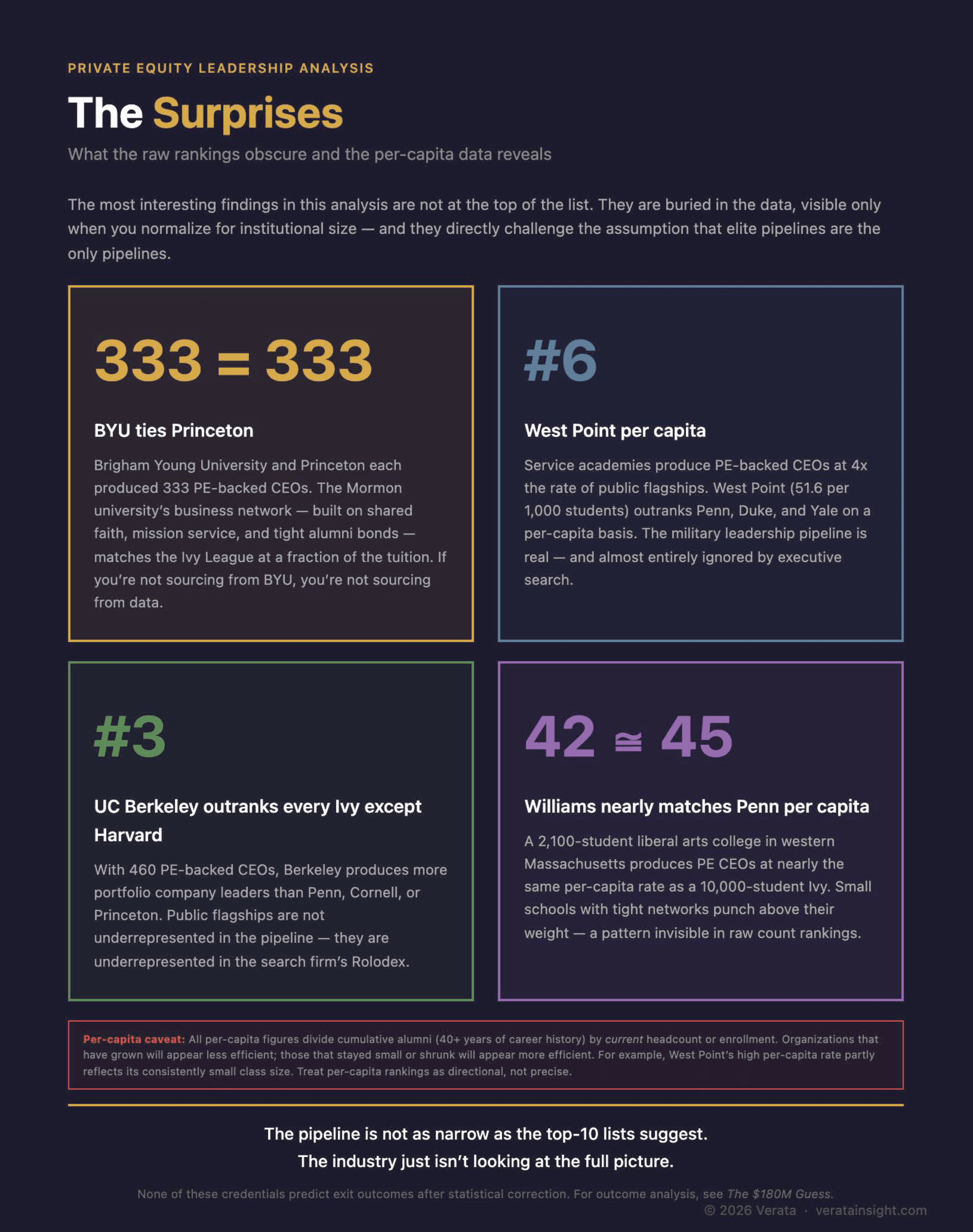
Brigham Young University and Princeton University have each produced exactly 333 PE-backed CEOs in a dataset of 47,643 CEO appointments drawn from 3,100+ undergraduate institutions. A Mormon university in Provo, Utah -- with annual tuition under $7,000 for LDS members -- has matched one of the most prestigious universities in the world in raw CEO production for private equity-backed companies.
This is not a rounding error or a statistical fluke. BYU's business network, forged through a combination of the Marriott School of Business, the LDS Church's global professional network, and an unusually cohesive alumni community, has produced a CEO pipeline that matches the Ivy League in absolute volume. UC Berkeley, ranked #3 in total CEO production, outranks every Ivy League school except Harvard. The undergraduate pipeline feeding PE-backed CEO roles is far broader, more diverse, and more distributed than the industry's search specifications assume.
And none of it matters for predicting outcomes. Undergraduate institution -- whether Ivy League, public flagship, or religiously affiliated -- does not predict exit success. The industry is not just looking in the wrong places. It is looking for the wrong things.
Why This Matters
Executive search specifications for PE-backed CEO roles routinely include undergraduate education as a screening criterion, either explicitly ("top-tier undergraduate institution preferred") or implicitly through the pattern-matching that dominates candidate evaluation. When an operating partner reviews a candidate slate, a Princeton degree registers as a quality signal. A BYU degree does not carry the same automatic weight -- despite producing the identical number of PE-backed CEOs.
This matters because it reveals a structural bias in how the industry sources talent. Search firms build candidate databases and alumni networks that skew heavily toward a narrow set of 20-30 "target" universities. Candidates from institutions outside that set are systematically under-sourced, under-contacted, and under-considered. The result is not just an unfair process -- it is an inefficient one. If the goal is to identify the largest possible pool of qualified CEO candidates, the industry is leaving enormous pools untapped because they do not fit a credentialing template that has no predictive value.
The BYU-Princeton equivalence is a single data point, but it represents a broader pattern. 3,100+ institutions have produced at least one PE-backed CEO. The talent pool is distributed across the entire higher education landscape, not concentrated in the 15-20 schools that dominate search specifications.
What the Data Shows
The undergraduate pipeline analysis maps 47,643 CEO appointments against 3,100+ undergraduate institutions. The raw volume rankings reveal several surprises that challenge conventional pipeline assumptions:
- Harvard leads in absolute volume, as expected
- BYU and Princeton are tied at 333 CEOs each
- UC Berkeley ranks #3 overall, ahead of every Ivy except Harvard
- Williams College, a small liberal arts school, nearly matches Penn's per-capita production rate
- West Point ranks #6 in per-capita CEO production, ahead of Penn, Duke, and Yale
The per-capita analysis is particularly revealing. When you normalize for student body size, the rankings shift dramatically. Small schools with strong professional networks (Dartmouth, MIT, Williams) punch far above their weight. Large public universities that produce high volumes in absolute terms (Michigan, Texas, Virginia) have lower per-capita rates but still contribute significantly to the total pipeline.
The critical finding, however, is what happens when you test whether any of these credentials predict exit outcomes. They do not. Ivy League undergraduate education does not predict positive exits. Non-Ivy education does not predict negative exits. The entire undergraduate prestige hierarchy, which absorbs enormous attention in candidate evaluation, carries zero predictive weight for the outcome that matters.
The industry has been narrowing its aperture around signals that do not differentiate performance -- and in doing so, it has systematically excluded candidates from institutions that produce CEOs at rates comparable to or exceeding the "target" schools.
What This Means for Your Firm
If your search specifications include language about "top-tier undergraduate institution" or if your search partners disproportionately source from a narrow set of 20-30 elite schools, you are operating with an artificially constrained pipeline that provides no measurable improvement in outcomes.
The practical implications are direct:
- Expand your sourcing universe. BYU, UC Berkeley, West Point, Michigan, and dozens of other institutions produce PE-backed CEOs at volumes and rates comparable to the traditional "target" schools. If your search partners are not sourcing from these networks, you are missing candidates.
- Eliminate undergraduate institution as a screening criterion. Whether a candidate attended Princeton or BYU has no bearing on whether they will deliver a successful exit. Using undergraduate prestige as a filter narrows your pool without improving your odds.
- Leverage non-traditional networks. The BYU finding highlights the power of community-based professional networks -- LDS business networks, military academy alumni, large public university systems -- that operate outside the traditional search firm ecosystem. These networks are often tighter, more responsive, and more willing to facilitate introductions than the over-fished Ivy League networks that every search firm targets.
- Ask better questions about education. Instead of asking "where did they go to school?", ask "what did they learn, and does it map to what this portfolio company needs?" A BYU graduate who spent 15 years building and scaling healthcare IT platforms is a stronger CEO candidate for a healthcare IT portfolio company than a Princeton graduate who spent 15 years in strategy consulting -- regardless of what the credential template says.
A Mormon university's business network matches the Ivy League at a fraction of the tuition. The data is telling the industry something important about where talent actually comes from. The question is whether the industry is listening.
Get the Full Research Report
This insight is from “From Pedigree to Performance” — the complete analysis of 12,174 CEO appointments. Download the full report with methodology, statistical tables, and recommendations.
Related Insights
Where PE-Backed CEOs Earned Their Degrees: The Surprises
87% of PE-backed CEOs went to schools outside the top 10. Harvard leads at just 1.77%, and UC Berkeley outranks every Ivy except Harvard.
The West Point Pipeline: Military Academies Outproduce the Ivy League Per Capita
West Point ranks #6 in producing PE-backed CEOs per capita at 51.6 per 1,000 students -- higher than Penn, Duke, and Yale.
The MBA Doesn't Predict Exit Outcomes
Harvard accounts for 11.9% of all MBA-holding PE-backed CEOs, but MBA holders' 36.3% exit rate is statistically indistinguishable from non-MBA holders' 33.7%.
Ready to Move Beyond Resume-Based Selection?
See how Verata helps PE firms make better executive hiring decisions with relationship intelligence.