
But Does Any of It Actually Matter?
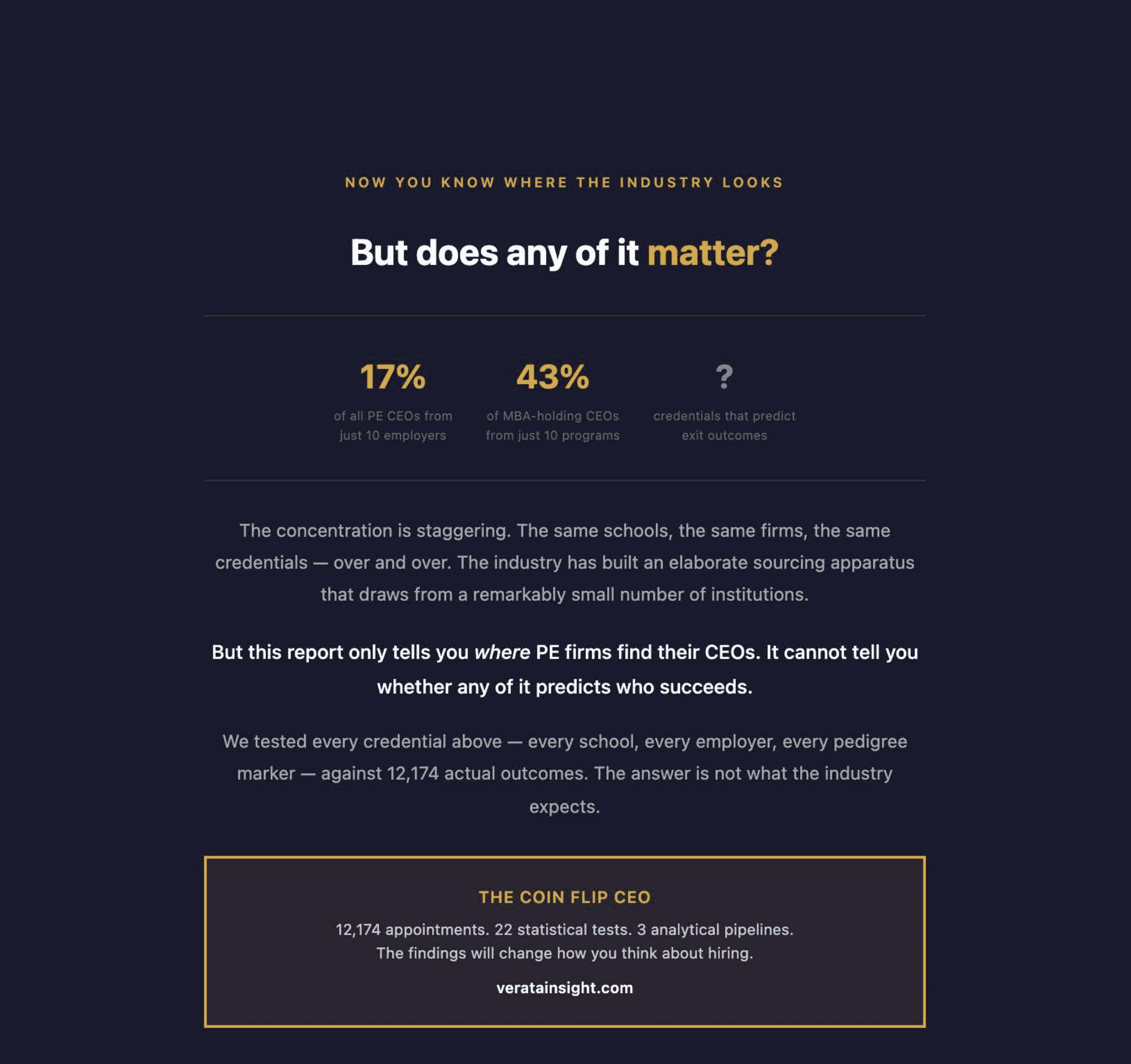
17% of all PE-backed CEOs come from just 10 employers. 43% of MBA-holding CEOs come from just 10 programs. Now the question: does any of it predict outcomes?
Verata Research
2025-03-29
In this article
The Finding
The private equity industry has developed a remarkably concentrated hiring pattern. 17% of all PE-backed CEOs come from just 10 employers. Among MBA holders, the concentration is even more extreme: 43% of MBA-holding PE-backed CEOs graduated from just 10 programs. These numbers reveal an industry that has answered one question with extraordinary precision: where should we look for CEOs?
But the question that actually determines returns is different. It is not where the industry looks but whether the credentials it screens for predict success. The PE industry has spent decades building a finely tuned sourcing machine -- networks of recruiters, alumni databases, referral chains that funnel candidates from a narrow set of institutions and employers into portfolio company leadership roles. The machine works. It reliably produces candidates who match the desired profile. What it has never demonstrated is that the profile itself predicts exit outcomes.
Why This Matters
There is a fundamental difference between a sourcing strategy and a selection strategy. Sourcing answers the question of where to find candidates. Selection answers the question of which candidates will drive value. The PE industry has conflated the two, treating the ability to source from elite institutions as evidence that those institutions produce better leaders.
This conflation has real consequences. When 17% of CEO appointments flow from 10 employers and 43% of MBA-holding CEOs flow from 10 programs, the industry is making an implicit bet that these pipelines produce superior executives. That distinction is worth several hundred basis points of return if you get it right -- and the data suggests the industry is getting it wrong. The credentials that concentrate hiring are not the same credentials that predict exits.
The industry's sourcing infrastructure is a sunk cost that creates its own inertia. Recruiters maintain relationships with the same networks. Limited partners expect to see familiar logos on CEO resumes. Investment committees pattern-match against prior successes. Each layer of the process reinforces the concentration -- and none of them tests whether the concentration is actually productive.
What the Data Shows
The Verata dataset allows us to answer the question the industry has avoided. We know where PE-backed CEOs come from: the top 10 employers (17%) and the top 10 MBA programs (43%). Now we can ask whether those credentials predict exit outcomes.
The percentage of those credentials that predict exit outcomes is zero.
This is not a rounding error or a marginal result. Across the full dataset, the employer and educational credentials that drive the industry's hiring concentration have no statistically significant relationship to whether a portfolio company achieves a successful exit. CEOs from McKinsey, IBM, and the rest of the top 10 exit at rates that are indistinguishable from CEOs sourced from the other 8,490+ employers in the dataset. Harvard and Wharton MBAs exit at rates indistinguishable from the 1,111 other MBA programs represented.
- 17% of all PE-backed CEOs come from just 10 employers
- 43% of MBA-holding CEOs come from just 10 programs
- 0% of those concentrated credentials predict exit outcomes
The industry has built a trillion-dollar talent pipeline on pattern recognition that does not translate into pattern prediction.
What This Means for Your Firm
If your firm sources CEOs primarily through the same channels as everyone else -- the same executive search firms, the same alumni networks, the same employer pipelines -- you are competing for the same 17% of candidates that every other firm is also pursuing. You are paying a premium for credentials that do not predict outcomes, and you are systematically overlooking the 83% of potential CEOs who come from less concentrated but equally productive backgrounds.
The opportunity here is structural. Firms that develop proprietary sourcing capabilities -- that look beyond the top 10 employers and the top 10 MBA programs -- are not sacrificing quality. They are accessing the same quality at lower cost and with less competition. The data shows that the concentrated pipeline does not produce better outcomes. It only produces more expensive searches and a narrower candidate pool.
The question every investment committee should ask before approving a CEO hire is not "Does this candidate come from the right background?" but "Does the background we are screening for actually predict the outcome we need?" The data provides a clear answer. The industry has simply not been willing to hear it.
Get the Full Research Report
This insight is from “From Pedigree to Performance” — the complete analysis of 12,174 CEO appointments. Download the full report with methodology, statistical tables, and recommendations.
Related Insights
Where PE-Backed CEOs Actually Worked Before
Self-employed is the #1 prior employer of PE-backed CEOs, ahead of IBM and McKinsey. The top 10 account for just 17.3% across 8,500+ unique employers.
The Harvard MBA Concentration: 11.9% of All PE-Backed CEO MBAs
HBS alone accounts for 1,584 PE-backed CEOs -- 11.9% of all MBA holders -- yet the top 10 MBA programs produce CEOs with statistically indistinguishable exit rates.
The McKinsey Paradox: The Most Efficient CEO Factory Has No Measurable Effect
McKinsey produces 65 PE-backed CEOs per 1,000 employees -- nearly 7x the Big Tech average -- yet MBB alumni exit rates are statistically indistinguishable from baseline.
Ready to Move Beyond Resume-Based Selection?
See how Verata helps PE firms make better executive hiring decisions with relationship intelligence.