
The Industry Tried Harder, the Market Did the Rest
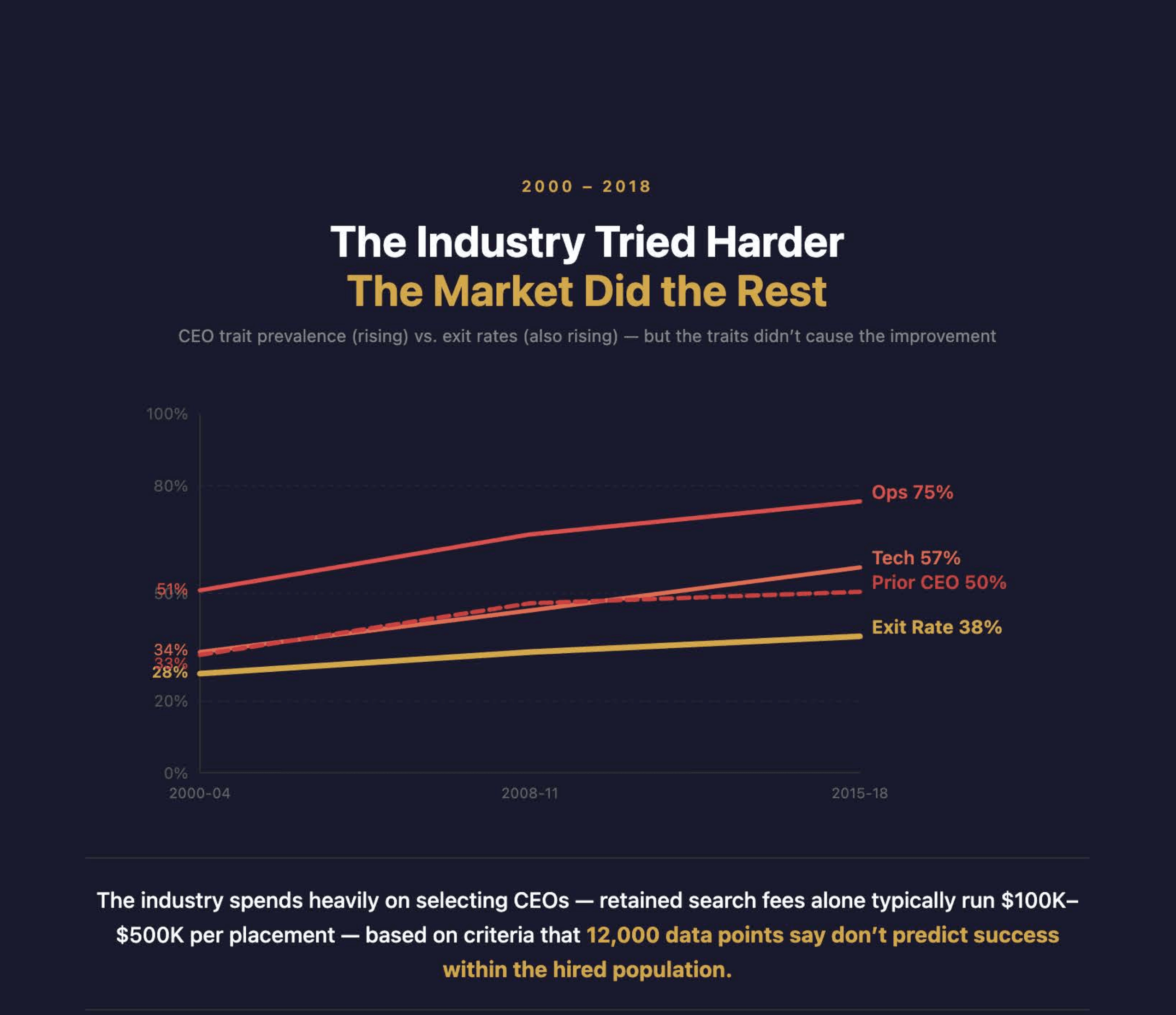
CEO trait prevalence doubled over two decades while exit rates rose -- but within any era, these traits have no relationship to outcomes. A classic confound.
Verata Research
2025-03-27
In this article
The Finding
Over the past two decades, the private equity industry has dramatically shifted its CEO hiring criteria -- and the numbers tell a striking story. Operations backgrounds surged from 28% to 75% of PE-backed CEO appointments. Technology backgrounds climbed from 25% to 57%. Prior CEO experience went from 34% to 50%. These are not marginal shifts; they represent a wholesale transformation of what the industry considers a qualified portfolio company leader.
At the same time, exit rates rose from 28% to 38%. On the surface, this looks like validation: the industry refined its hiring criteria, and outcomes improved. But this narrative collapses under scrutiny. Within any given era, these traits have no relationship to exit outcomes. The rising tide lifted all boats -- credentialed and uncredentialed alike. What changed was the market environment, not the predictive power of the credentials being selected for.
Why This Matters
This is a textbook example of a confounding variable -- and the PE industry has been running its hiring model on it for two decades. When two trends move in the same direction over time, it is tempting to assume one caused the other. Operations-heavy CEOs became more prevalent. Exit rates improved. Therefore, operations backgrounds drive exits. The logic feels airtight until you control for the variable that actually changed: the market itself.
The implications are enormous. If the industry's hiring frameworks are built on a confound, then the entire executive search apparatus -- the specification sheets, the candidate scorecards, the pattern-matching that narrows thousands of potential leaders down to a handful of finalists -- is optimizing for the wrong signal. Firms are paying premium fees to identify candidates who match a profile that correlates with success only because both the profile and success correlate with time.
This is not an academic distinction. It is a capital allocation problem. Every CEO search that screens out non-traditional candidates because they lack an operations background or prior C-suite experience is narrowing the funnel based on criteria that have no within-era predictive validity. The opportunity cost of those filtered-out candidates is invisible but real.
What the Data Shows
The Verata dataset allows us to test this directly. A predictive model trained on pre-2015 CEO appointment data -- using the full suite of background characteristics that the industry selects for -- was tested against 2015-2018 exit outcomes. The model's AUC ranged from 0.518 to 0.523. For context, an AUC of 0.50 is pure coin-flip randomness. The industry's preferred CEO traits, rigorously measured and modeled, are statistically indistinguishable from guessing.
This result is not driven by a lack of data or a poorly specified model. It reflects a fundamental reality: the traits the industry screens for do not carry forward predictive power across market regimes. A CEO profile that "worked" in 2005 worked because the 2005 market rewarded nearly everyone, not because the profile itself was uniquely suited to value creation.
- Operations background prevalence: 28% (2000) to 75% (2018)
- Technology background prevalence: 25% (2000) to 57% (2018)
- Prior CEO experience: 34% (2000) to 50% (2018)
- Exit rates across the same period: 28% to 38%
- Predictive model AUC on out-of-sample data: 0.518-0.523
The industry spent two decades doubling down on the same credentials. The market got better. The selection criteria did not.
The Counterargument
The obvious pushback is that the convergence toward operations-heavy, experienced CEOs reflects genuine learning. Perhaps these traits do matter, and the industry's increasing emphasis on them is why exit rates improved. The problem with this argument is that it fails the most basic test of causation: within any single time window, the traits do not predict which companies exit and which do not.
If operations backgrounds genuinely drove exits, we would expect to see a measurable difference in outcomes between operations-background CEOs and non-operations-background CEOs within each era. We do not. The trait prevalence and the exit rate both rose because the same underlying force -- a favorable market environment, increasing institutional sophistication, and growing dry powder -- drove both trends simultaneously.
Another counterargument is that the model's low AUC reflects noisy data rather than a genuine absence of signal. But the dataset is large (tens of thousands of appointments), the traits are measured consistently, and the result replicates across multiple model specifications. The signal is not hiding in the noise. It is not there.
What This Means for Your Firm
If your firm's CEO search process starts with a specification sheet that emphasizes operations backgrounds, prior CEO experience, and technology fluency, you are describing the median PE-backed CEO of the last decade -- not a differentiated leader. Context matters more than individual pedigree. Timing beats talent on paper.
The actionable takeaway is not that credentials are irrelevant. It is that they are table stakes that have been mistaken for differentiators. The industry has converged on a hiring profile that feels rigorous but lacks predictive power. Firms that recognize this have an opportunity to widen their aperture, evaluate candidates on dimensions that actually vary with outcomes, and build a structural advantage in the one lever that matters most to portfolio returns: who runs the company.
The firms that will outperform in the next decade are not the ones that find the best-credentialed CEO. They are the ones that abandon the credential-driven model entirely and replace it with something that actually predicts results.
Get the Full Research Report
This insight is from “From Pedigree to Performance” — the complete analysis of 12,174 CEO appointments. Download the full report with methodology, statistical tables, and recommendations.
Related Insights
The Flatline: Every CEO Trait's Effect on Exit Outcomes
A forest plot of every testable CEO trait shows nearly every confidence interval crosses the 1.0 'no effect' line. The resume doesn't differentiate outcomes.
Timing Is the #1 Predictor of CEO Success in PE
SHAP analysis reveals era/timing as the strongest predictor of exit success (importance: 0.322), nearly double the next closest factor. Context beats credentials.
The Dilution Effect: When Everyone Has the Credential, No One Does
Prior CEO experience grew from 34% to 50% prevalence over 18 years -- and its predictive power dropped to zero. The FICO analogy breaks down: the inputs themselves lack signal.
Ready to Move Beyond Resume-Based Selection?
See how Verata helps PE firms make better executive hiring decisions with relationship intelligence.