
The McKinsey Paradox: The Most Efficient CEO Factory Has No Measurable Effect
McKinsey produces 65 PE-backed CEOs per 1,000 employees -- nearly 7x the Big Tech average -- yet MBB alumni exit rates are statistically indistinguishable from baseline.
Verata Research
2025-03-17
In this article
The Finding
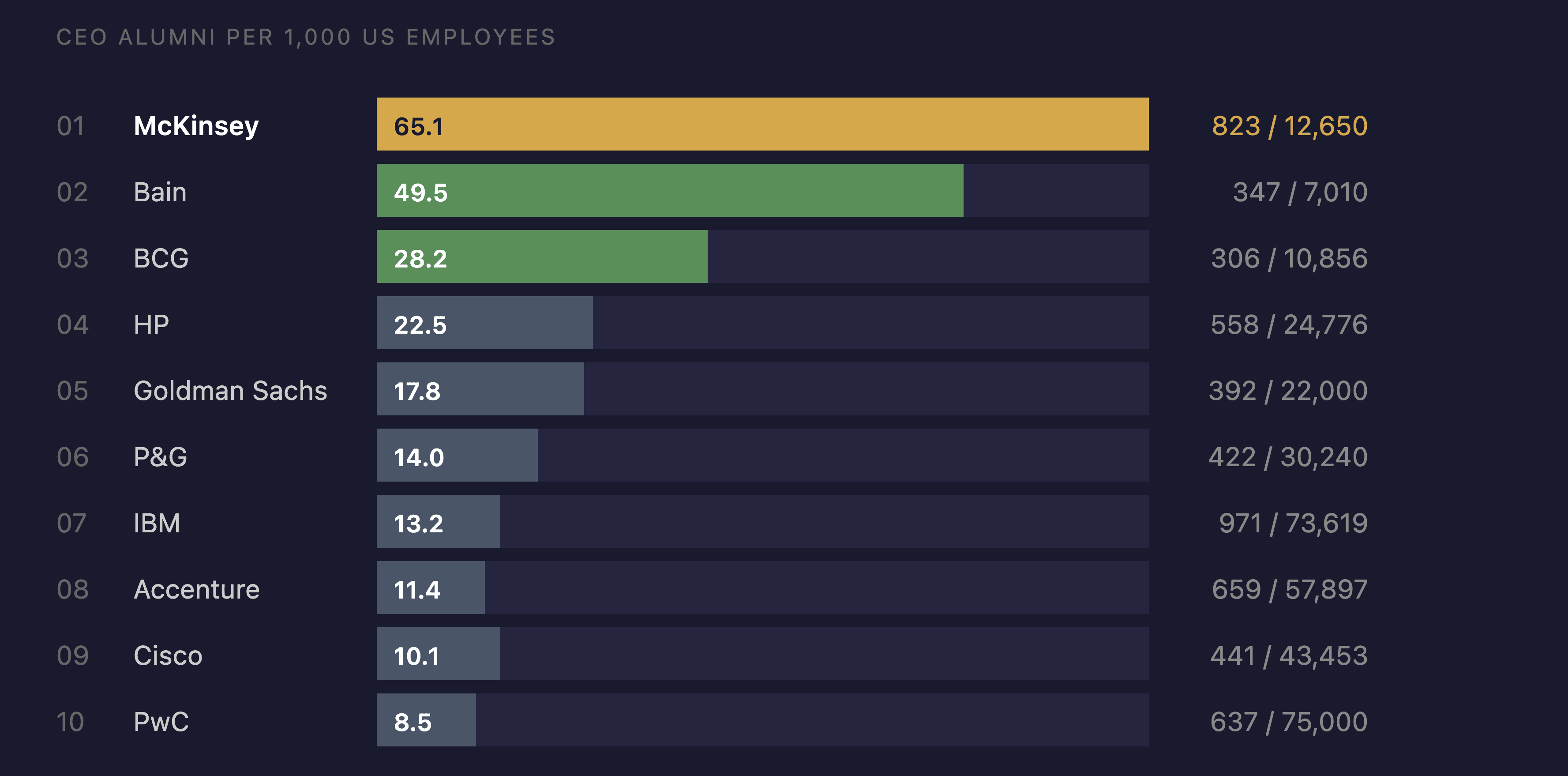
McKinsey & Company produces 65 PE-backed CEOs per 1,000 employees -- the highest concentration rate of any employer in the dataset. Across the MBB firms collectively, the average is 48 CEOs per 1,000 staff, nearly 7x the Big Tech average of 7 per 1,000. By any measure of pipeline efficiency, the elite management consulting firms are the most prolific CEO factories in the private equity ecosystem. McKinsey alone accounts for over 800 PE-backed CEOs in our dataset of 47,643 appointments across 8,500+ unique employers.
And yet, when you test whether MBB alumni actually perform better as PE-backed CEOs, the answer is no. The MBB consulting background variable produces an odds ratio of 1.17 with a 95% confidence interval spanning 0.94 to 1.45. The interval crosses 1.0, meaning we cannot rule out zero effect. After Benjamini-Hochberg correction for multiple testing, the result is not statistically significant. The most efficient CEO factory in private equity has no measurable effect on exit outcomes.
This is the McKinsey Paradox: the firm that produces the most PE-backed CEOs per capita does not produce better ones. The industry has been confusing concentration with quality -- and paying a premium for the confusion.
Why This Matters
The MBB pedigree occupies a uniquely privileged position in PE CEO selection. McKinsey, Bain, and BCG alumni are over-represented not just in candidate slates but in the mental models of the partners who build those slates. The logic seems self-evident: these firms select for analytical rigor, train structured problem-solving, expose consultants to dozens of industries and operating contexts, and create alumni networks that span every major sector of the economy. If any employer credential should predict CEO success, MBB experience seems like the strongest candidate.
The data shows that this intuition, however reasonable, does not translate into measurable outcomes. The concentration of MBB alumni in PE CEO roles reflects the efficiency of the MBB-to-PE pipeline -- the network effects, the search firm relationships, the cultural familiarity between consulting and private equity. It does not reflect a causal relationship between consulting training and CEO performance. Appointment frequency is not outcome prediction. Concentration is not causation.
This matters because the MBB filter narrows the candidate aperture in ways that are costly and invisible. When an operating partner defaults to "let's start with candidates who have McKinsey or Bain on their resume," the firm is not selecting for better outcomes. It is selecting for a familiar network -- and excluding candidates from less conventional pathways who may be equally or more capable.
What the Data Shows
The employer concentration analysis draws from the full dataset of 47,643 CEO appointments and maps each CEO's prior employer history against a universe of 8,500+ unique employers. The per-capita CEO production rates tell a striking story about pipeline efficiency:
- McKinsey: 65 PE-backed CEOs per 1,000 employees
- Bain & Company: 49.5 per 1,000
- BCG: 28.2 per 1,000
- MBB average: 48 per 1,000
- Big Tech average (FAANG): 7 per 1,000
McKinsey's rate is more than 9x that of the average FAANG employer. This concentration is remarkable and reflects both the firm's size and the strength of the McKinsey-to-CEO pipeline. But when we shift from "how many CEOs does McKinsey produce?" to "do those CEOs deliver better exits?", the signal disappears.
The logistic regression for MBB consulting background produces an odds ratio of 1.17 (95% CI: 0.94-1.45). The confidence interval includes 1.0, which means the data is consistent with MBB alumni performing no better than non-MBB CEOs. After FDR correction across all 22 traits tested, the MBB variable's p-value does not reach significance. The raw exit rate for MBB-background CEOs is 38.5% vs. 34.5% for non-MBB -- a suggestive gap, but one that could easily arise from confounding (MBB alumni also tend to have MBAs, more years of experience, and other correlated traits).
The conclusion is not that McKinsey produces bad CEOs. It is that McKinsey alumni perform indistinguishably from their non-McKinsey peers once you control for the obvious confounders. The premium the industry places on MBB experience is unsupported by outcome data.
The Counterargument
Defenders of the MBB pipeline will raise two objections. First, that the sample of 338 MBB-background CEOs may be underpowered to detect a real but small effect. Second, that MBB alumni may be placed in harder situations -- turnarounds, more competitive markets, more ambitious operating plans -- which would suppress their observable exit rates relative to their true capability.
The power objection has some validity. With 338 observations, the study can reliably detect odds ratios above approximately 1.30. If the true MBB effect is smaller than that, the study might miss it. But this is itself a damaging admission: if the "best CEO pipeline in private equity" produces an effect so small that it requires a larger sample to detect, the practical value of screening for MBB experience is negligible. An OR of 1.10 translates to roughly 2 additional successful exits per 100 hires. That is not a selection criterion -- it is noise dressed up as signal.
The selection-into-harder-situations objection is harder to test but equally problematic for the conventional model. If MBB alumni are systematically placed into more difficult portfolio companies, that suggests the industry is *misallocating* its highest-pedigree talent into situations where pedigree provides no advantage. Either way, the conclusion is the same: MBB experience is not a reliable predictor of the outcome PE firms care about most.
What This Means for Your Firm
If your firm has been using MBB experience as a primary filter in CEO searches, the data suggests you are narrowing your candidate pool without improving your hit rate. This does not mean you should exclude MBB alumni -- it means you should stop treating MBB experience as a positive signal that justifies prioritization.
The practical shifts are straightforward:
- Remove MBB as a screening filter. If "consulting background preferred" or "McKinsey/Bain/BCG" appears in your search specifications, recognize that this criterion has no demonstrated relationship with the outcome you are optimizing for. It is a familiarity heuristic, not a performance predictor.
- Audit your pipeline concentration. If more than 30-40% of your CEO hires come from consulting backgrounds, you likely have a pipeline concentration problem. Diversifying your sourcing channels -- industry operators, internal promotions, functional leaders from non-traditional backgrounds -- will not reduce your expected hit rate, because the MBB hit rate is not distinguishably better than baseline.
- Evaluate what MBB actually trained. Rather than treating MBB as a blanket credential, evaluate whether the specific skills a candidate developed at McKinsey or Bain are relevant to the specific operating context of your portfolio company. A consultant who spent three years on healthcare strategy engagements is a very different profile than one who spent three years on organizational restructuring. The firm name on the resume is not the signal -- the work is.
McKinsey is the most efficient CEO factory in private equity. The data says that efficiency of production and quality of outcomes are two completely different things.
Get the Full Research Report
This insight is from “From Pedigree to Performance” — the complete analysis of 12,174 CEO appointments. Download the full report with methodology, statistical tables, and recommendations.
Related Insights
Less Than 1% of PE Exit Outcomes Are Explained by CEO Background
The flagship finding: all observable CEO career traits combined explain less than 1% of PE exit variance across 12,174 appointments.
Where PE-Backed CEOs Actually Worked Before
Self-employed is the #1 prior employer of PE-backed CEOs, ahead of IBM and McKinsey. The top 10 account for just 17.3% across 8,500+ unique employers.
The Ranking That Isn't: Every Employer's Exit Rate Overlaps
Oracle, McKinsey, US Army, Goldman Sachs -- every single employer exit rate confidence interval overlaps with every other. The 'ranking' is noise.
Ready to Move Beyond Resume-Based Selection?
See how Verata helps PE firms make better executive hiring decisions with relationship intelligence.