
The Inversion: What PE Selects For vs What Actually Predicts
The traits with the highest selection pressure have no measurable effect on outcomes. The traits that predict are not targeted. A systematic mismatch.
Verata Research
2025-04-10
In this article
The Finding
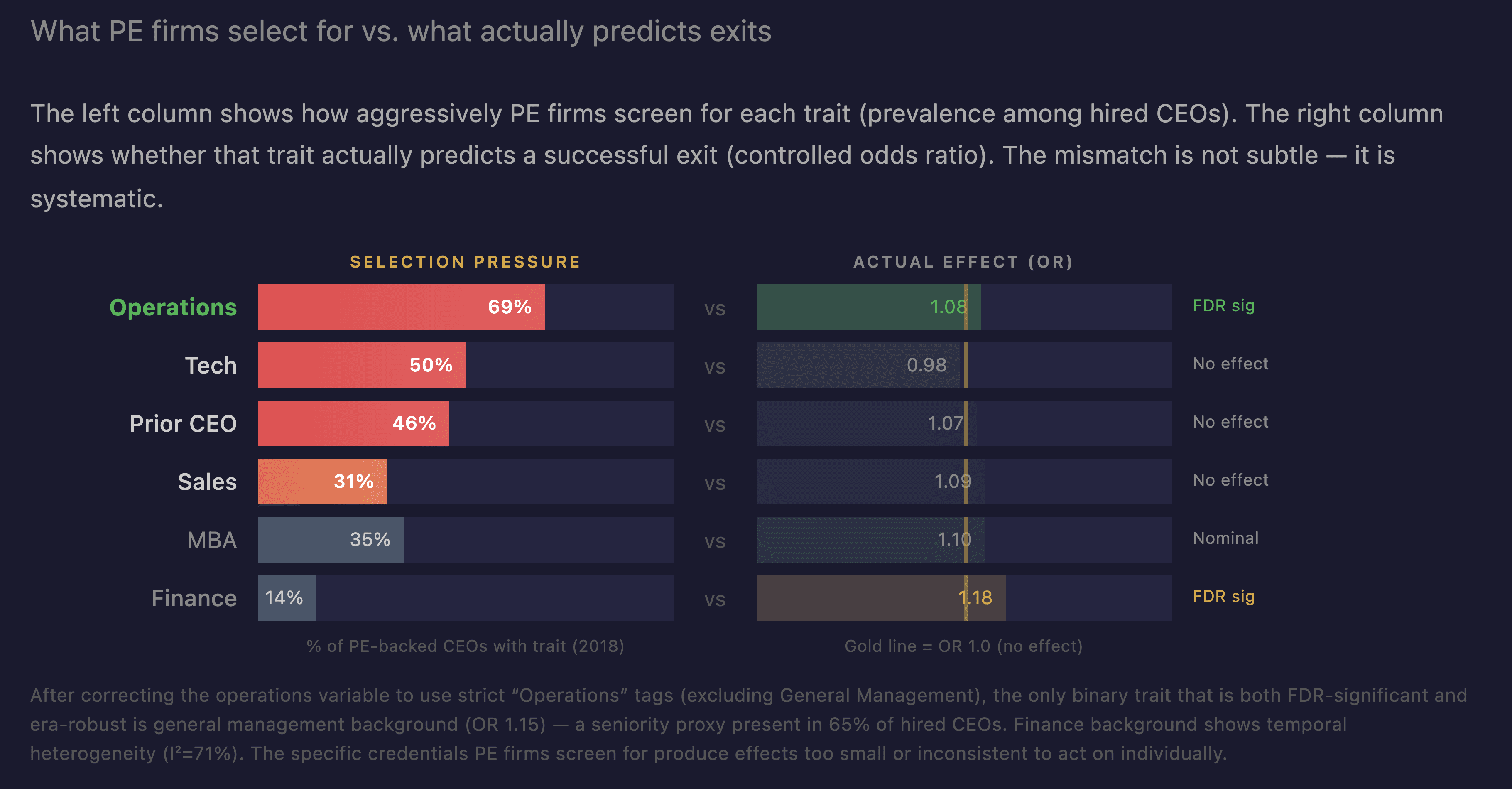
When you rank CEO background traits by how aggressively PE firms select for them -- measured by prevalence among hired CEOs -- and then rank the same traits by their actual predictive power for successful exits, the two lists are inverted. The overlap between the most-selected traits and the most-predictive traits is zero.
The most-selected traits: Operations background at 69% prevalence, tech background at 50%, prior CEO title at 46%, MBA at 35%, sales background at 31%. The most-predictive traits: general management background (OR 1.15, FDR significant) and years of experience (OR 1.07 per decade, FDR significant). The traits the industry pursues most aggressively range from modestly positive to outright null. The traits that actually predict are not the focus of search mandates.
This is not a marginal misalignment. It is a structural inversion -- a systematic mismatch between selection criteria and outcome predictors that has persisted across nearly two decades of data.
Why This Matters
In most domains, selection criteria eventually converge with outcome predictors. Baseball's adoption of sabermetrics is the canonical example: once the data showed that on-base percentage outperformed batting average as a predictor of runs scored, front offices shifted their scouting criteria accordingly. The market corrected.
Private equity CEO selection has not corrected. The data on what predicts has been available -- in fragmentary form -- for over a decade, yet the selection model has not materially changed. The industry continues to select for the traits it has always selected for, not because those traits have been validated, but because the selection process itself has never been subjected to rigorous outcome analysis.
The inversion persists because the feedback loop is broken. A CEO appointment takes 3-7 years to produce an observable outcome. By the time a fund knows whether a CEO hire succeeded, the partners who made the decision may be on their next fund. The search firm has moved on. The operating model that produced the hire is never tested against the outcome it was supposed to optimize. Without a closed feedback loop, selection criteria drift toward consensus and pattern-matching rather than evidence.
What the Data Shows
The data sorts CEO traits into three distinct categories, and the taxonomy is revealing.
Category 1: Seniority proxies only. These traits predict nothing beyond what years-of-experience already captures. Prior CEO title (OR 1.07, not significant after controlling for experience) and board experience fall here. They are signals of seniority, not signals of capability.
Category 2: Heavily selected, no signal. Operations (69% prevalence, OR crosses 1.0), Tech (50% prevalence, OR 0.98), Sales (31% prevalence, OR not significant), MBA (35% prevalence, OR 1.10 -- nominally positive but does not survive FDR correction). These are the traits that dominate PE search mandates. They are also the traits with the weakest empirical support. The industry's revealed preference is for traits that produce no measurable differentiation.
Category 3: The dead zone. FAANG pedigree (OR 0.82, not significant), specific sector matches, and other narrow credentials. Low prevalence, no signal, and in some cases a trend toward negative association.
The one exception that proves the rule: Finance background (14% prevalence) is FDR significant -- a trait the industry does not aggressively select for, yet one that shows a real statistical relationship with exits. The inversion is nearly perfect: the traits pursued most intensely carry no signal, while a trait largely ignored in search mandates carries one of the stronger effects.
The two traits that actually survive full statistical correction -- general management breadth and years of accumulated experience -- are rarely the headline criteria in a search mandate. They are background noise in a process optimized for foreground credentials that do not predict.
What This Means for Your Firm
The inversion creates an asymmetric opportunity for firms willing to act on the data. If your competitors are systematically selecting for traits that do not predict outcomes, and systematically ignoring traits that do, then correcting the mismatch is a source of edge -- not just in talent quality, but in talent access and cost.
Consider the practical implications. A CEO candidate with deep general management experience but no prior CEO title, no operations-specific background, and no MBA would be screened out by most PE search mandates today. Yet this candidate's profile aligns more closely with the traits that actually predict exits than the 'perfect resume' candidate who checks every traditional box.
- Audit your last five search mandates. List the top three criteria in each. Cross-reference against the predictive data. How many of your specified criteria have empirical support?
- Reweight your scorecard. If general management breadth and years of experience are the only surviving predictors, they should carry disproportionate weight in your evaluation framework -- not be treated as table stakes.
- Expand the aperture. The candidates your current process screens out may be statistically indistinguishable from the ones it screens in. A wider funnel does not increase risk. It increases optionality.
The traits that are targeted do not predict. The traits that predict are not targeted. The firms that correct this inversion first will have a structural advantage in one of PE's most consequential decisions.
Get the Full Research Report
This insight is from “From Pedigree to Performance” — the complete analysis of 12,174 CEO appointments. Download the full report with methodology, statistical tables, and recommendations.
Related Insights
The Flatline: Every CEO Trait's Effect on Exit Outcomes
A forest plot of every testable CEO trait shows nearly every confidence interval crosses the 1.0 'no effect' line. The resume doesn't differentiate outcomes.
Less Than 1% of PE Exit Outcomes Are Explained by CEO Background
The flagship finding: all observable CEO career traits combined explain less than 1% of PE exit variance across 12,174 appointments.
The Question Problem: Why PE's CEO Selection Model Doesn't Work
The industry doesn't have a data problem. It has a question problem. It asks 'Does this person look like a successful CEO?' instead of 'Does looking like one make you one?'
Related Guides
Ready to Move Beyond Resume-Based Selection?
See how Verata helps PE firms make better executive hiring decisions with relationship intelligence.