
The West Point Pipeline: Military Academies Outproduce the Ivy League Per Capita
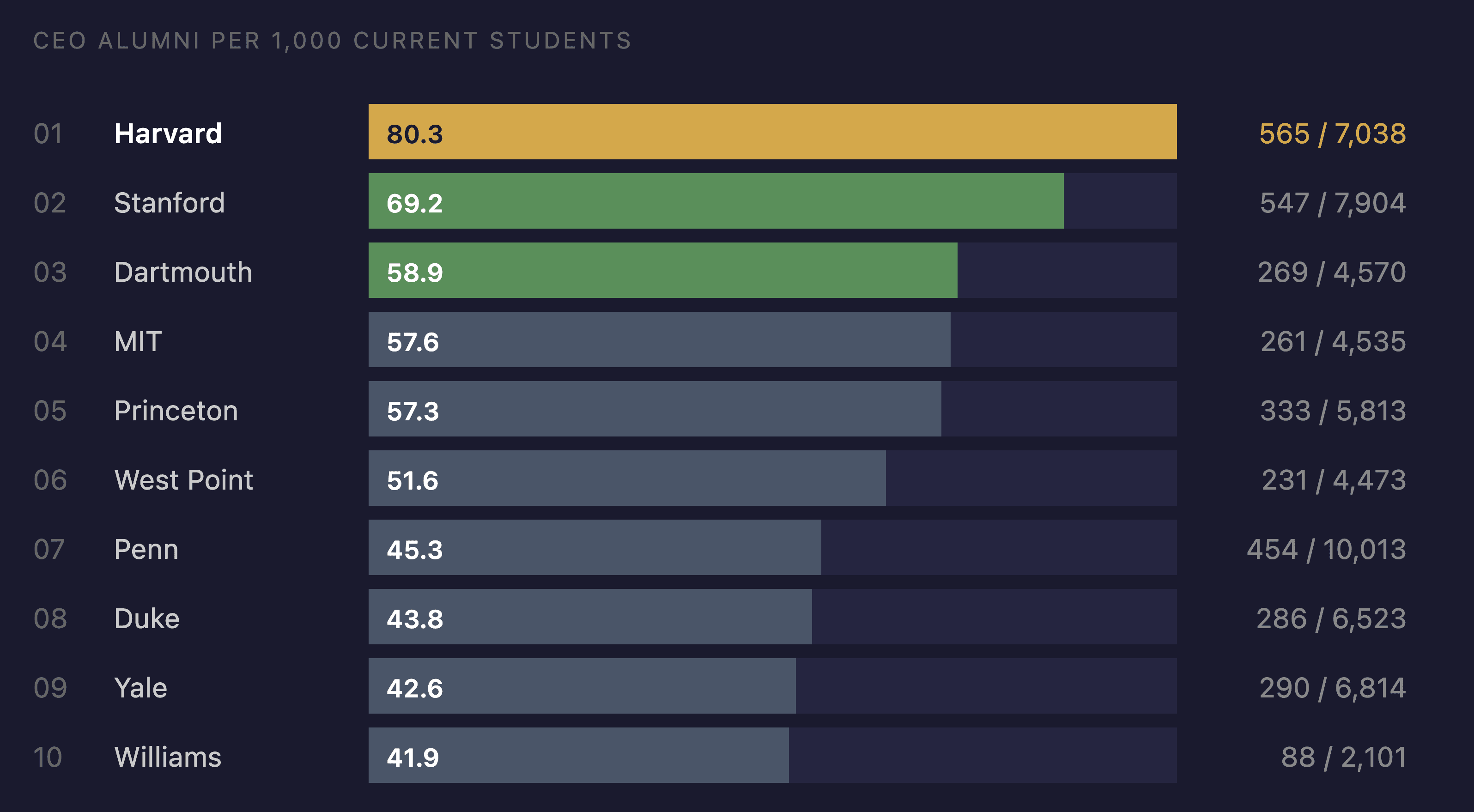
West Point ranks #6 in producing PE-backed CEOs per capita at 51.6 per 1,000 students -- higher than Penn, Duke, and Yale.
Verata Research
2025-03-24
In this article
The Finding
The United States Military Academy at West Point ranks #6 in the nation in producing PE-backed CEOs on a per-capita basis, with a rate of 51.6 CEOs per 1,000 students. This rate is higher than the University of Pennsylvania (45.3), Duke, and Yale. Across the service academies collectively, the per-capita CEO production rate is approximately 4x the rate of public flagship universities.
West Point has produced 231 PE-backed CEOs in the dataset -- not a trivial number. These are executives who transitioned from military careers into private sector leadership and ultimately into the CEO seat at PE-backed companies. They represent a talent pipeline that is almost entirely invisible to the executive search industry.
The per-capita rankings for the top institutions tell a clear story about where CEO talent actually comes from:
- Harvard: 80.3 per 1,000
- Stanford: 69.2 per 1,000
- Dartmouth: 58.9 per 1,000
- MIT: 57.6 per 1,000
- Princeton: 57.3 per 1,000
- West Point: 51.6 per 1,000
- Penn: 45.3 per 1,000
West Point is not an outlier or an anomaly in this list. It is a top-tier CEO pipeline by any quantitative measure -- one that the industry has systematically overlooked.
Why This Matters
When was the last time a PE search specification called for military academy graduates? For most firms, the answer is never. The executive search industry's mental model of a CEO candidate does not include "West Point, Army officer, transitioned to private sector." It includes "Harvard MBA, McKinsey, FAANG, Fortune 500 leadership." The search specifications reflect where the industry expects talent to come from -- and that expectation is empirically wrong.
Military academy graduates bring a distinct set of leadership capabilities that are directly relevant to PE-backed CEO roles. They have led organizations under resource constraints. They have managed complex operations across distributed teams. They have made high-stakes decisions with incomplete information. They have been trained in mission-focused execution, accountability, and the ability to operate in ambiguous, rapidly changing environments. These are precisely the capabilities that PE-backed companies demand of their CEOs -- particularly in the first 100 days after an acquisition, when the operating plan must be executed with discipline and speed.
The service academies also produce exceptionally strong alumni networks. The West Point alumni network, the Naval Academy's network, and the Air Force Academy's network are among the tightest and most responsive professional communities in the United States. These networks facilitate introductions, provide mentorship, and support career transitions in ways that rival or exceed the Ivy League alumni networks that dominate executive search sourcing.
What the Data Shows
The per-capita analysis normalizes CEO production by the size of each institution's annual graduating class, which reveals pipeline efficiency rather than just raw volume. Large schools with thousands of graduates per year (Michigan, Texas, Ohio State) produce many CEOs in absolute terms but have lower per-capita rates because the denominator is large. Small, selective schools (Dartmouth, MIT, West Point) produce fewer total CEOs but at much higher rates relative to their class size.
West Point's per-capita rate of 51.6 per 1,000 is particularly striking when you consider the institution's mission. West Point exists to produce military officers, not business executives. Yet the career trajectories of its graduates lead to PE-backed CEO roles at a rate that exceeds most Ivy League schools. The service academies collectively produce CEOs at 4x the rate of public flagship universities -- a concentration that suggests military leadership training translates powerfully into private sector executive capability.
The 231 West Point alumni who have served as PE-backed CEOs span a range of industries: defense and government services (as expected), but also healthcare, technology, logistics, manufacturing, and professional services. The military-to-CEO pipeline is not confined to defense-adjacent sectors. It produces general-purpose executive talent that the search industry has simply not been looking for.
Critically, the same caveat applies here as across all institutional credentials: none of these undergraduate institutions predict exit outcomes. West Point graduates do not have statistically higher or lower exit rates than graduates of any other institution. The data does not say "hire West Point graduates." It says "if you are going to source from institutional pipelines, at least source from all of them -- including the ones your search specifications have been ignoring."
The Counterargument
Some will argue that the military-to-CEO pipeline is self-selecting in ways that inflate the per-capita numbers. Military academy graduates who transition to private sector careers may represent the most ambitious and business-oriented subset of their graduating classes, meaning the 51.6 per 1,000 rate reflects a highly filtered group rather than the institution's general output. This is a fair observation -- but it applies equally to every institution on the list. Harvard's 80.3 per 1,000 rate also reflects self-selection: not every Harvard graduate pursues a career in business, and those who become PE-backed CEOs are a filtered subset.
Others will argue that military leadership skills do not translate directly to corporate leadership. The military operates with clear hierarchies, defined missions, and institutional authority structures that differ from the ambiguity and stakeholder complexity of a PE-backed company. This objection has some merit in the abstract, but the data undermines it in practice: 231 West Point alumni have already made the transition successfully enough to be hired as PE-backed CEOs, and their outcomes are statistically indistinguishable from the broader population.
The real question is not whether military academy graduates are "better" or "worse" CEO candidates than Ivy League graduates. They are neither -- because neither credential predicts exit outcomes. The question is why the industry systematically sources from one pipeline and ignores the other, when both produce talent at comparable rates and neither predicts performance.
What This Means for Your Firm
The West Point finding is a specific instance of a general principle: the talent pool is broader than the search specification, and the specification is not working anyway. If your firm's CEO sourcing is concentrated in the traditional channels -- Ivy League alumni networks, top MBA programs, MBB consulting alumni -- you are ignoring pipelines that produce executive talent at comparable or higher per-capita rates.
The practical applications are straightforward:
- Add military academy alumni networks to your sourcing channels. The West Point Society, the Naval Academy Alumni Association, and similar organizations provide access to a pool of 231+ proven PE-backed CEO candidates and hundreds more who are positioned for CEO-level roles. These networks are under-fished by the executive search industry, which means your firm can build relationships and access candidates that competitors are not reaching.
- Evaluate military leadership experience on its merits. A former Army officer who led a 500-person battalion, managed a $50 million operating budget, and executed complex operations across multiple geographies has directly transferable CEO-level experience. The skills -- mission execution, resource optimization, team leadership under pressure, decision-making with incomplete information -- are precisely what PE-backed companies need.
- Challenge your search partners' sourcing assumptions. If your retained search firm's candidate slates never include military academy graduates, ask why. The answer is likely that their sourcing databases and alumni networks are not configured to reach this population -- not that the candidates do not exist or are not qualified.
- Broaden the pipeline systematically. West Point is one example, but the broader lesson is that PE-backed CEO talent comes from far more places than the industry's narrow search specifications assume. BYU matches Princeton. UC Berkeley outranks most Ivies. Williams matches Penn per capita. The talent pool is broad, distributed, and largely untapped by firms that source from the same 20 schools that every other firm targets.
The specification is not working. If you are going to source from pipelines, at least source from all of them.
Get the Full Research Report
This insight is from “From Pedigree to Performance” — the complete analysis of 12,174 CEO appointments. Download the full report with methodology, statistical tables, and recommendations.
Related Insights
BYU Equals Princeton: The Undergraduate Pipeline Isn't What You Think
BYU has produced as many PE-backed CEOs as Princeton (333 each), challenging the narrow pipeline assumptions that dominate executive search.
Where PE-Backed CEOs Earned Their Degrees: The Surprises
87% of PE-backed CEOs went to schools outside the top 10. Harvard leads at just 1.77%, and UC Berkeley outranks every Ivy except Harvard.
The Ranking That Isn't: Every Employer's Exit Rate Overlaps
Oracle, McKinsey, US Army, Goldman Sachs -- every single employer exit rate confidence interval overlaps with every other. The 'ranking' is noise.
Ready to Move Beyond Resume-Based Selection?
See how Verata helps PE firms make better executive hiring decisions with relationship intelligence.