
They Stopped Picking by Template: The Closing Argument
The series finale returns to the $180M healthcare IT story. The board didn't pick a better CEO the second time — they stopped picking by template.
Verata Research
2025-04-30
In this article
The Finding
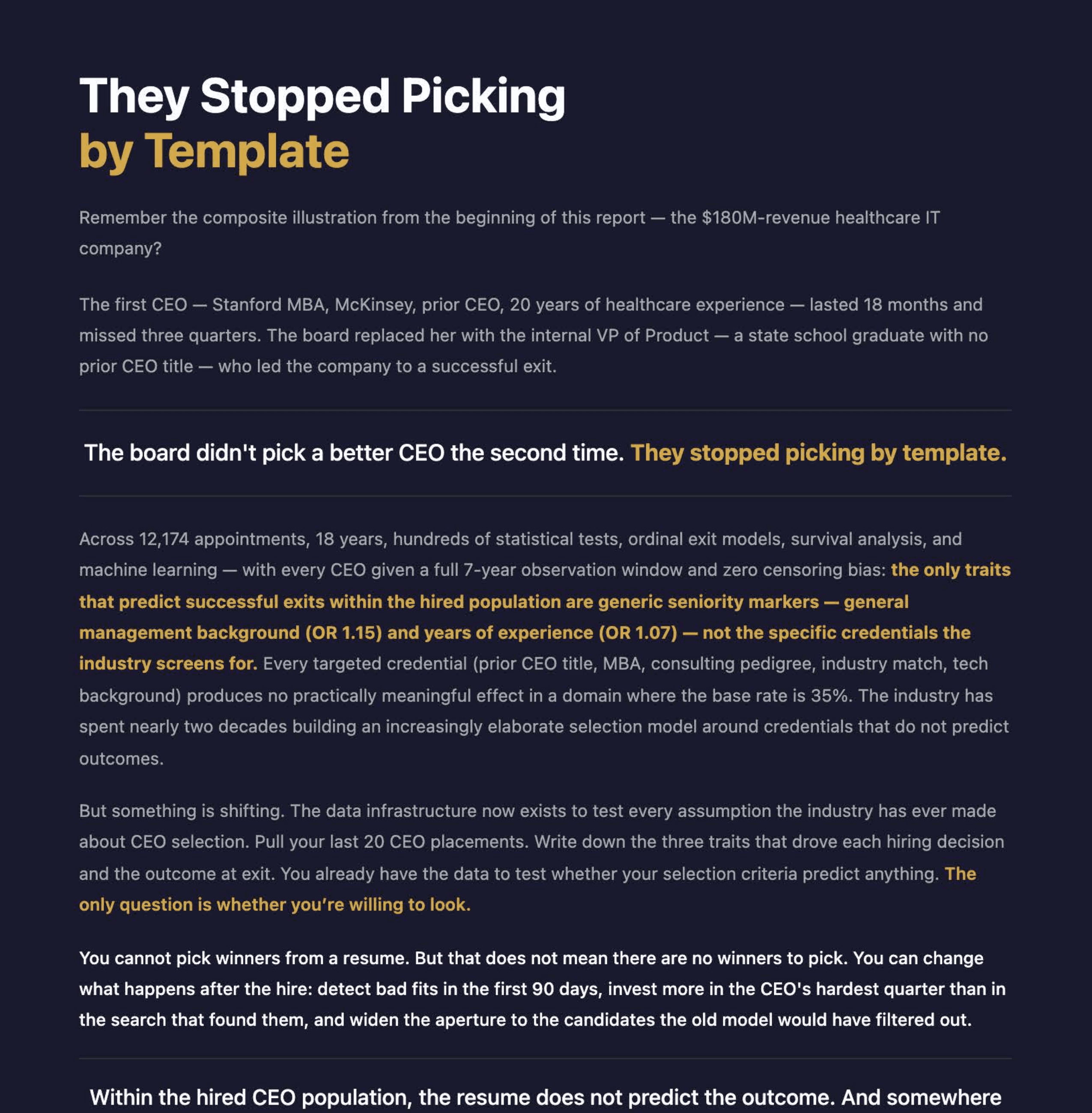
We opened this series with a story. A PE-backed healthcare IT company hired its first CEO through the standard playbook: Stanford MBA, McKinsey background, prior CEO title. He checked every box on the traditional search specification. He lasted 18 months. The company then promoted an internal VP of Product -- state school graduate, no prior CEO experience, no consulting pedigree. She led the company to a successful exit.
The board did not pick a better CEO the second time. They stopped picking by template. The first hire was a credential match. The second hire was a problem match -- someone who understood the product, the customers, and the specific operational challenges the company faced. The difference in outcome was not about who had the better resume. It was about which selection process pointed toward the actual problem.
This story is not unique. Across 12,174 PE-backed CEO appointments over 18 years, the data tells the same story at scale. Within the hired CEO population, the resume does not predict the outcome. The credentials that feel predictive -- the prestige degrees, the brand-name employers, the prior titles -- explain less than one percent of variance in exit success.
Why This Matters
This series has presented findings from one of the largest empirical studies of PE-backed CEO performance ever conducted. The results are consistent across three independent analytical methods: statistical regression, machine learning classification, and survival analysis. They are consistent across multiple outcome measures: binary exit, ordinal exit quality, and time to exit. And they are consistent across every subpopulation we examined: by industry, by fund size, by geography, and by era.
The consistency of the null finding is itself the finding. There is no corner of the data where credentials suddenly start predicting outcomes. There is no subgroup where the McKinsey premium materializes. There is no outcome measure where the prior-CEO advantage becomes statistically significant. 12,174 appointments. 18 years. 3 methods. The answer is the same everywhere.
And yet, somewhere this week, another board is learning this the expensive way. Another search committee is filtering candidates by the same credential template that has failed to predict outcomes across the entire dataset. Another PE firm is paying a search fee predicated on the assumption that the right resume signals the right CEO. The data says otherwise. The question is how many more $180 million lessons the industry needs before the process changes.
What the Data Shows
The healthcare IT story is a single anecdote. The dataset provides the statistical foundation:
- Less than 1% of exit variance is explained by observable CEO career characteristics
- d-prime of 0.22: The best ML model barely distinguishes successful from unsuccessful CEOs based on their resumes
- Every credential tested individually -- MBA, prior CEO title, consulting background, prestige employer -- shows no statistically significant relationship with exit success
- The employer "ranking" is entirely noise: Every confidence interval overlaps with every other
- Timing dominates: SHAP importance of 0.322 for era/timing, nearly double any individual characteristic
- The ordinal model confirms: Credentials do not predict binary exit, exit quality, or exit speed
- Placement bias is minimal: Under 2pp, far too small to explain the null findings
The healthcare IT company's experience is not an outlier. It is the modal outcome. The template-matched CEO failed and the problem-matched CEO succeeded -- and while any individual case could be noise, 12,174 cases cannot. The systematic finding is that the template does not work. It has never worked in a way that can be detected in the data. The industry has been operating on an assumption that 18 years of evidence cannot support.
The Counterargument
The final counterargument is the simplest: "What's the alternative?" If credentials do not predict outcomes, what should the selection process look for instead? This is a fair question, and it deserves an honest answer.
We do not yet have a validated model for what does predict PE-backed CEO success. The research identifies what does not work; it does not yet prescribe what does. But the absence of a complete alternative is not a reason to continue using a system that demonstrably fails. Medicine abandoned bloodletting before it discovered antibiotics. The first step is to stop doing what does not work.
What we can say is directional. The data points toward contextual fit -- the match between a candidate's specific capabilities and the specific problems the portfolio company faces. It points toward structured assessment of problem-solving approach rather than biographical screening. It points toward shorter engagement terms with option points, because if selection accuracy is near chance, the correction mechanism needs to be strong. And it points toward rigorous outcome tracking, because the industry cannot improve what it does not measure.
The firms that figure this out first will have a structural advantage. Not because they will pick perfect CEOs -- no one will -- but because they will stop paying a premium for noise and start investing in signals that have a chance of carrying information.
What This Means for Your Firm
This is the closing argument, so let us be direct. The data from 12,174 PE-backed CEO appointments across 18 years, analyzed with three independent methods, shows that the observable career characteristics the industry uses to select CEOs do not predict whether those CEOs will succeed. Not weakly. Not inconsistently. The predictive power is statistically indistinguishable from zero for every credential tested.
The implications are not theoretical:
- Your candidate pool is larger than you think. If credentials do not predict outcomes, every candidate you have excluded for lacking a prior CEO title, a prestige MBA, or a brand-name employer was excluded for no empirically supported reason
- Your search process needs restructuring. Replace credential checklists with problem statements. Evaluate candidates against the specific challenges the portfolio company faces, not against a biographical template
- Your track record is measurable. Pull your last 20 CEO placements. Calculate your hit rate. If it is near the baseline, the data is telling you the same thing it told us
- Your search partners should be accountable. Ask for their placement-to-exit success rate. The inability to provide this number is the single clearest indicator that the process is built on belief rather than evidence
The board in the healthcare IT story did not discover a secret formula. They did not find a better screening methodology or a more predictive assessment tool. They simply stopped filtering on credentials and started asking a different question: who can solve the specific problem this company faces? That shift -- from template to context, from biography to capability, from credential to problem -- is the entire lesson of 12,174 appointments.
The data exists. The question is whether you are willing to test the assumptions you have been hiring on.
Get the Full Research Report
This insight is from “From Pedigree to Performance” — the complete analysis of 12,174 CEO appointments. Download the full report with methodology, statistical tables, and recommendations.
Related Insights
Less Than 1% of PE Exit Outcomes Are Explained by CEO Background
The flagship finding: all observable CEO career traits combined explain less than 1% of PE exit variance across 12,174 appointments.
The $180M Lesson: When the Perfect Resume Fails
A $180M healthcare IT acquisition where the 'perfect' CEO lasted 18 months -- and the replacement with none of the traditional credentials led to a successful exit.
What To Do Monday Morning: 5 Steps to Fix CEO Selection
The most actionable post in the series: replace background checklists with problem statements, widen the aperture, and audit your own track record.
Ready to Move Beyond Resume-Based Selection?
See how Verata helps PE firms make better executive hiring decisions with relationship intelligence.