
The Dilution Effect: When Everyone Has the Credential, No One Does
Prior CEO experience grew from 34% to 50% prevalence over 18 years -- and its predictive power dropped to zero. The FICO analogy breaks down: the inputs themselves lack signal.
Verata Research
2025-04-18
In this article
The Finding
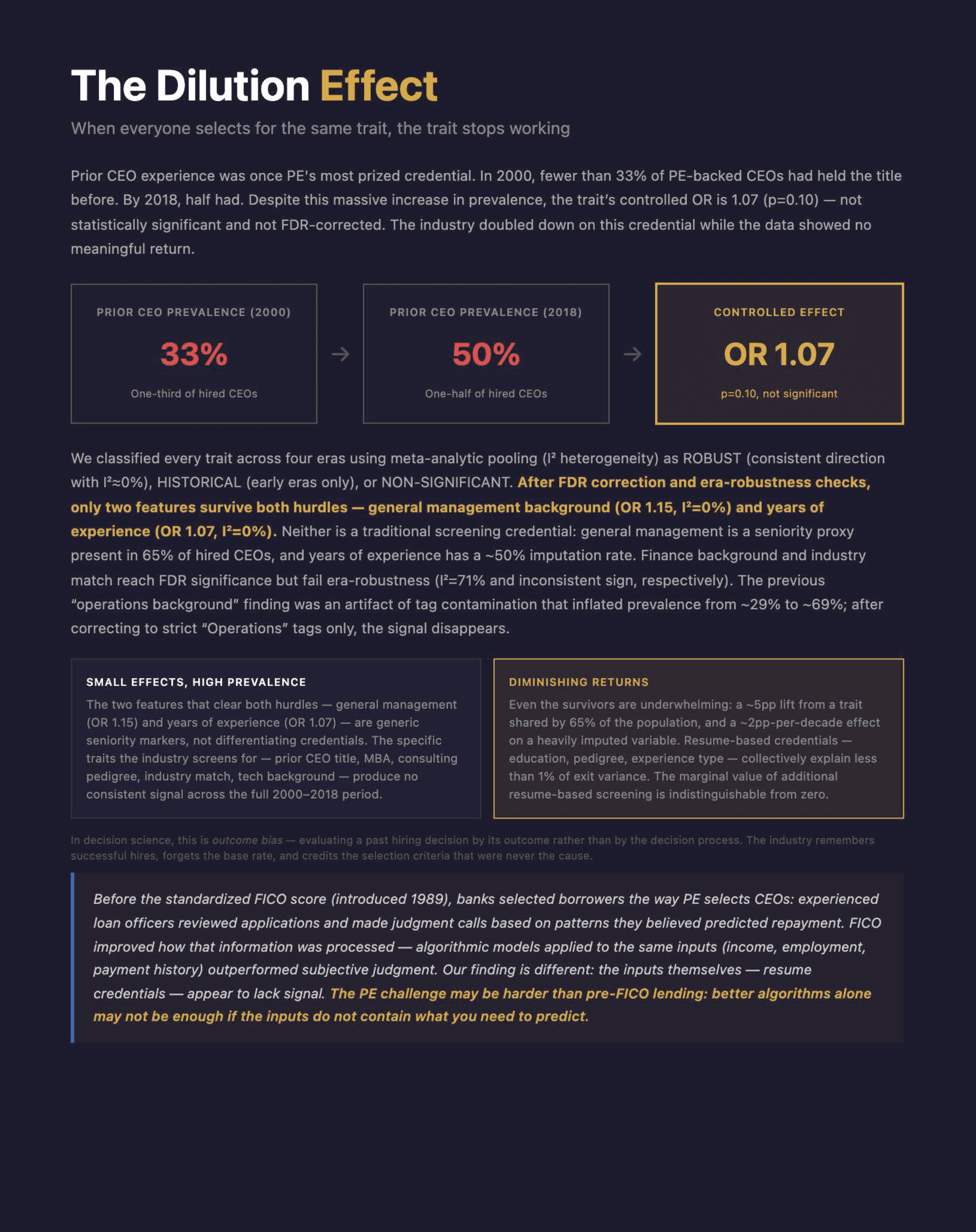
In 2000, roughly 34% of PE-backed CEO appointments went to candidates with prior CEO experience. By 2018, that figure had risen to 50%. Over eighteen years, the industry increased its selection pressure on this single credential by nearly 50%. The predictive return on that increased selection pressure: zero.
Controlling for sector, deal size, vintage year, and other background traits, prior CEO experience produces an odds ratio of 1.07 with a confidence interval of 0.99-1.15. It is not statistically significant. The industry's most popular credential -- the one it has systematically pursued with increasing intensity for nearly two decades -- does not measurably improve the probability of a successful exit.
This is the dilution effect in action. What was once a signal of exceptionalism -- a marker that distinguished a small subset of candidates -- has become a minimum threshold that half of all hired CEOs clear. When a credential becomes ubiquitous, it stops differentiating. It becomes table stakes, not an edge.
Why This Matters
The dilution effect exposes a fundamental flaw in credential-based selection: credentials are subject to reflexive devaluation. The more aggressively an industry selects for a credential, the more prevalent that credential becomes in the candidate pool, and the less information it conveys.
This dynamic is well-documented in labor economics. When employers began requiring college degrees for roles that previously did not require them, the signaling value of a college degree declined. The same mechanism applies to PE CEO selection: as firms increasingly require prior CEO experience, more candidates with prior CEO experience enter the pipeline, and the trait's ability to differentiate performance decays to zero.
The FICO analogy is instructive -- and ultimately misleading. FICO proved that better algorithms applied to the same credit inputs could outperform traditional underwriting models. This inspired a generation of 'Moneyball for talent' thinking: the idea that better analysis of existing CEO resume data could unlock hidden signal. Our finding is different and more fundamental. The inputs themselves appear to lack signal. This is not a case where the algorithm needs improvement. It is a case where the data being fed into the algorithm does not contain the information the algorithm needs to make useful predictions.
What the Data Shows
The temporal trend in prior CEO prevalence is the clearest illustration of the dilution effect, but it is not the only one.
- Prior CEO experience: 34% prevalence in 2000, 50% in 2018. Controlled OR: 1.07, not significant. The industry doubled down on this credential. The data returned nothing.
- Operations background: Also showed increasing prevalence over the study period, from approximately 55% to 72%. Controlled OR: crosses 1.0. Same pattern -- increased selection pressure, no predictive return.
- MBA prevalence: Relatively stable at 33-37% across the period. Controlled OR: 1.10, does not survive FDR. Stable selection pressure, no predictive return.
The pattern is consistent across credentials. Whether the industry increased its selection pressure (prior CEO, operations) or held it steady (MBA), the predictive return is the same: negligible or zero. This suggests the dilution effect is not the only mechanism at work. Even credentials whose prevalence has not changed show no predictive power. The inputs themselves may simply not contain the signal the industry assumes they contain.
The data also shows that the industry's response to poor outcomes has been to intensify selection on the same criteria rather than to question the criteria themselves. When exits disappoint, the instinct is to search harder for the 'right' candidate -- more references, more interviews, more rigorous screening on the same resume traits. The data suggests this is the wrong response. The problem is not search intensity. The problem is what you are searching for.
What This Means for Your Firm
The dilution effect creates a specific, exploitable market inefficiency. If your competitors are paying a premium -- in search fees, in time, in opportunity cost -- to secure candidates with credentials that do not predict outcomes, then you can achieve equivalent expected outcomes at lower cost by widening your aperture.
The firms that recognize this dynamic first will benefit in three ways.
- Deeper talent pool. Dropping the prior-CEO-experience requirement immediately expands your candidate universe by roughly 50%. These are candidates who are being systematically overlooked by an industry that has convinced itself this credential matters. The data says it does not.
- Lower acquisition cost. Candidates without the 'perfect' resume are in lower demand. They command lower compensation premiums, require less search effort to identify, and are more likely to accept. You are not sacrificing expected performance by hiring them. You are paying less for equivalent expected outcomes.
- Faster deployment. The search for a candidate who checks every credential box is slow. A search that relaxes non-predictive criteria is faster. In PE, where every month of CEO vacancy is a month of value creation delay, speed has direct financial value.
When everyone has the credential, it stops being a signal. It becomes a minimum threshold. The industry increased its selection pressure on prior CEO experience by 50% over eighteen years. The predictive return was zero. The firms that act on this finding will widen their aperture, access a deeper talent pool at lower cost, and deploy leadership faster -- while their competitors continue to compete for a narrowing pool of 'credentialed' candidates whose credentials do not predict the outcome that matters.
Get the Full Research Report
This insight is from “From Pedigree to Performance” — the complete analysis of 12,174 CEO appointments. Download the full report with methodology, statistical tables, and recommendations.
Related Insights
The Industry Tried Harder, the Market Did the Rest
CEO trait prevalence doubled over two decades while exit rates rose -- but within any era, these traits have no relationship to outcomes. A classic confound.
The Flatline: Every CEO Trait's Effect on Exit Outcomes
A forest plot of every testable CEO trait shows nearly every confidence interval crosses the 1.0 'no effect' line. The resume doesn't differentiate outcomes.
The Inversion: What PE Selects For vs What Actually Predicts
The traits with the highest selection pressure have no measurable effect on outcomes. The traits that predict are not targeted. A systematic mismatch.
Related Guides
Ready to Move Beyond Resume-Based Selection?
See how Verata helps PE firms make better executive hiring decisions with relationship intelligence.