
Where PE-Backed CEOs Actually Worked Before
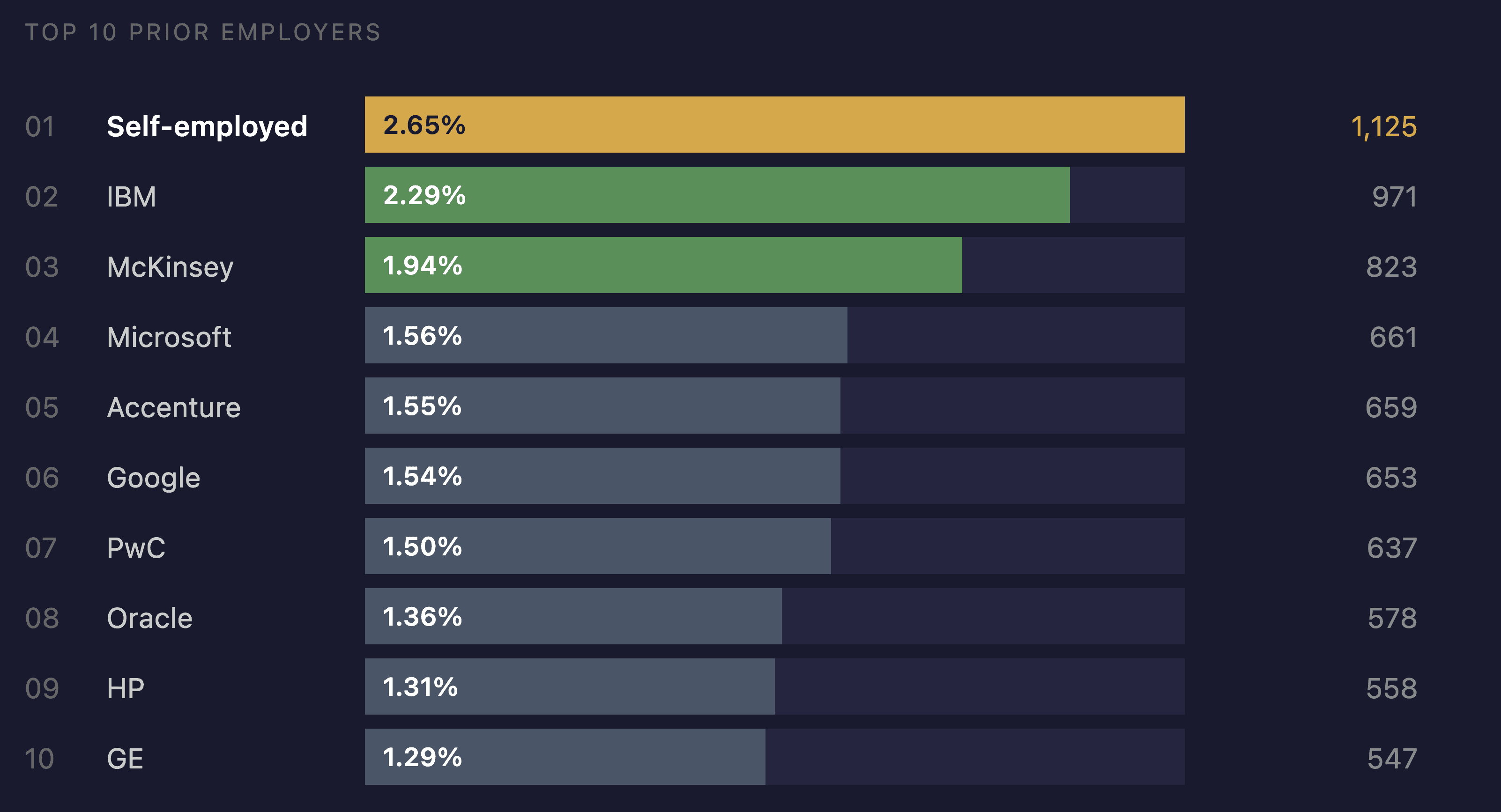
Self-employed is the #1 prior employer of PE-backed CEOs, ahead of IBM and McKinsey. The top 10 account for just 17.3% across 8,500+ unique employers.
Verata Research
2025-04-02
In this article
The Finding
When you map the prior employment history of PE-backed CEOs, the single most common entry is not a blue-chip corporation or an elite consulting firm. It is "self-employed." With 1,125 CEO appointments (2.65% of the dataset), self-employed founders and independent operators lead the list, ahead of IBM (971 appointments, 2.29%) and McKinsey (823, 1.94%).
The top 10 prior employers account for just 17.3% of all PE-backed CEO appointments, drawn from a pool of more than 8,500 unique prior employers. The remaining 82.7% come from 8,490+ other organizations -- a long tail so vast that it defies any attempt to build a sourcing strategy around employer pedigree alone. The PE-backed CEO population is not a narrow elite drawn from a handful of institutions. It is a broad, heterogeneous group whose prior experience spans virtually every corner of the economy.
Why This Matters
The dominance of self-employed individuals at the top of this list challenges a core assumption in PE executive recruiting: that the best CEOs are developed inside large, structured organizations. The recruiting industry is built on employer-brand recognition. Search firms maintain databases organized by company, division, and title. Investment committees evaluate candidates partly on the strength of the organizations they have led or worked within. "Where did they come from?" is often the first question asked about a CEO candidate.
But the data says that the most common answer is "nowhere in particular" -- or more precisely, "from their own ventures." Self-employed CEOs are, by definition, harder to source through traditional channels. They do not show up in corporate alumni networks. They are less likely to be in executive search databases. They may lack the Fortune 500 line items that make a resume easy to sell to an investment committee. And yet they are the single largest category of PE-backed CEO by prior employment.
This matters because it reveals a structural blind spot. The industry's sourcing infrastructure is optimized for candidates who come from recognizable employers. The single largest category of actual PE-backed CEOs comes from the least recognizable employer of all: themselves.
What the Data Shows
The full top 5 prior employers of PE-backed CEOs, ranked by number of CEO appointments:
- Self-employed: 1,125 appointments (2.65%)
- IBM: 971 appointments (2.29%)
- McKinsey & Company: 823 appointments (1.94%)
- Microsoft: 661 appointments (1.56%)
- Accenture: 659 appointments (1.55%)
The top 10 account for 17.3% of all appointments. That means 82.7% of PE-backed CEOs come from 8,490+ other organizations -- companies that individually contribute a fraction of a percent to the total. The distribution follows a classic long-tail pattern: a small number of large employers contribute a disproportionate share, but the majority of the population is scattered across thousands of smaller, less prominent organizations.
IBM's position at number two is notable. It produces more PE-backed CEOs than any single company except self-employed -- 971 CEO appointments across the dataset. This likely reflects IBM's size, its historical role as a training ground for general managers, and the decades-long restructuring that has pushed experienced executives out of the organization and into PE-backed leadership roles. McKinsey's third-place position is expected given the firm's well-documented pipeline into operating roles, but even McKinsey accounts for less than 2% of total appointments.
The Counterargument
One objection is that "self-employed" is a catch-all category that aggregates diverse experiences -- serial entrepreneurs, independent consultants, interim executives, and others -- making it misleading to call it the "number one employer." This is a fair point. Self-employed is not a single organization with a coherent training program or culture. It is a label applied to anyone whose most recent affiliation was their own venture or practice.
But this objection actually strengthens the finding. If the most common prior background of PE-backed CEOs is a category so heterogeneous that it defies simple classification, then the industry's attempt to screen CEOs based on employer pedigree is even more misguided than the top-line number suggests. The largest single source of PE-backed CEOs is a category that employer-based sourcing strategies are structurally unable to reach.
A second objection is that these numbers reflect appointments, not outcomes. Just because self-employed individuals are frequently appointed as PE-backed CEOs does not mean they perform well. This is correct -- and the answer, consistent with the broader Verata dataset, is that prior employer has no meaningful relationship to exit outcomes. Self-employed CEOs exit at rates indistinguishable from IBM alumni, McKinsey alumni, or anyone else.
What This Means for Your Firm
If your sourcing strategy is built around employer pipelines -- maintaining relationships with alumni networks at McKinsey, IBM, GE, and similar organizations -- you are fishing in a pond that contains less than 17.3% of the actual PE-backed CEO population. The other 82.7% is distributed across thousands of organizations, with the single largest category being individuals who do not belong to any corporate alumni network at all.
This does not mean employer-based sourcing is useless. It means it is incomplete, and the incompleteness is systematic. The candidates most likely to be missed by traditional sourcing -- self-employed operators, leaders from mid-market companies, executives at organizations too small to appear on search firm radar -- are not a marginal population. They are the majority.
Firms that build proprietary sourcing capabilities to access this long tail -- through sector-specific networks, portfolio company referral programs, and data-driven identification of operators who would never surface in a traditional search -- are not reaching into the discount bin. They are accessing the 82.7% of the market that the rest of the industry has systematically under-covered. The competitive advantage is in the long tail, not the short head.
Get the Full Research Report
This insight is from “From Pedigree to Performance” — the complete analysis of 12,174 CEO appointments. Download the full report with methodology, statistical tables, and recommendations.
Related Insights
The McKinsey Paradox: The Most Efficient CEO Factory Has No Measurable Effect
McKinsey produces 65 PE-backed CEOs per 1,000 employees -- nearly 7x the Big Tech average -- yet MBB alumni exit rates are statistically indistinguishable from baseline.
But Does Any of It Actually Matter?
17% of all PE-backed CEOs come from just 10 employers. 43% of MBA-holding CEOs come from just 10 programs. Now the question: does any of it predict outcomes?
The Ranking That Isn't: Every Employer's Exit Rate Overlaps
Oracle, McKinsey, US Army, Goldman Sachs -- every single employer exit rate confidence interval overlaps with every other. The 'ranking' is noise.
Ready to Move Beyond Resume-Based Selection?
See how Verata helps PE firms make better executive hiring decisions with relationship intelligence.