
The $180M Lesson: When the Perfect Resume Fails
A $180M healthcare IT acquisition where the 'perfect' CEO lasted 18 months -- and the replacement with none of the traditional credentials led to a successful exit.
Verata Research
2025-03-22
In this article
The Finding
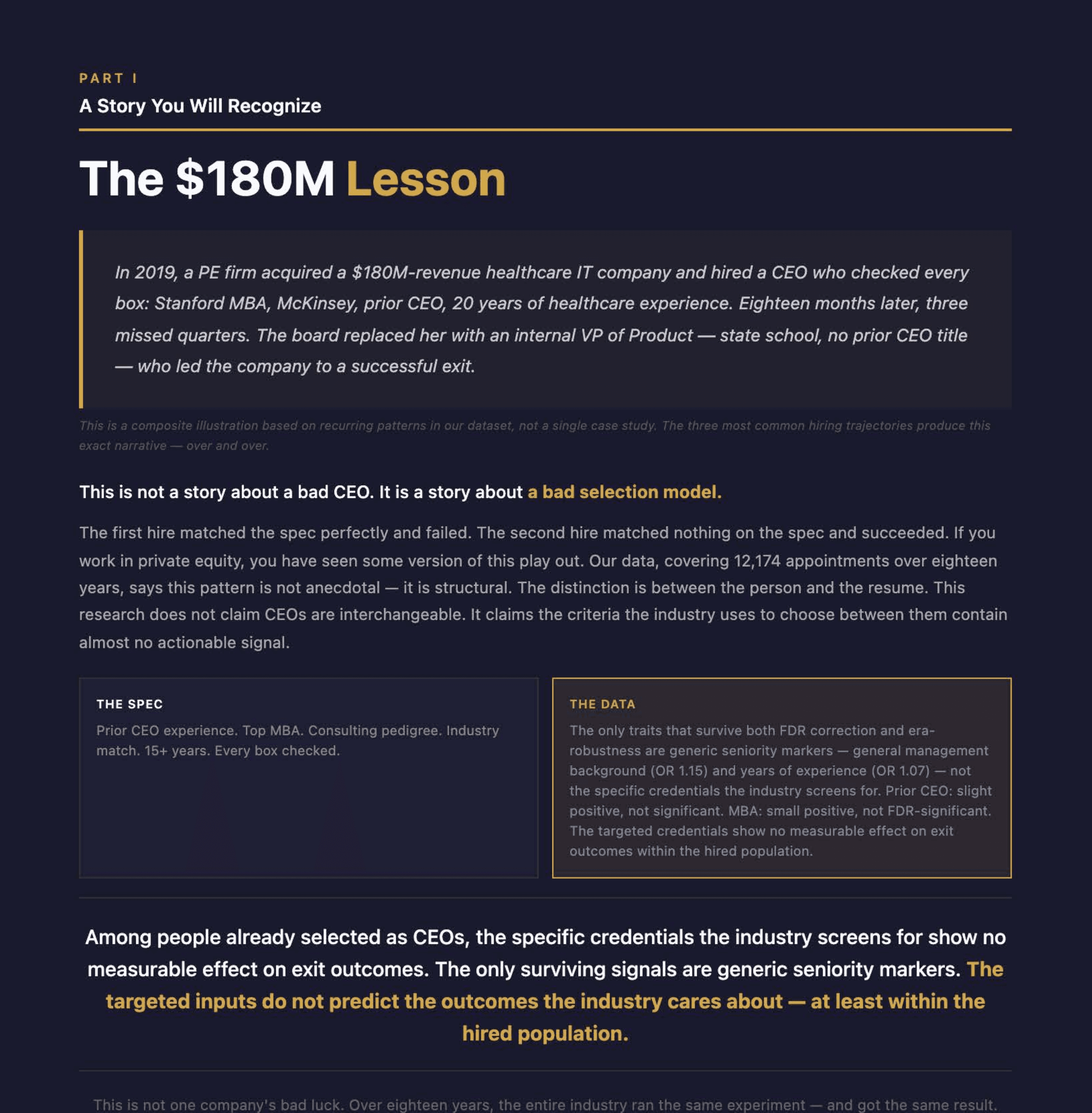
In 2019, a PE firm acquired a $180 million-revenue healthcare IT company and installed what appeared to be the ideal CEO. CEO #1 had the full credential stack: Stanford MBA, McKinsey background, prior CEO title at a comparable company, and 20 years of directly relevant healthcare IT experience. By every criterion the industry uses to evaluate CEO candidates, this was a textbook hire. The search specification could not have produced a better match.
Eighteen months later, CEO #1 was gone. Three consecutive missed quarters. Revenue deceleration. Key talent departures. A value creation plan that had stalled before it started. The board initiated a transition and, out of necessity rather than conviction, promoted the internal VP of Product -- a candidate with a state school degree, no MBA, no consulting background, and no prior CEO title. CEO #2 led the company to a successful exit.
This is not an anecdote designed to prove that credentials are bad. It is a case study that illustrates what the statistical analysis confirms at scale: the resume tells a coherent story, but that story does not predict performance. Every individual trait that made CEO #1 the "perfect" candidate -- prior CEO experience, MBA, consulting background, industry match -- fails to reach statistical significance as a predictor of PE exit outcomes.
Why This Matters
The $180M case matters because it crystallizes a pattern that is invisible at the individual-hire level but unmistakable at the portfolio level. Every PE firm has a version of this story. The "perfect" CEO who failed. The unlikely replacement who succeeded. These cases are typically treated as anomalies -- bad luck with CEO #1, good luck with CEO #2. But the statistical evidence suggests they are not anomalies at all. They are the predictable consequence of a selection model that optimizes for observable credentials rather than situational fit.
The CEO #1 failure was not caused by incompetence. This was a highly capable executive with a track record of success. The failure was a function of mismatch -- between the skills the CEO possessed and the skills the situation demanded. Healthcare IT in 2019 required product-led growth, rapid iteration, and deep customer proximity. CEO #1's strengths were in strategic repositioning and M&A-driven growth. The credential stack was impressive but irrelevant to the operating context.
This is not a story about a bad CEO. It is a story about a bad selection model. The model screened for credentials that mapped to a generic archetype of "successful CEO" rather than evaluating which specific capabilities the specific situation required. The result was a hire that looked perfect on paper and failed in practice -- a pattern that, according to the data, plays out across the industry with depressing regularity.
What the Data Shows
Every credential that made CEO #1 the "ideal" candidate has been tested against exit outcomes across 12,174 CEO appointments. The results are uniformly weak:
- Prior CEO experience: Slight positive association with exit outcomes, but not statistically significant after FDR correction. Having been a CEO before does not reliably predict being a successful CEO again -- particularly when the prior context differs from the current one.
- MBA (Stanford or otherwise): MBA holders show a 2.6 percentage point exit premium that is not statistically significant (FDR p = 0.0636). The credential that anchored CEO #1's candidacy carries no measurable predictive weight.
- MBB consulting background: Odds ratio of 1.17, confidence interval spanning 0.94-1.45, not significant after FDR correction. McKinsey on the resume does not move the needle.
- Industry match: One of only four traits that survived FDR correction, but with a tiny odds ratio of 1.06 and moderate era heterogeneity (I-squared = 38%). Even the trait that should most favor CEO #1 -- 20 years of healthcare IT experience -- provides a barely detectable signal.
Taken together, the combined predictive power of CEO #1's entire credential stack explains less than 1% of exit variance. The model that selected this candidate was not choosing signal over noise. It was choosing noise and calling it signal.
Meanwhile, CEO #2's profile -- internal promotion, state school, no MBA, no consulting, no prior CEO title -- represents exactly the kind of candidate that credential-based screening systematically excludes. The data shows that none of those "missing" credentials predict failure, just as none of CEO #1's "present" credentials predicted success.
The Counterargument
The obvious objection is that one case study proves nothing. A single CEO failure and a single CEO success could be explained by a thousand idiosyncratic factors -- board dynamics, market timing, team composition, customer concentration, competitive moves. This is true, and the $180M case should not be read as proof that all credentialed CEOs fail and all unconventional CEOs succeed.
But the case study is not the evidence. The evidence is the statistical analysis of 12,174 appointments. The case study is the illustration -- a concrete example of how the pattern identified in the data plays out in a real portfolio company. The $180M lesson is not "Stanford MBAs are bad CEOs." The lesson is that the selection model that prioritizes Stanford MBAs (and McKinsey backgrounds, and prior CEO titles, and industry match) is optimizing for criteria that explain less than 1% of the outcome it is trying to predict.
A second objection is that internal promotions succeed because of context-specific knowledge, not because external hires are inherently worse. This is likely correct -- and it reinforces the core finding. Context-specific knowledge, institutional relationships, team trust, and product intuition are the kinds of capabilities that matter for CEO performance but are not captured by resume credentials. A selection model that screens for credentials rather than situational capabilities will systematically favor impressive-looking external hires over capable internal candidates who lack the pedigree but possess the context.
What This Means for Your Firm
The $180M lesson has direct implications for how PE firms approach CEO selection, onboarding, and evaluation:
- Evaluate situational fit, not credential fit. Before launching a CEO search, define the three to five specific operating capabilities the portfolio company needs in the next 18-36 months. Then evaluate candidates against those capabilities -- not against a generic template of what a "great CEO" looks like. CEO #1 was a great CEO in the abstract. CEO #2 was the right CEO for this specific situation.
- Take internal candidates seriously. The reflexive preference for external hires with impressive resumes over internal candidates with deep context is not supported by the data. Internal promotions succeed for reasons that credential-based screening cannot capture: institutional knowledge, team relationships, product understanding, and customer proximity. Your VP of Product or VP of Operations may be a stronger CEO candidate than the external search delivers -- and at a fraction of the transition cost.
- Structure your first 90-day evaluation around leading indicators. The $180M case would have been identifiable within 90 days if the board had been evaluating CEO #1 against specific operating milestones rather than giving the benefit of the doubt to an impressive resume. Three missed quarters is 9-12 months of value destruction that could have been mitigated with earlier intervention.
- Build a feedback loop. Track the relationship between CEO selection criteria and actual portfolio outcomes across your fund. Most PE firms have never systematically analyzed whether their hiring criteria predict their exit outcomes. When they do, they will find what the data shows at scale: the criteria are not working.
The gap between the precision of your return expectations and the imprecision of your CEO selection criteria is where value is being destroyed. The $180M lesson is not about one company or one CEO. It is about an industry-wide selection model that is systematically miscalibrated -- and the returns that are being left on the table as a result.
Get the Full Research Report
This insight is from “From Pedigree to Performance” — the complete analysis of 12,174 CEO appointments. Download the full report with methodology, statistical tables, and recommendations.
Related Insights
Less Than 1% of PE Exit Outcomes Are Explained by CEO Background
The flagship finding: all observable CEO career traits combined explain less than 1% of PE exit variance across 12,174 appointments.
They Stopped Picking by Template: The Closing Argument
The series finale returns to the $180M healthcare IT story. The board didn't pick a better CEO the second time — they stopped picking by template.
The Question Problem: Why PE's CEO Selection Model Doesn't Work
The industry doesn't have a data problem. It has a question problem. It asks 'Does this person look like a successful CEO?' instead of 'Does looking like one make you one?'
Related Guides
Ready to Move Beyond Resume-Based Selection?
See how Verata helps PE firms make better executive hiring decisions with relationship intelligence.