
The Complete Guide to Proprietary Deal Sourcing
A comprehensive playbook for building a systematic proprietary origination process. Learn how top PE firms source 50%+ of their deals through relationships.
Verata Research Team
January 2025
In this guide
Why Proprietary Sourcing Matters
The math of PE returns has fundamentally changed. With 15,000+ PE firms globally competing for deals, auction dynamics have compressed returns on intermediated transactions to levels that barely justify the risk.
The Proprietary Premium
Deals sourced through relationships command a 15-25% discount to comparable auction processes. On a $200M transaction, that's $30-50M in entry valuation savings—which flows directly to returns.
But the benefits extend beyond price: - Better information: Relationships provide context that due diligence alone cannot - Longer runway: You can engage companies years before a formal process - Founder preference: Many sellers prefer working with buyers they know and trust - Reduced competition: By definition, proprietary deals have fewer bidders
The Data
Top-quartile PE firms source 40-60% of their deals through relationships. This isn't coincidence—it's a systematic capability they've built over decades. The question is: how do you build that capability at your firm?
Mapping Your Firm's Network
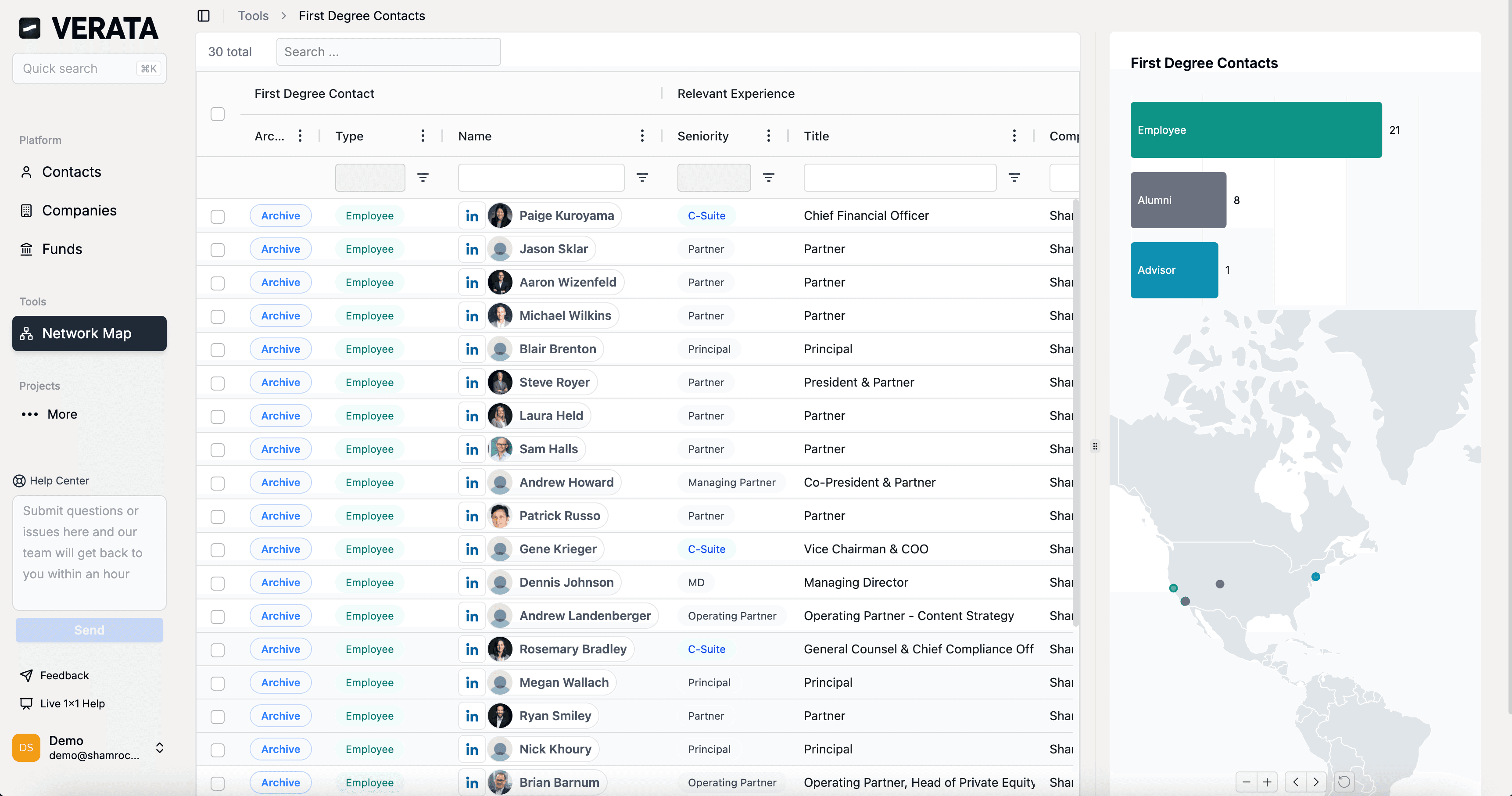
Every PE firm sits at the center of an enormous network—they just can't see it. Partners, Principals, operating advisors, portfolio company executives, limited partners, and alumni collectively know tens of thousands of executives, founders, and board members.
The Network Inventory
Start by cataloging your network assets:
- Investment team relationships: Who does each partner and principal know from prior roles, board service, and deal work?
- Operating partner network: Your operating advisors typically have the deepest industry relationships—former colleagues, competitors, and industry connections.
- Portfolio company executives: Your CEOs and CFOs know their peers, competitors, and adjacent market players.
- LP relationships: Many institutional LPs sit on boards and have their own investment networks.
- Alumni network: Former team members maintain relationships and often become sources themselves.
From Inventory to Intelligence
The challenge isn't having relationships—it's knowing which relationships are relevant for any given target. This requires:
- Systematic data collection: Regular processes to capture and update relationship information
- Quality indicators: Not all relationships are equal—distinguish between LinkedIn connections and real professional relationships
- Path mapping: The ability to see chains of relationships to any target company or executive
Building Relationship Intelligence Infrastructure
Relationship intelligence isn't a project—it's infrastructure that compounds over time. The firms that invest in this infrastructure create durable sourcing advantages.
Core Components
- Contact Database
- - Every person in your network with relationship metadata
- - Full career histories showing overlapping tenures
- - Relationship strength indicators
- - Last contact dates and interaction notes
- Company Database
- - Private company profiles with estimated metrics
- - Ownership status and transaction history
- - Executive team composition
- - Relationship paths from your network
- Path Mapping Engine
- - Algorithms that identify connection chains
- - Quality weighting based on relationship type
- - Multiple path discovery for redundancy
- Workflow Integration
- - CRM synchronization to avoid duplicate entry
- - Meeting prep automation
- - Outreach tracking and follow-up
Build vs. Buy
Some firms build proprietary systems; most find that the engineering investment doesn't make sense. Modern relationship intelligence platforms like Verata provide turnkey infrastructure that would cost millions to replicate internally.
The key is selecting a platform built specifically for PE workflows—not repurposing sales tools designed for different use cases.
The Outreach Playbook
Having relationship paths is useless without a systematic approach to activating them. The best sourcing teams treat outreach as a process, not an art.
The Warm Introduction Framework
Warm introductions convert at 10-20x the rate of cold outreach. Here's how to request them effectively:
- The Ask: Be specific about what you want ("I'd love a 20-minute call to learn about his views on the market") rather than vague ("I'd love to connect")
- The Context: Give the introducer enough information to make the connection valuable ("We're researching the industrial software space and she'd be an incredible perspective")
- The Easy Out: Make it easy to decline without awkwardness ("No worries if the timing isn't right")
- The Follow-Through: Send a draft email the introducer can forward—reducing friction to zero
Cold Outreach That Works
Sometimes warm paths don't exist. Cold outreach can still work when done right:
- Lead with value: Share a relevant perspective, not a pitch
- Reference specific context: Show you've done homework on the company
- Keep it short: Busy executives won't read long emails
- Multi-channel: Combine email, LinkedIn, and phone strategically
Tracking and Iteration
Measure everything: - Response rates by outreach type - Conversion to meetings - Meetings to actionable pipeline - Pipeline to closed deals
This data reveals what's working and where to invest more effort.
Measuring Sourcing Performance
What gets measured gets managed. The best sourcing teams have dashboards that track every stage of the funnel.
Core Metrics
- Network Coverage
- - Total relationships in the database
- - Coverage by sector, geography, and company size
- - Relationship quality distribution
- - Growth rate over time
- Activity Metrics
- - Outreach volume by team member
- - Meeting volume and type
- - Warm intro requests made and fulfilled
- - Response rates by channel
- Pipeline Metrics
- - Companies actively engaged
- - Stage progression velocity
- - Conversion rates at each stage
- - Proprietary vs. intermediated mix
- Outcome Metrics
- - Deals sourced through relationships
- - Entry multiple premium captured
- - Time from first contact to close
- - ROI on sourcing investment
Benchmarks
Top-performing firms typically see: - 40-60% of closed deals from proprietary sources - 30%+ response rates on warm outreach - 2-3 year average from first contact to deal close - 15-25% entry multiple improvement vs. auction
Building the Culture
Metrics only matter if the team engages with them. The best firms: - Review sourcing dashboards in weekly pipeline meetings - Celebrate relationship-sourced wins prominently - Set sourcing targets alongside financial targets - Invest in training and enablement continuously
Proprietary sourcing isn't a one-time initiative—it's a muscle that grows stronger with consistent exercise.
Related Guides
Relationship Mapping 101
The fundamentals of building and maintaining a relationship map for your PE firm. From data collection to activation strategies.
Deal SourcingThe Sector Coverage Playbook
How to build comprehensive coverage of any sector—from initial mapping to ongoing monitoring and outreach.
OutreachThe Warm Introduction Playbook
Proven templates and strategies for requesting and facilitating warm introductions to target executives.
Ready to Put This Into Practice?
See how Verata can help you implement these strategies with relationship intelligence built for PE.