
Relationship Mapping 101
The fundamentals of building and maintaining a relationship map for your PE firm. From data collection to activation strategies.
Verata Research Team
January 2025
In this guide
What is Relationship Mapping?
Relationship mapping is the process of systematically documenting, visualizing, and activating the professional connections across your organization. For PE firms, this means understanding how your team connects to target companies, executives, and industry experts.
Why It Matters
Your firm's network is its most valuable sourcing asset—but only if you can see it. Without relationship mapping:
- Partners don't know who their colleagues know
- Warm paths to targets go undiscovered
- Relationship capital sits dormant
- Sourcing depends on memory and luck
The Building Blocks
A relationship map consists of:
- Nodes: People in your network (team members, contacts, executives)
- Edges: Connections between people (based on shared professional context)
- Attributes: Metadata about people and connections (roles, dates, strength)
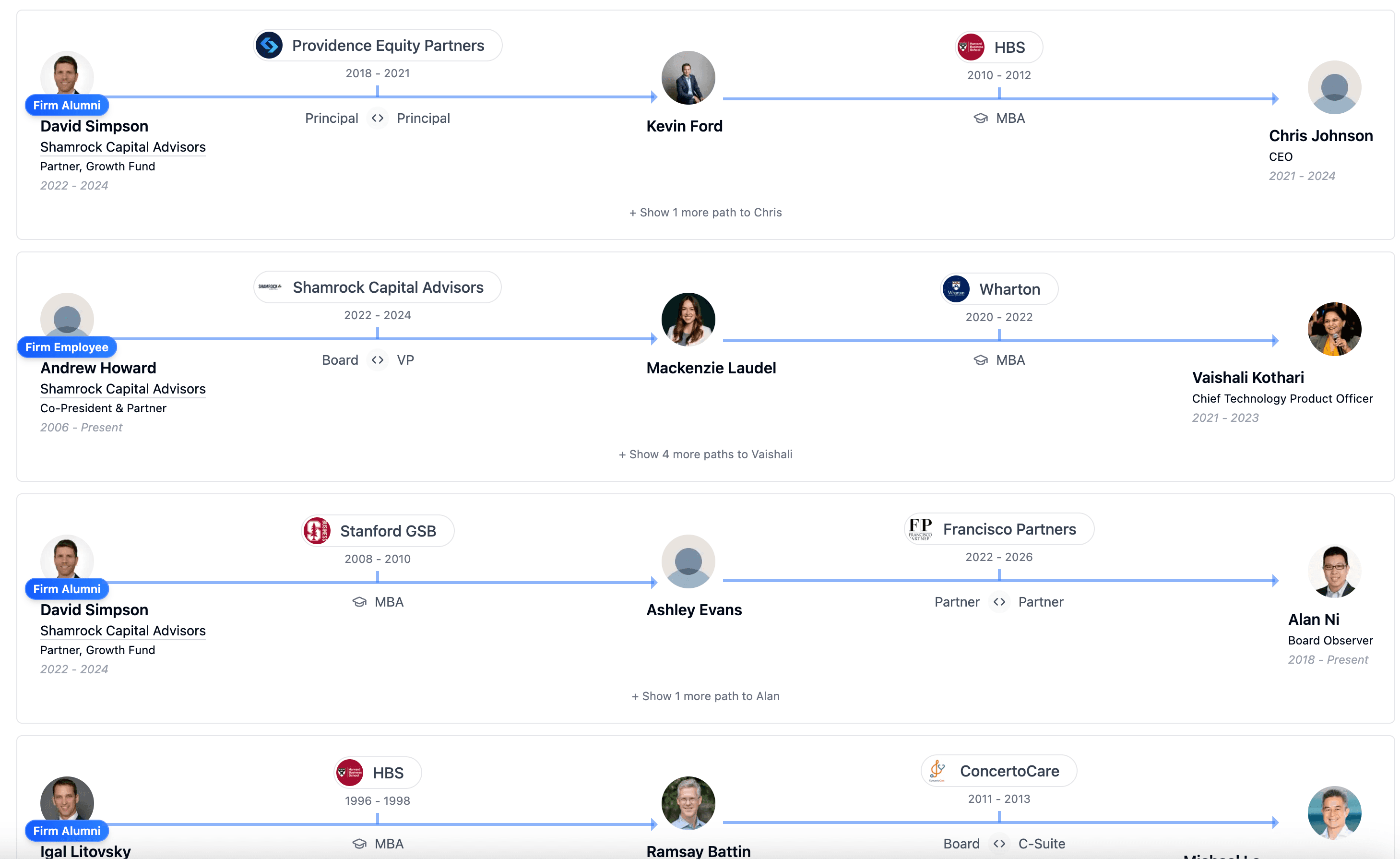
- Paths: Chains of connections to reach any target
Defining Relationship Quality Tiers
Not all relationships are equal. A LinkedIn connection with someone you've never spoken to is very different from a former colleague you've worked with for years.
The Quality Spectrum
Tier 1 - Deep Professional Relationships - Board co-service (worked together on a board) - Direct reporting relationships - Co-founders or co-investors - Multi-year working relationships
These relationships carry real weight. A Tier 1 contact will take your call, make introductions, and provide honest assessments.
Tier 2 - Meaningful Professional Contact - Same company, different teams - Business school classmates - Conference acquaintances with follow-up - Industry association connections
Tier 2 relationships require more context but can be activated effectively.
Tier 3 - Weak Ties - LinkedIn connections without real interaction - One-time meeting contacts - Name recognition only
Tier 3 connections are rarely worth activating directly but can serve as bridges to stronger connections.
Why This Matters
Quality tiering prevents embarrassing outreach ("Can you introduce me to your former colleague?" when they barely know the person) and focuses effort on the paths most likely to succeed.
Collecting Relationship Data Systematically
Relationship data doesn't collect itself. Successful firms build processes that capture relationship intelligence continuously.
Data Sources
- Team interviews: Sit down with each team member quarterly to update their relationship inventory. Focus on: new relationships formed, existing relationships strengthened, and relevant context.
- Calendar mining: Meeting history reveals relationships. Who has each team member met with in the past year? (Requires care with privacy and consent)
- Email patterns: Communication frequency indicates relationship strength. (Again, privacy considerations apply)
- LinkedIn data: While quality is low, LinkedIn provides broad coverage of professional history and connections.
- CRM records: Meeting notes and interaction history from your deal tracking system.
- Event attendance: Who attended which conferences, dinners, and industry events together?
Making It Stick
Data collection fails when it's seen as overhead. Make it valuable:
- Show team members immediate benefit (e.g., paths they didn't know existed)
- Build collection into existing workflows (meeting debriefs, annual planning)
- Keep the ask small and focused
- Celebrate wins that come from relationship data
Keeping Your Map Current
Relationship data decays. People change jobs, connections grow stronger or weaker, and new relationships form constantly.
Decay Rates
- Job changes: 15-20% of executives change roles annually
- Relationship strength: Connections not maintained weaken over time
- Contact information: Email addresses and phone numbers go stale
Maintenance Processes
- Quarterly team updates: Schedule recurring reviews with each team member to update their relationship inventory.
- Automated monitoring: Track job changes for key contacts via news alerts, LinkedIn, or relationship intelligence platforms.
- Interaction logging: Note every meaningful interaction to track relationship health.
- Annual audit: Once per year, review the entire database for accuracy and completeness.
Prioritization
You can't maintain every relationship. Focus maintenance effort on:
- High-quality (Tier 1) relationships
- Connections in active target sectors
- Relationships held by team members who may depart
- Historically productive sources
Converting Paths to Meetings
The goal of relationship mapping isn't a pretty network diagram—it's meetings with target companies and executives.
The Activation Process
- Identify the target: Who do you want to reach?
- Find paths: Query your relationship map for connections. Look for multiple paths—redundancy increases success probability.
- Assess path quality: Evaluate each path based on relationship strength, recency, and relevance.
- Select the best path: Choose the path with the highest probability of successful activation.
- Request the introduction: Reach out to your connection with a clear, easy-to-fulfill ask.
- Follow through: When the intro is made, move quickly. Send a brief, value-oriented outreach within 24 hours.
Common Mistakes
- Choosing paths based on convenience rather than quality
- Making vague asks that are hard to fulfill
- Waiting too long after an introduction is made
- Failing to close the loop with the introducer
- Not tracking what works and what doesn't
Measuring Success
Track conversion rates at each stage: - Path identified → Intro requested - Intro requested → Intro made - Intro made → Meeting scheduled - Meeting scheduled → Meeting held
This data reveals bottlenecks and improvement opportunities.
Related Guides
The Complete Guide to Proprietary Deal Sourcing
A comprehensive playbook for building a systematic proprietary origination process. Learn how top PE firms source 50%+ of their deals through relationships.
OutreachThe Warm Introduction Playbook
Proven templates and strategies for requesting and facilitating warm introductions to target executives.
Ready to Put This Into Practice?
See how Verata can help you implement these strategies with relationship intelligence built for PE.