
The Sector Coverage Playbook
How to build comprehensive coverage of any sector—from initial mapping to ongoing monitoring and outreach.
Verata Research Team
January 2025
In this guide
What is Sector Coverage?
Sector coverage means knowing every company that fits your investment criteria in a given industry vertical—not just the obvious ones, but the hidden gems that haven't hit anyone's radar yet.
The Coverage Advantage
Firms with strong sector coverage: - See opportunities earlier - Engage companies before formal processes - Build relationships that pay off years later - Have informed perspectives for every conversation
Coverage Components
Complete sector coverage requires:
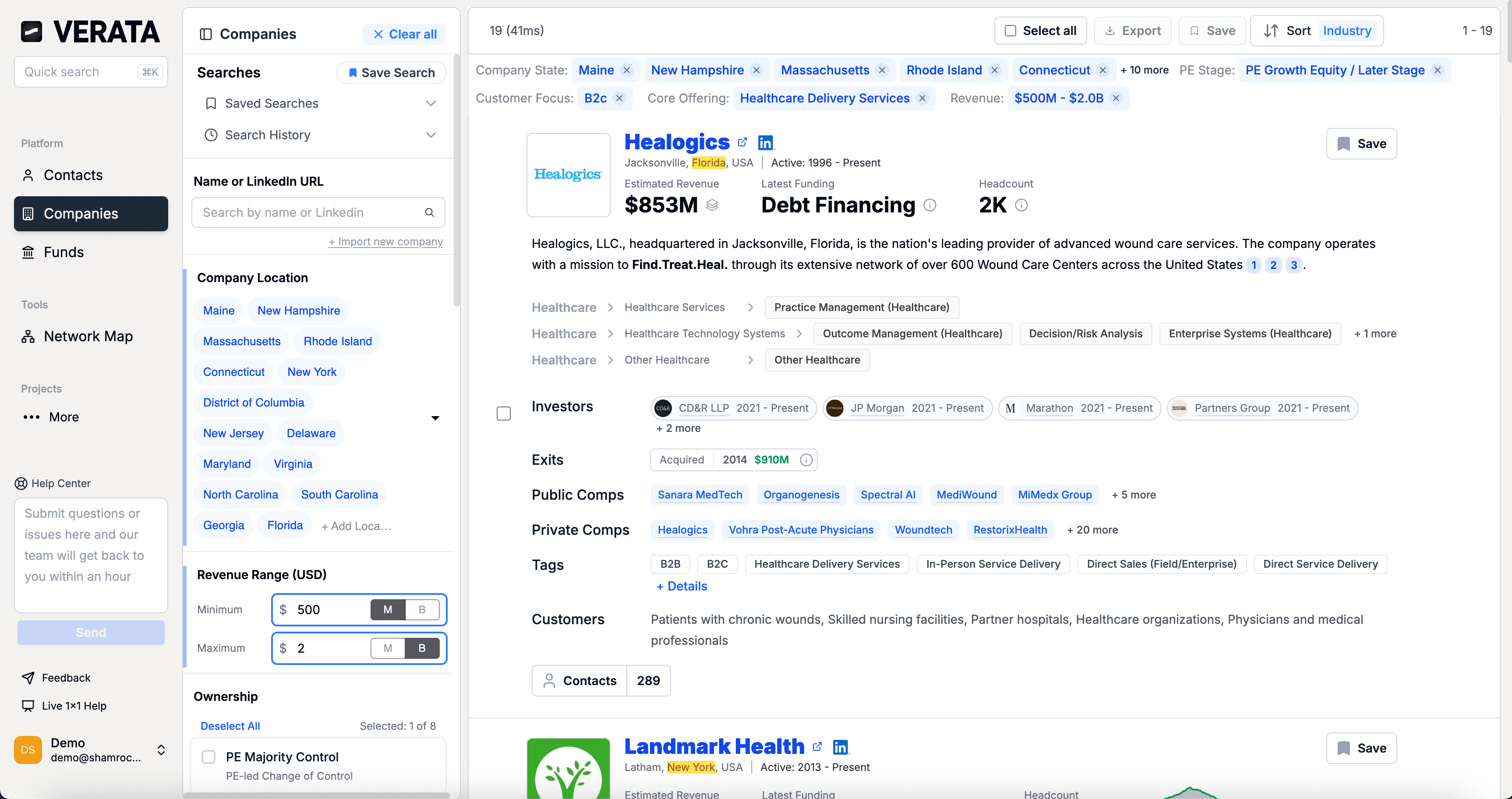
- Company universe: Exhaustive list of companies in the space
- Company intelligence: Key metrics and context for each
- Relationship mapping: Paths to reach each company
- Monitoring: Alerts when something changes
- Engagement history: Record of all interactions
Defining Your Ideal Company Profile
Before building coverage, define what you're looking for. Vague criteria lead to unfocused coverage.
Profile Components
- Industry vertical: Specific sub-sectors, not broad categories (e.g., "healthcare IT for ambulatory surgery centers" not "healthcare")
- Business model: Revenue model, customer type, go-to-market approach
- Size parameters: Revenue range, employee count, growth rate
- Geography: Headquarters location, operational footprint
- Ownership structure: Family-owned, founder-led, PE-backed, corporate subsidiary
- Stage: Growth stage, maturity of operations, readiness for ownership transition
Example Profile
"B2B SaaS companies selling to mid-market manufacturing companies, $15-75M revenue, growing 15%+, headquartered in the Midwest, founder-owned with succession planning needs."
Why Specificity Matters
Specific profiles enable: - More efficient company identification - More relevant outreach messaging - Clearer prioritization decisions - Better tracking of coverage progress
Building Exhaustive Company Lists
The goal is to identify every company that fits your profile—not just the ones you already know.
Primary Sources
- Industry databases: D&B, PitchBook, PrivCo, and sector-specific databases
- Trade associations: Member directories often reveal companies absent from commercial databases
- Conference attendees: Industry event exhibitor and attendee lists
- Customer lists: If you know who buys from the sector, work backwards to suppliers
- Competitor research: Look at who competes with known companies
Secondary Sources
- News and press releases
- Patent filings
- Job postings (companies hiring often match your growth profile)
- Social media and LinkedIn company pages
- Government contractor databases
Validation Process
Not every company will fit your profile. Build a quick validation checklist:
- Confirm industry fit
- Estimate size (revenue, headcount)
- Verify ownership status
- Check for recent transactions
- Assess relationship paths
Building the List
Start with commercial databases, then layer in secondary sources. For a typical mid-market sector, expect:
- 50-200 companies that closely fit your profile
- 200-500 companies in the broader space
- Ongoing discovery of 10-20 new companies quarterly
Prioritizing by Relationship Strength
You can't pursue every company equally. Prioritization ensures focus on the highest-probability opportunities.
The Prioritization Matrix
Score each company across two dimensions:
Fit Score (0-10) - Alignment with investment criteria - Attractiveness of the business - Estimated size and growth - Ownership situation and timing
Access Score (0-10) - Strength of relationship paths - Number of paths available - Quality of the best path - History of engagement
Priority Tiers
- Tier 1 (High Fit + High Access): Active engagement—pursue immediately
- Tier 2 (High Fit + Low Access): Build access—cultivate relationships
- Tier 3 (Low Fit + High Access): Monitor—may become attractive
- Tier 4 (Low Fit + Low Access): Passive—check periodically
Resource Allocation
Top-tier opportunities deserve concentrated attention:
- Direct partner involvement
- Multiple touchpoints per quarter
- Relationship cultivation across the organization
- Deep research investment
Lower tiers get scaled attention through more automated approaches.
Monitoring and Alerts
Markets evolve. Companies change. Your coverage must stay current.
What to Monitor
- Leadership changes: New CEO, CFO, or board members often signal transition readiness
- Financial signals: Revenue milestones, funding rounds, profitability changes
- Strategic moves: Acquisitions, divestitures, new product launches
- Ownership events: Shareholder changes, estate planning activity
- Competitor activity: Transactions in the space may create pressure or opportunity
Alert Infrastructure
Build monitoring into your workflow:
- Google Alerts for company names and key executives
- LinkedIn notifications for job changes
- News aggregators for industry coverage
- Platform alerts (Verata, PitchBook, etc.)
- CRM reminders for periodic check-ins
Response Protocols
Alerts are useless without action. Define response protocols:
- Leadership change at Tier 1 company → Immediate outreach
- Funding round in the space → Add to next coverage review
- Competitor acquisition → Research and share with team
Coverage Reviews
Monthly: Review alerts and update company records Quarterly: Full sector coverage review with the team Annually: Refresh the entire company universe
Related Guides
The Complete Guide to Proprietary Deal Sourcing
A comprehensive playbook for building a systematic proprietary origination process. Learn how top PE firms source 50%+ of their deals through relationships.
Getting StartedRelationship Mapping 101
The fundamentals of building and maintaining a relationship map for your PE firm. From data collection to activation strategies.
Ready to Put This Into Practice?
See how Verata can help you implement these strategies with relationship intelligence built for PE.