
Beyond the Resume: Why Backchannel Diligence Beats Credential Screening
If CEO backgrounds can't predict PE exit success, what can? The answer lies in relationship-based intelligence and backchannel executive diligence.
Verata Research Team
February 2025
In this guide
The Resume Screening Trap
Private equity firms invest extraordinary resources in executive diligence. A typical CEO search for a portfolio company consumes 100+ hours of internal team time, $200,000-$400,000 in search firm fees, and 3-6 months of elapsed time. By any measure, this is one of the most consequential and resource-intensive decisions a PE firm makes during the life of an investment.
Yet the vast majority of that effort is directed at a signal that our research shows is nearly worthless: the candidate's resume credentials.
The Standard Playbook
The typical PE executive search follows a predictable pattern. A search firm is engaged with a specification built around credential requirements: MBA preferred (Top-25 strongly preferred), 15+ years of experience, prior CEO/COO role, industry experience, Fortune 500 or PE-backed company background. The search firm uses these criteria to build a long list of 50-100 candidates, then narrows to a slate of 5-8 who are presented to the PE team for interviews.
Notice what this process optimizes for: credentials that can be read off a LinkedIn profile. The entire filtration mechanism is designed to identify candidates who look good on paper. But our research on 47,643 CEO appointments demonstrates conclusively that looking good on paper has almost no relationship with producing good PE outcomes.
The Numbers Don't Lie
The data is unambiguous: - AUC 0.562: The best machine learning model, given access to 22 resume traits simultaneously, achieves prediction accuracy barely above coin-flip levels - ICC 6.82%: CEO identity itself — everything about the person, not just their resume — explains less than 7% of exit outcome variance - MBA: FDR p = 0.0636 (not significant), 2.6 pp raw difference - FAANG: OR 0.85, negative direction - Elite Banking: OR 0.93, zero signal - MBB: FDR p = 0.2351 (not significant)
PE firms are spending hundreds of hours optimizing a screening process that, according to the data, provides almost no predictive value. This is the resume screening trap: the process feels rigorous and productive, but it's optimizing the wrong signal.
The Opportunity Cost
The resume screening trap doesn't just waste time — it actively harms outcomes by excluding potentially excellent candidates who lack the "right" credentials. Every PE firm has stories of unconventional CEOs who delivered extraordinary results: the former military officer who turned around a struggling manufacturer, the founder-operator from a small business who scaled a PE platform acquisition, the industry insider with no brand-name employers who delivered a 5x return. These candidates would never survive a credential-based screening process, yet they represent exactly the kind of contextual fit that our research shows matters most.
By filtering on credentials, PE firms systematically bias their candidate pools toward a narrow archetype (MBA, Fortune 500, major market) that has no demonstrated performance advantage. The talent pool they're drawing from is unnecessarily small and homogeneous — not because the excluded candidates are less capable, but because their capabilities don't show up in the credentials being screened.
What Backchannel References Actually Reveal
If resume credentials don't predict PE CEO success, what information CAN inform better talent decisions? Our research points to one category of intelligence that, by its nature, captures the contextual, relational, and situational factors that drive outcomes: backchannel references.
A backchannel reference is a conversation with someone who has actually worked with the candidate — not a reference the candidate provides (which is inherently curated), but someone you independently identify and reach through your professional network. The information that backchannel references reveal is fundamentally different from what any resume or interview can provide.
Leadership Style Under Pressure
Resumes show titles and tenure; backchannel references reveal how a leader actually behaves when things get difficult. Does this person freeze in crisis, or do they rally the team? Do they become autocratic under stress, or do they lean into collaboration? How do they handle bad news — do they shoot the messenger or encourage transparency? These behavioral patterns under pressure are among the strongest predictors of CEO effectiveness in PE-backed environments, where pressure is constant and crises are frequent. No credential on a resume captures this information.
A backchannel conversation with a former direct report might reveal: "When we lost our largest customer, she gathered the leadership team within 24 hours, laid out three response scenarios, and had us executing within a week. She was calm, decisive, and transparent about the severity of the situation." This is actionable intelligence that no amount of resume screening can provide.
Board Relationship Management
PE-backed CEO roles are uniquely demanding in terms of board relationship management. The CEO must navigate a board that includes the company's owners, who have deep financial expertise and strong opinions about strategy and operations. Many otherwise excellent leaders struggle with this dynamic. Backchannel references from people who've observed the candidate in board settings — former board members, co-executives, or advisors — provide critical insight into whether the candidate can manage this relationship effectively.
Key questions that backchannel references can answer: - Does this person communicate proactively with the board, or do they wait until asked? - How do they handle pushback on their recommendations? - Can they present complex operational information in a way that resonates with financially oriented board members? - Do they treat the board as partners or adversaries?
Cultural Fit With Specific Team Dynamics
Every portfolio company has a unique culture, management team, and set of interpersonal dynamics. A CEO who thrived in one culture may struggle in another. Backchannel references from people who understand both the candidate's leadership style AND the portfolio company's culture can assess the likely fit with specificity that no standardized assessment can match.
Pattern Matching From Similar Situations
Perhaps the most valuable form of backchannel intelligence is from references who've seen the candidate in situations similar to the one they're being hired into. If you're hiring a CEO to lead a carve-out integration, talk to people who worked with the candidate during a prior integration. If the mandate is to accelerate organic growth, find references from a prior growth-phase company. The relevance of the reference context dramatically increases the value of the information.
Actual Performance, Not Resume Bullet Points
Resumes and interviews present a curated, optimistic narrative. Backchannel references provide ground truth. A candidate might claim to have "driven 30% revenue growth" at a prior company, but a backchannel reference from a former colleague might reveal that the growth was driven by a tailwind in the market, and the candidate's actual contribution was maintaining the status quo. Conversely, a candidate with a modest resume might turn out to have been the critical leader behind a successful transformation that the CEO took credit for. Only backchannel conversations reveal these nuances.
Building a Relationship-Based Diligence Process
Understanding the value of backchannel diligence is one thing; building a systematic process for conducting it is another. Most PE firms conduct some form of informal reference checking, but few have the infrastructure to do it systematically, comprehensively, and at scale. Here is a five-step framework for building a relationship-based diligence process.
Step 1: Map Your Network's Connections to the Candidate
Before you can conduct backchannel diligence, you need to know WHO to call. The first step is mapping your firm's network to identify people who have professional connections to the candidate. This means looking beyond first-degree connections to include: - 2nd-degree paths: People in your network who know people who worked with the candidate - 3rd-degree paths: Longer chains that may connect you to relevant references through intermediaries - Shared-tenure connections: People who overlapped with the candidate at the same company during the same time period — these are the most valuable references because they have direct observational knowledge
This mapping requires comprehensive data on professional relationships and career histories across your entire network. It's not enough to know that your partner "knows someone at the candidate's old company" — you need to know specifically who overlapped, in what roles, during what time period, and how to reach them.
Step 2: Identify Shared-Tenure Connections
Not all references are created equal. The gold standard for backchannel diligence is a shared-tenure connection: someone who worked at the same company as the candidate during an overlapping time period and had a working relationship with them. Shared-tenure connections have direct, firsthand knowledge of the candidate's performance, leadership style, and interpersonal dynamics.
Prioritize shared-tenure connections based on: - Recency: More recent shared tenures provide more relevant information about the candidate's current capabilities - Duration: Longer shared tenures mean deeper knowledge of the candidate - Seniority: References who were peers, direct reports, or supervisors of the candidate provide different and complementary perspectives - Role relevance: References who observed the candidate in a role similar to the one being filled are most informative
Step 3: Prioritize References by Relevance
Not every reference is equally valuable. Prioritize references who can speak to the specific context of the role being filled: - If the portfolio company is in healthcare, prioritize references from the candidate's healthcare experience - If the mandate is a turnaround, prioritize references who saw the candidate in a turnaround situation - If the PE firm has a specific board management style, prioritize references who've observed the candidate in PE-backed or board-heavy environments - If cultural fit is a concern, prioritize references who understand both the candidate and the portfolio company's culture
Step 4: Triangulate Feedback Across Multiple Independent Sources
A single reference, no matter how insightful, provides a limited perspective. Systematic backchannel diligence requires triangulation: gathering feedback from multiple independent sources and looking for consistent patterns. We recommend a minimum of 5-7 backchannel references per candidate, drawn from different periods and contexts in the candidate's career.
Look for: - Consistent themes: If three independent references mention the candidate's exceptional ability to build teams, that's a reliable signal - Red flags that repeat: If multiple references independently mention communication issues with boards, that's a serious concern - Context-dependent patterns: A candidate might receive glowing reviews from growth-phase references but concerning feedback from turnaround-phase references — valuable information for role fit
Step 5: Weight Recent, Relevant References Over Distant Ones
People change over the course of their careers. A reference from 15 years ago is less informative than one from 3 years ago. Similarly, a reference from a relevant context (similar industry, similar company stage, similar PE dynamic) is more valuable than one from a different context. Build a weighting system that prioritizes: 1. Recency (last 5 years > 5-10 years > 10+ years) 2. Context relevance (same industry/stage/dynamic) 3. Depth of relationship (daily collaboration > occasional interaction) 4. Independence (references who don't know each other provide more information than a cluster of close colleagues)
The Infrastructure Requirement
This five-step process requires systematic relationship data — knowing not just WHO you know, but who THEY know, where they worked, when they overlapped, and how to reach them through your network. Building this infrastructure manually is theoretically possible but practically infeasible at scale. Modern relationship intelligence platforms provide the data infrastructure that makes systematic backchannel diligence operationally viable.
How Verata Powers Backchannel Diligence
The shift from credential screening to relationship-based diligence requires a fundamental upgrade in the data infrastructure PE firms use for talent decisions. Verata's relationship intelligence platform was built to enable exactly this kind of diligence at scale.
Career Overlap Mapping Across 40M+ Professionals
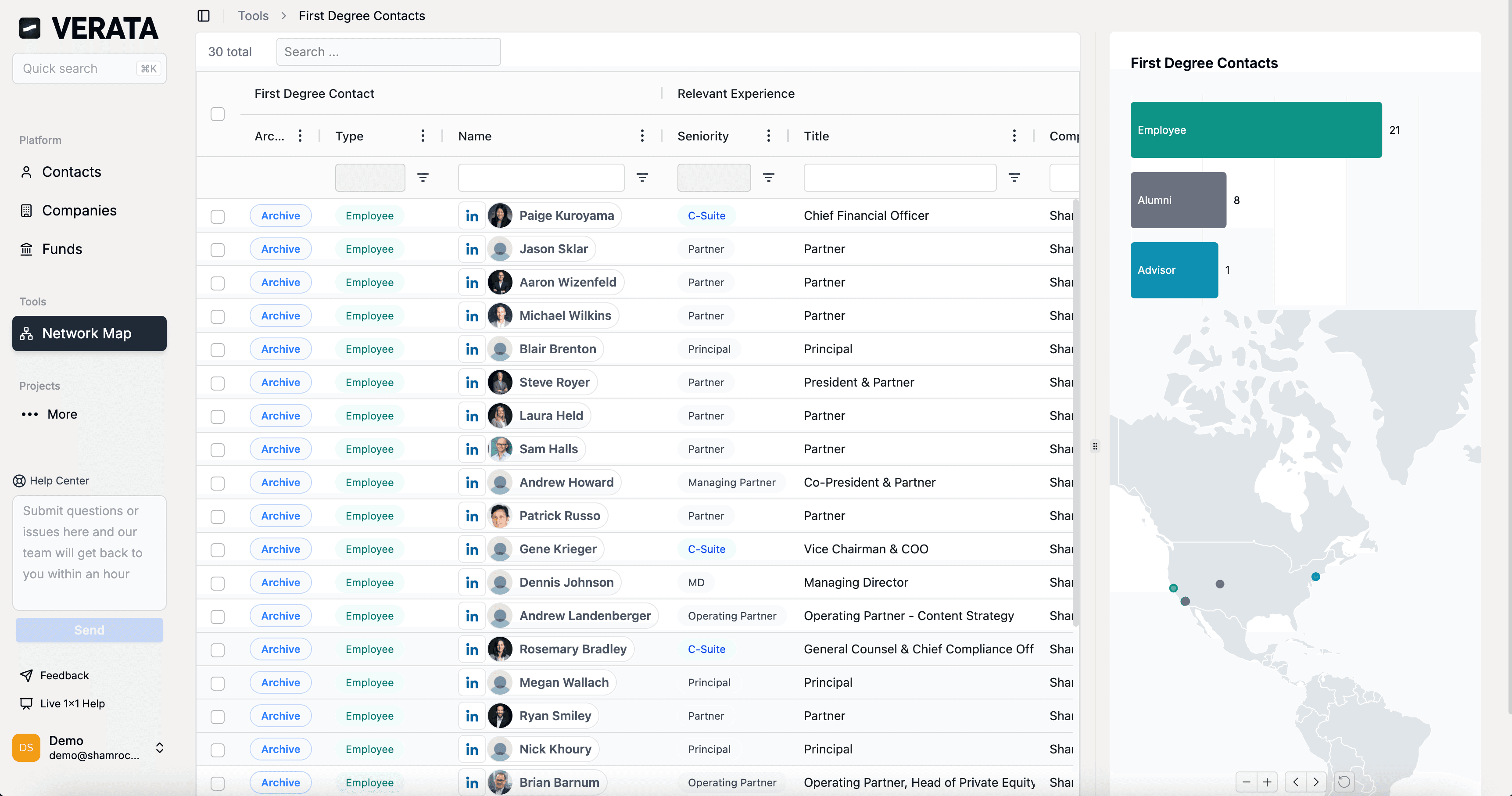
Verata's core data asset is a comprehensive map of professional career histories and overlapping tenures across more than 40 million professionals. For any CEO candidate, Verata can instantly surface: - Every company the candidate has worked at, with specific roles and date ranges - Every colleague who overlapped with the candidate at each company, with their own career trajectories - The depth of each overlap: same department, same leadership team, direct reporting relationship, or broader organizational co-tenure
This career overlap map is the foundation of backchannel diligence. Instead of asking "Who do we know who might know this candidate?", PE firms can ask "Who specifically overlapped with this candidate at Company X from 2015-2019, and how do we connect to them?"
Network Path Discovery
For each shared-tenure connection identified, Verata maps the relationship paths from your firm's network to that reference. This includes: - 1st-degree connections: People in your firm's network who directly know the shared-tenure reference - 2nd-degree paths: Two-step chains connecting your network to the reference through an intermediary - 3rd-degree paths: Longer chains for harder-to-reach references
Each path is annotated with the nature and strength of each link, allowing your team to choose the most effective introduction route. A path through a trusted former colleague is more valuable than a path through a casual LinkedIn connection.
Contextual Filtering
Not all references are equal. Verata allows you to filter shared-tenure connections by: - Time period: Focus on references from the candidate's most recent and relevant roles - Seniority: Identify peers, direct reports, and supervisors separately - Industry: Prioritize references from contexts most similar to the portfolio company - Connection strength: Weight references connected through strong, trusted paths over weak ties
This contextual filtering transforms a raw list of hundreds of potential references into a prioritized, actionable diligence plan.
Transforming Executive Diligence
The combined effect of career overlap mapping, network path discovery, and contextual filtering is a fundamental transformation of executive diligence:
- From credential screening to relationship intelligence: Instead of evaluating what's on the resume, evaluate what the candidate's actual colleagues say about their performance and leadership
- From curated references to independent sources: Instead of calling the three references the candidate provides, identify and reach dozens of independent backchannel sources through your network
- From gut feel to systematic process: Instead of ad hoc reference checking, build a structured diligence process based on comprehensive relationship data
- From hours of manual research to instant intelligence: Instead of spending days trying to figure out who might know the candidate, get instant maps of shared-tenure connections and network paths
Our research on 47,643 CEO appointments shows that resume credentials explain almost nothing about PE exit outcomes (AUC 0.562), while CEO identity itself accounts for less than 7% of variance (ICC 6.82%). The 93% of outcomes driven by contextual factors can only be assessed through the kind of relationship-based, contextual intelligence that backchannel diligence provides.
Getting Started
PE firms can begin implementing relationship-based diligence immediately. Visit /solutions/talent to learn more about how Verata's platform enables systematic backchannel diligence for executive talent decisions. Whether you're evaluating a CEO candidate for a new acquisition, planning a portfolio company leadership transition, or building an executive talent pipeline, Verata provides the relationship intelligence infrastructure to make better, data-informed talent decisions.
The credential-screening era in PE talent is ending. The relationship-intelligence era is beginning. The firms that make this transition earliest will have a sustained advantage in identifying, evaluating, and selecting the CEOs who will drive their portfolio company outcomes.
Related Guides
Do CEO Traits Predict PE Exit Success? What 47,643 Appointments Reveal
A comprehensive analysis of whether CEO background characteristics — MBA, FAANG, MBB, elite banking — predict positive exit outcomes for PE-backed companies.
ResearchWhat Actually Predicts PE CEO Success? Only 2 of 22 Traits Survived Our Analysis
After testing 22 CEO background traits across 12,174 appointments with FDR correction and temporal validation, only 2 survived: general management background and years of experience.
TalentBuilding an Executive Talent Pipeline
A step-by-step guide to building a proprietary database of portfolio company executive candidates.
Ready to Put This Into Practice?
See how Verata can help you implement these strategies with relationship intelligence built for PE.